
Balancing transparency and confidentiality has become one of the most difficult challenges in modern finance, especially as financial systems increasingly migrate on-chain. Traditional blockchains were designed with radical transparency as a core principle, where every transaction, balance, and interaction is publicly visible by default. While this model works well for permissionless experimentation and open verification, it fundamentally clashes with real-world financial requirements. Institutions, enterprises, and regulated markets cannot operate on systems where sensitive transaction data, counterparties, and balance histories are permanently exposed. At the same time, fully opaque systems undermine trust, auditability, and regulatory oversight. The true challenge, therefore, is not choosing between transparency and privacy, but designing a system where both can coexist without compromising one another. This is precisely where Dusk introduces a fundamentally different architectural approach to blockchain-based finance.
In traditional financial systems, confidentiality is enforced through centralized control, legal agreements, and trusted intermediaries. Banks, custodians, and clearinghouses act as gatekeepers of sensitive information, selectively disclosing data to regulators while shielding it from the public. Blockchain systems remove these intermediaries, which raises the question of how confidentiality can be preserved without reintroducing centralized trust. Dusk approaches this problem by embedding privacy directly into the protocol layer rather than treating it as an optional feature or external add-on. Transactions on Dusk are private by default, meaning balances, transaction amounts, and participant identities are not publicly exposed on the ledger. This design choice fundamentally changes how transparency is achieved. Instead of relying on raw data visibility, Dusk relies on cryptographic guarantees that allow the network to verify correctness, validity, and compliance without revealing sensitive information.
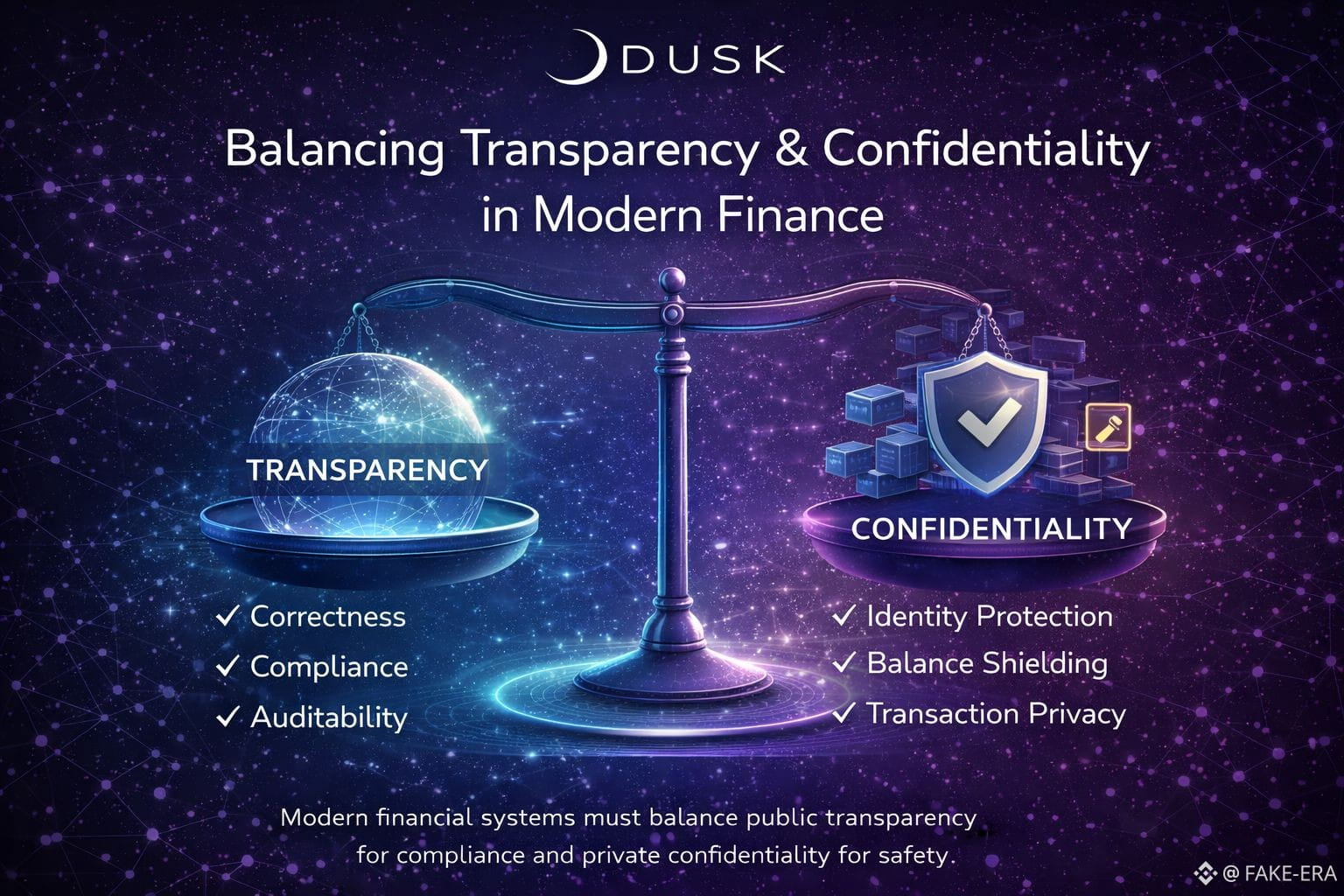
A key insight behind Dusk’s architecture is that transparency does not require data exposure; it requires verifiability. Zero-knowledge proofs enable this shift by allowing one party to prove that a statement is true without revealing the underlying data. On Dusk, zero-knowledge proofs are not limited to isolated privacy features but are deeply integrated into transaction validation, state transitions, and smart contract execution. This allows the network to confirm that transactions follow protocol rules, that balances remain conserved, and that compliance conditions are met, all without exposing private financial details. As a result, transparency is preserved at the level that matters most: correctness, fairness, and enforceability.
One of the most critical financial use cases where this balance is required is security tokenization. Regulated assets such as equities, bonds, and funds come with strict legal requirements around ownership tracking, transfer restrictions, auditability, and lifecycle management. Public blockchains struggle in this area because unrestricted transparency can violate confidentiality obligations, while unrestricted privacy can violate regulatory mandates. Dusk addresses this paradox by supporting selective disclosure. Asset issuers and participants can keep transactional data private while still enabling authorized parties, such as regulators or auditors, to verify compliance conditions when required. This selective transparency ensures that sensitive information is revealed only to the right parties, at the right time, and under the right conditions, rather than being permanently exposed to the entire network.
Another dimension of the transparency–confidentiality balance lies in transaction finality and accountability. In public ledgers, finality is achieved through visible consensus processes, but this often comes at the cost of exposing transaction flows and economic behavior. Dusk’s consensus mechanism achieves finality without sacrificing confidentiality by combining privacy-preserving leader selection with cryptographic validation of blocks. Validators participate in consensus without revealing their identities or strategies, reducing attack surfaces such as front-running, censorship, and targeted manipulation. At the same time, the network maintains strong guarantees that finalized transactions are irreversible, valid, and globally consistent. This approach aligns closely with the needs of financial markets, where predictability and final settlement are more important than speculative transparency.
From a user perspective, confidentiality is not merely about hiding information; it is about preserving economic freedom and security. Public blockchains expose users to risks such as transaction graph analysis, balance profiling, and behavioral surveillance. Over time, these risks can lead to financial discrimination, targeted exploitation, or loss of competitive advantage. By defaulting to confidential balances and transfers, Dusk protects users from these systemic risks while still allowing them to prove ownership, solvency, or compliance when necessary. This shifts the power dynamic back to users and institutions, allowing them to control how and when their financial data is shared rather than having transparency imposed unconditionally.
Importantly, Dusk does not treat compliance as an external constraint imposed after the fact. Instead, compliance is embedded into the transaction model itself. Features such as approval-based transfers, auditable balance histories, and cryptographic commitments ensure that regulatory requirements can be satisfied without breaking confidentiality. For example, transferred assets can remain accounted for in the sender’s balance until explicitly approved by the receiver, aligning with real-world settlement practices. Balance changes can be logged privately while only cryptographic roots are published on-chain, enabling audits without exposing full histories. These design choices demonstrate that confidentiality and accountability are not mutually exclusive when privacy is implemented at the protocol level.

The long-term implication of this architecture is significant. Financial markets require systems that can scale, interoperate, and evolve without leaking sensitive information or relying on centralized trust. Dusk’s approach offers a blueprint for how blockchain technology can move beyond the transparency-at-all-costs mindset and toward a more mature model of programmable privacy. By decoupling data visibility from verification, Dusk enables a financial infrastructure where trust is derived from mathematics and protocol guarantees rather than exposure and surveillance. This is particularly important as regulatory frameworks such as GDPR, MiCA, and other data protection regimes increasingly intersect with blockchain adoption.
In essence, balancing transparency and confidentiality is not a technical optimization but a foundational design decision. Dusk demonstrates that when privacy is treated as a first-class architectural principle rather than a feature bolted on later, it becomes possible to build financial systems that are both trustworthy and discreet. Transparency is preserved where it matters—rules, enforcement, and correctness—while confidentiality is respected where it is essential—identity, balances, and transactional intent. This balance positions Dusk not just as a privacy-focused blockchain, but as a realistic foundation for the next generation of regulated, institution-ready, and user-respecting financial infrastructure.