
@Plasma Money is meant to be dependable. It is supposed to sit calmly in the background of life, enabling decisions rather than complicating them. Yet for much of the world, money has become unpredictable. It loses value without warning, moves slowly when urgency matters most, and often feels controlled by systems that do not reflect everyday realities. In this fragile environment, stablecoins emerged not as a technological curiosity, but as a form of financial self defense. They offered consistency in a world shaped by instability. Still, the infrastructure carrying these stablecoins often inherited the same friction and complexity that people were trying to escape.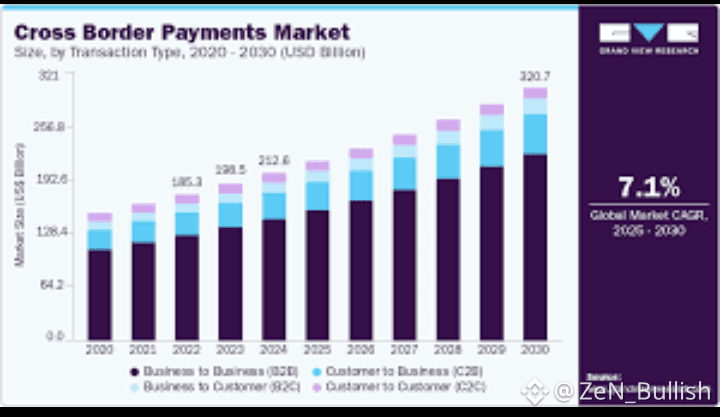
This is the space where Plasma finds its purpose. Plasma is a Layer 1 blockchain designed with a simple but profound understanding of human behavior: people do not want to think about how money moves. They want it to move correctly, affordably, and without emotional cost. Plasma does not attempt to redefine money or dazzle users with abstraction. Instead, it asks a quieter question. What would a blockchain look like if it were built specifically for stable value rather than speculation?
Most blockchains were born in an experimental era. They optimized for openness, innovation, and possibility. These systems invited users to tolerate volatility, fluctuating fees, and learning curves as the price of participation. That mindset worked when blockchains were playgrounds for developers and traders. It works far less well when they become financial tools for daily life. Stablecoin users are not experimenting. They are paying salaries, protecting savings, settling invoices, and supporting families across borders. For them, unpredictability is not exciting. It is stressful.
Plasma’s stablecoin centric design reflects an understanding of this emotional landscape. Gasless USDT transfers are not merely a technical feature. They remove a silent tax on attention and anxiety. When transaction costs are volatile or denominated in assets that fluctuate, every payment carries hesitation. People delay. They double check. They worry about timing. By allowing stablecoins to move without requiring users to hold or calculate with volatile gas tokens, Plasma restores a sense of clarity that traditional finance once promised but increasingly fails to deliver.
Speed plays an equally important role in shaping trust. Sub second finality through PlasmaBFT transforms the experience of sending money. Waiting for confirmations, refreshing transaction pages, and wondering whether a transfer will reverse all create psychological friction. Instant settlement feels decisive. It feels complete. It mirrors the confidence of handing cash to someone and knowing the exchange is finished. This sense of immediacy matters deeply in commerce, wages, and remittances, where uncertainty can disrupt real lives.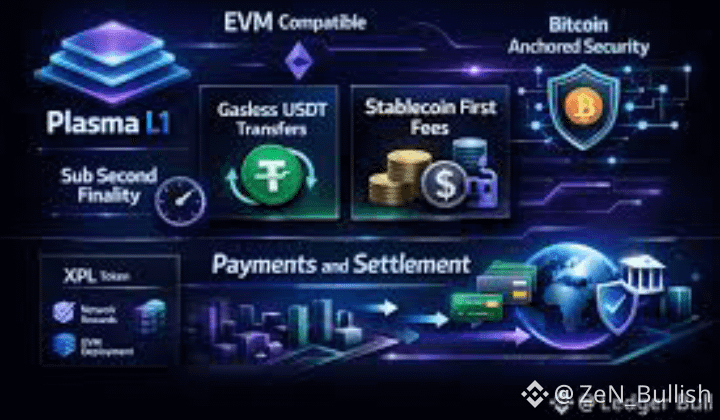
Despite its specialized focus, Plasma does not isolate itself from the broader blockchain ecosystem. Full EVM compatibility through Reth ensures that developers and institutions do not need to abandon existing tools or knowledge. This compatibility reflects a subtle form of respect. Progress, Plasma seems to acknowledge, is not about forcing people to start over. It is about making what already exists work better for how people actually use it.
Security, often discussed in abstract terms, carries a deeper meaning in Plasma’s design. By anchoring its security to Bitcoin, Plasma aligns itself with a network that has earned trust through time rather than persuasion. Bitcoin’s strength lies not only in cryptography, but in its neutrality and resistance to control. For a settlement layer meant to serve diverse populations and institutions, this anchoring provides more than protection. It provides reassurance. It signals that the system is designed to endure rather than adapt to short term pressures.
The people Plasma speaks to most clearly are often absent from mainstream crypto narratives. They are individuals in high adoption regions using stablecoins to protect purchasing power. They are freelancers navigating cross border payments. They are small businesses operating between currencies. They are institutions that require predictability, compliance, and accounting clarity. Plasma’s stablecoin first gas model aligns with how these users already think about money. Not as an opportunity for risk, but as a unit of stability around which life is organized.
In many parts of the world, stablecoins already function as informal financial infrastructure. They compensate for failing banks, slow transfers, and restrictive systems. Plasma does not try to change this behavior. It tries to support it with infrastructure that feels fair and reliable. When a system fades into the background and stops demanding attention, people regain mental space. That space is not abstract. It translates into confidence, planning, and dignity.
There are, of course, challenges ahead. A blockchain designed around stablecoins operates close to regulation, scrutiny, and shifting political interpretations. Rules will evolve. Expectations will change. Plasma’s long term success will depend on its ability to adapt without compromising the simplicity that defines its purpose. There is also the deliberate tradeoff of specialization. Plasma does not attempt to be everything. It chooses settlement, stability, and restraint. In a culture that often rewards excess, restraint can feel counterintuitive. Yet restraint is often the mark of systems that last.
There is something quietly philosophical about Plasma’s approach. Early blockchain culture celebrated complexity as intelligence and volatility as opportunity. Plasma suggests maturity looks different. It looks like predictability. It looks like boring systems that work every time. It looks like infrastructure that supports life rather than distracting from it.
As the world moves toward more digital, automated, and global forms of exchange, the need for stable, instant settlement will only deepen. Machines will pay machines. Remote teams will rely on seamless payroll. Governments and institutions will search for neutral rails that do not fracture under pressure. In that future, the most important systems may not be the loudest, but the most trusted.
Plasma does not promise a dramatic transformation of money. It promises something quieter and perhaps more meaningful. It promises to let money behave the way people have always needed it to behave. Reliable. Immediate. Understandable. In a world where financial systems often feel distant and indifferent, that quiet respect for human experience may be the most powerful innovation of all.

