
Dusk Network feels like one of those projects that quietly refuses to play the usual crypto game of “look how loud we can be,” because its entire identity is built around a much harder promise: bringing privacy into on-chain finance without turning the whole system into a black box, which is exactly why it leans into the idea of regulated, institution-ready infrastructure where confidentiality is normal, auditability is still possible, and settlement is treated like a serious engineering requirement rather than a marketing slogan.
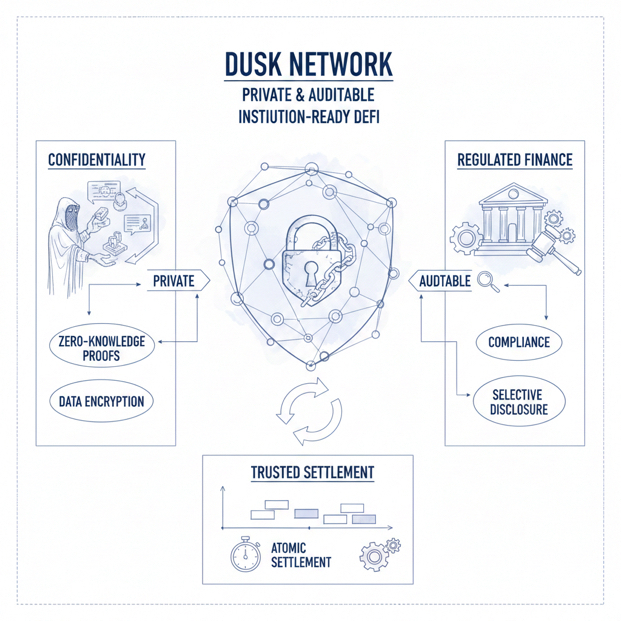 What makes Dusk interesting is that it is not chasing privacy as a lifestyle brand, it is chasing privacy as a financial primitive, meaning the goal is not simply to hide transactions but to prevent the kind of information leakage that makes real markets uncomfortable on transparent ledgers, because in real finance you do not broadcast every position, counterparty relationship, deal term, treasury movement, or risk exposure to the public, and Dusk is essentially trying to build the chain that lets tokenized assets and compliant financial activity exist on-chain without forcing everyone to accept surveillance-by-default as the cost of participation.
Under the surface, Dusk’s story revolves around the idea that privacy cannot be a bolt-on feature if you want it to hold up inside complex applications, which is why it emphasizes Phoenix as a transaction model designed for confidentiality at the protocol level, not as a superficial “shielded transfer” gimmick, and the important takeaway here is that Phoenix is meant to support private value movement and private logic in a way that can still play nicely with real execution requirements, where costs, state changes, and contract outcomes do not always behave like neat, predictable transfers.
Then there is Zedger, which matters because finance is full of instruments that carry rules rather than merely balances, and security-like assets often need behavior that resembles accounts, restrictions, and structured ownership logic, so Dusk’s hybrid approach is essentially a recognition that pure privacy systems can struggle when they try to represent securities-grade realities, and the project’s direction here signals that they are aiming for a world where confidentiality does not break the practical needs of issuance, governance, reporting, or controlled transfer conditions that regulated assets tend to require.
The same philosophy shows up in XSC, the Confidential Security Contract standard, which reads like Dusk drawing a line between “any token” and “financial instruments that have to behave responsibly,” because once you move beyond simple transfers into tokenized securities and real-world assets, you run into requirements like confidentiality, selective disclosure, issuer controls, and verifiable compliance processes, and Dusk is trying to offer a native framework for that category rather than pretending that one generic smart contract pattern fits everything from meme tokens to regulated products.
Another piece of the project’s identity is its focus on finality and settlement design, because when you talk about financial applications the conversation naturally shifts away from “how fast is it in theory” and toward “how deterministic is it when it counts,” and Dusk’s consensus direction is presented as finance-friendly, which is less about being flashy and more about being dependable, since institutions care about the moment a transaction becomes irreversible in practice, and not about aesthetic metrics that look good on a chart but fall apart under real operational pressure.
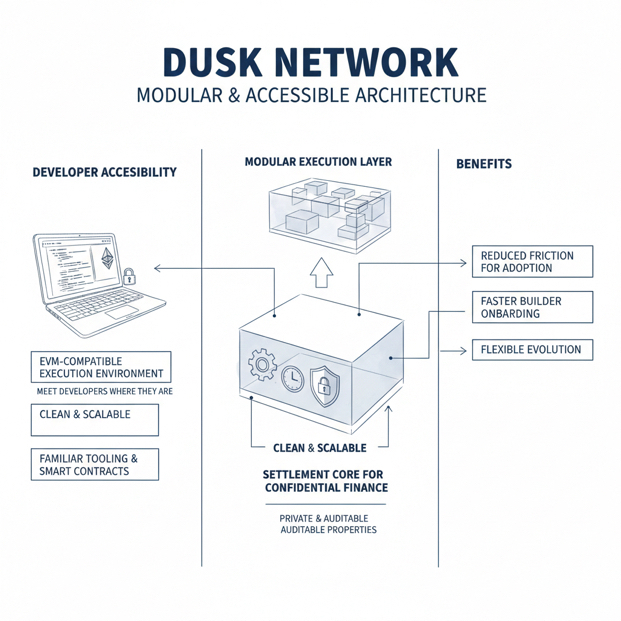
The project also signals a modular mindset in how it evolves, with an emphasis on keeping the settlement layer clean and scalable while supporting developer accessibility through an EVM-oriented path, which is important because adoption is not just a question of technology but also of friction, and if Dusk wants builders to show up, it needs to meet developers where they already are while still delivering the privacy and settlement properties that differentiate the network, so the whole approach reads like an attempt to merge familiar execution environments with a settlement core designed for confidential finance.
Dusk right now is as an infrastructure project that is building for the long game, where progress looks like tooling maturity, clearer standards, improved developer experience, and hardened operational practices, because privacy networks aiming at regulated finance do not win by moving fast and breaking things, they win by becoming boring in the best way, meaning reliable, predictable, and difficult to disrupt, and if Dusk succeeds it will not be because it convinced people to love privacy as a concept, but because it made privacy-compatible finance feel normal, usable, and safe enough that serious actors can actually settle value and issue assets without exposing their entire business to the public internet.