
Vanar feels like one of those projects that started with a very practical instinct about how real adoption happens, because it did not begin by trying to win the DeFi narrative war or by promising to reinvent finance overnight, but by aiming directly at the kinds of industries that punish weak infrastructure immediately, which is exactly why the early emphasis on games, entertainment, and brands still matters even if the buzzwords around those sectors rise and fall, because consumer products only succeed when the technology underneath them behaves like reliable plumbing rather than an experiment that constantly asks users to understand it.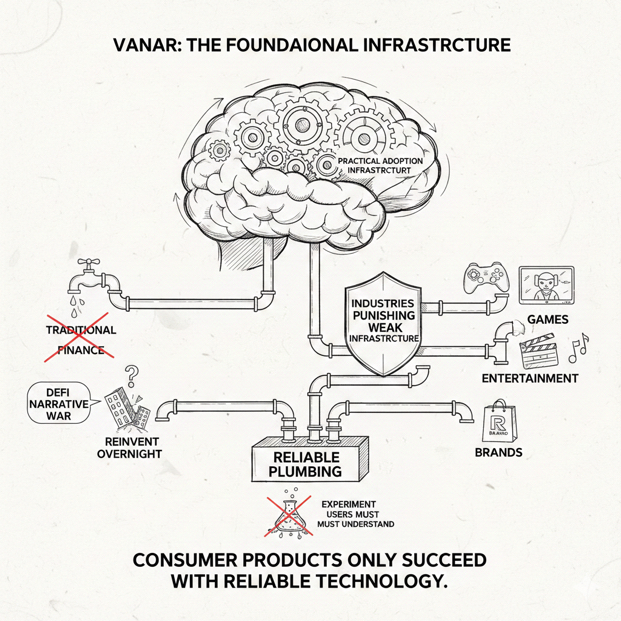
At its core, Vanar is presenting itself as a layer-1 blockchain built to be used by everyday people through mainstream experiences, and that framing is not just a marketing layer on top of a generic chain, because the project keeps returning to the same central idea that Web3 cannot reach the next wave of users if the platform assumes they will tolerate friction, confusing wallet flows, unpredictable fees, or an interface that feels like it was designed for insiders, and when you read through the way Vanar describes itself in its official materials, you can see the consistent attempt to talk in terms of outcomes like speed, low cost, and usability rather than in purely technical flexes that only developers care about.
What makes Vanar especially interesting right now is that the project has been leaning into a stronger “infrastructure” identity, because it is no longer only trying to be the chain that hosts consumer applications, but is increasingly describing itself as a platform that can support a new class of applications where AI, structured data, and on-chain execution are designed to work together more naturally, and while many projects attach “AI” to their name as a decorative trend, Vanar is attempting to sell a more specific thesis that blockchains are historically good at recording transactions but weak at handling meaning and context, which becomes a major limitation when you try to build payment-like systems, compliance-heavy flows, or any application where the user expects the system to understand intent rather than simply process raw inputs.
The way Vanar explains this shift is through the idea of a layered approach that goes beyond “just a chain,” because the project’s own description points to components intended to support semantic handling, logic, and data structures that can make the network feel more usable for real-world application patterns, and even if you do not adopt every part of the framing at face value, the direction is clear in their messaging: they want the base layer to be fast and affordable, but they also want to provide additional primitives that reduce the amount of fragile off-chain glue developers normally have to build when they try to connect AI workflows, compliance logic, and real user experiences to on-chain execution.
Another thread that keeps showing up in the project’s positioning is the push toward payment-oriented and real-world asset narratives, because Vanar’s site explicitly highlights PayFi and tokenized real-world assets as part of what it is built for, and those sectors are demanding in a way that many crypto-native categories are not, since they tend to require clear rules, predictable execution, better data handling, and a level of reliability that makes partnerships possible, so when a chain chooses to orient itself in that direction, it is effectively choosing a harder path than simply competing for short-cycle liquidity, which is why the project’s direction, if executed well, can be meaningful even if it takes longer to show up in quick metrics.
The token side of the project is also part of its identity, but it is most useful to think about it as the operational fuel for the network rather than as the entire story, because VANRY exists as an ERC-20 token on Ethereum with the contract you linked, which gives it broad compatibility for wallets and exchange infrastructure while the project’s own identity is as a layer-1 ecosystem token, and this duality is common for chains that want both network-native utility and easy access through the most liquid token standards.
The shift from TVK to VANRY is an important piece of the project’s timeline, because it was not presented as a split or a complicated conversion but as a clean 1:1 token swap, and what that kind of move usually signals in practice is a deliberate attempt to unify branding, simplify the asset identity, and align the token more closely with the chain narrative, which matters because fragmented identities and legacy tickers often become a long-term drag on growth, listings, and community coherence.
When it comes to what VANRY is actually for, the straightforward view is usually the most accurate, because an L1 token lives or dies on whether it is meaningfully used in the system’s daily operation, and the project’s own materials and third-party asset profiles describe the familiar but real set of functions: paying for transactions, supporting network security through staking and validator economics, and participating in governance and ecosystem incentives, which is not a guarantee of value by itself, but it is the baseline utility structure that makes an L1 token coherent as more than a logo.
Where the project’s story becomes more “real” is not in any single claim, but in whether these pieces connect into a developer and user loop that sustains itself, because if Vanar can deliver an environment where builders can ship consumer-grade apps without constantly fighting the underlying system, and if its AI-oriented infrastructure actually reduces complexity for teams working on data-heavy flows, and if the network can show signs of sticky usage rather than bursts that disappear after incentives fade, then the chain becomes something that can stand for a specific, defensible idea in the market, which is that Web3 can feel like a normal platform rather than a hobbyist toolkit.
The most grounded way to think about what comes next for Vanar is to look at what the project itself is clearly prioritizing in its public materials, because the current emphasis suggests a continued push toward turning the AI-infrastructure framing into usable developer primitives, expanding the chain’s relevance to payment and real-world asset workflows, and showing that the “built for real-world adoption” positioning translates into measurable traction, and although this kind of progress does not always arrive as dramatic announcements, it is usually visible through repeated shipping, improved documentation and tooling, ecosystem launches that look like products rather than demos, and the gradual strengthening of the network’s operational story.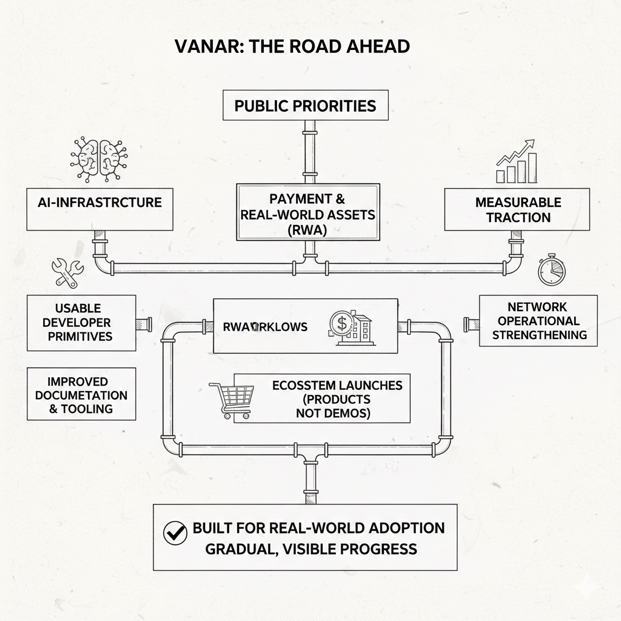
Vanar On the “last 24 hours” question, it is important to separate market noise from project progress, because the token’s market metrics naturally move all the time and can be checked on trackers, but true project updates require official communications like blog posts, release notes, documentation updates, or clearly sourced announcements, and the safest verifiable “fresh” signal that consistently exists without guessing is the live market activity shown on major trackers alongside the fact that the project continues to promote its presence and ongoing activity through its official channels, which is why if your goal is a clean, trustworthy 24-hour changelog of real developments, the best inputs are the project’s official posts and release communications rather than price movement alone.