


Walrus doesn’t push bytes onto Sui and call it architecture.
That misunderstanding shows up fast when systems get busy.
Sui is where arguments get settled.
Walrus is where weight lives.
The distinction matters the first time something goes wrong without breaking.
Bytes are heavy. They move slowly. They get repaired. They linger. They don’t belong inside an execution environment built to resolve conflicts, not babysit storage. Walrus keeps them where time can stretch and nothing has to pretend it’s instant.
What crosses the chain is smaller. Sharper. A record that says an obligation started and didn’t evaporate halfway through a retry.
That’s where the control plane quietly lives.
A transaction on Sui doesn’t want your media. It wants certainty. It wants to know whether the thing it’s pointing at is real enough to depend on without stalling everyone else. So it asks the only question that matters: did this blob cross the line, under rules the validators recognize, or not.
Everything else happens elsewhere.
Walrus takes the mess. Distribution paths that aren’t symmetric. Repair traffic that shows up when reads don’t politely pause. Nodes that churn without asking your app whether it’s a good time. That work doesn’t fit onchain. It fits off to the side, where delays don’t poison consensus.
Validators feel the difference immediately. They don’t fetch bytes. They don’t argue about payloads. They look at objects and thresholds and whatever proof is supposed to exist. If it’s there, fine. If it isn’t, nobody’s “almost right.” They just don’t move.
If you collapse the boundary... if you treat the chain like a dumping ground for data, you turn every transaction into a bandwidth negotiation. Parallelism disappears. Everyone waits. Nothing settles cleanly. The system gets loud in all the wrong places.
Walrus avoids that by being boring in the right places.
Onchain stays strict. Offchain stays messy and handled. The boundary is explicit enough that apps can’t pretend anymore. You can’t ship “final” while your bytes are still best-effort. You can’t rely on timing games. You can’t hide behind UI success when coordination never finished.
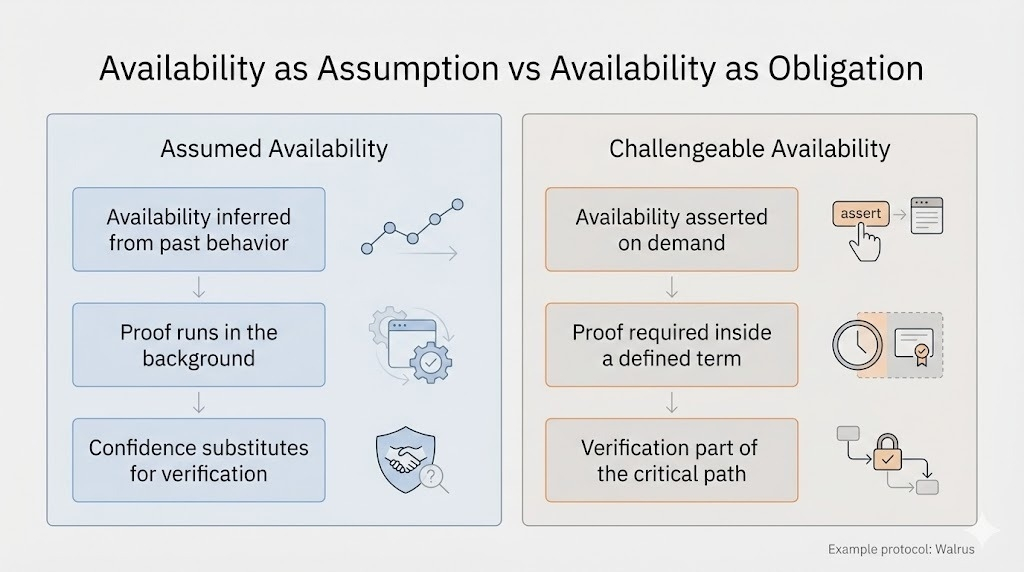
That’s why the mental model holds: Sui decides whether something counts. Walrus carries what that something turns into over time, under stress, with no guarantee the network stays polite.
And the day you ignore that line, it won’t look like a hack.
It’ll look like users pulling on a blob you treated as “settled,” while the system is still deciding whether it ever was.