
@Dusk The first thing you learn when you live inside Dusk long enough is that “starting a network” is not a countdown moment. It’s a consent moment. The chain doesn’t earn trust because blocks begin to appear. It earns trust because, from the very first state it ever holds, it makes the rules legible enough that people can stop guessing. That is what the genesis layer is really doing. It’s not trying to impress anyone. It’s trying to prevent the kinds of small misunderstandings that become expensive fights later, when money is moving and someone’s compliance deadline is two hours away.
Dusk’s rollout made this feel unusually concrete. On December 20, 2024, the project framed mainnet as a sequence of controlled transitions—activation of the onramp contract, early deposits, early stakes being included in the genesis state, and then the first immutable block scheduled for January 7, 2025. If you were watching closely, the message wasn’t “look, we launched.” It was “here is the order in which we will let reality touch the ledger.” That order is emotional infrastructure. It tells a cautious user that the team understands what it feels like to move value when the consequences are real, not theoretical
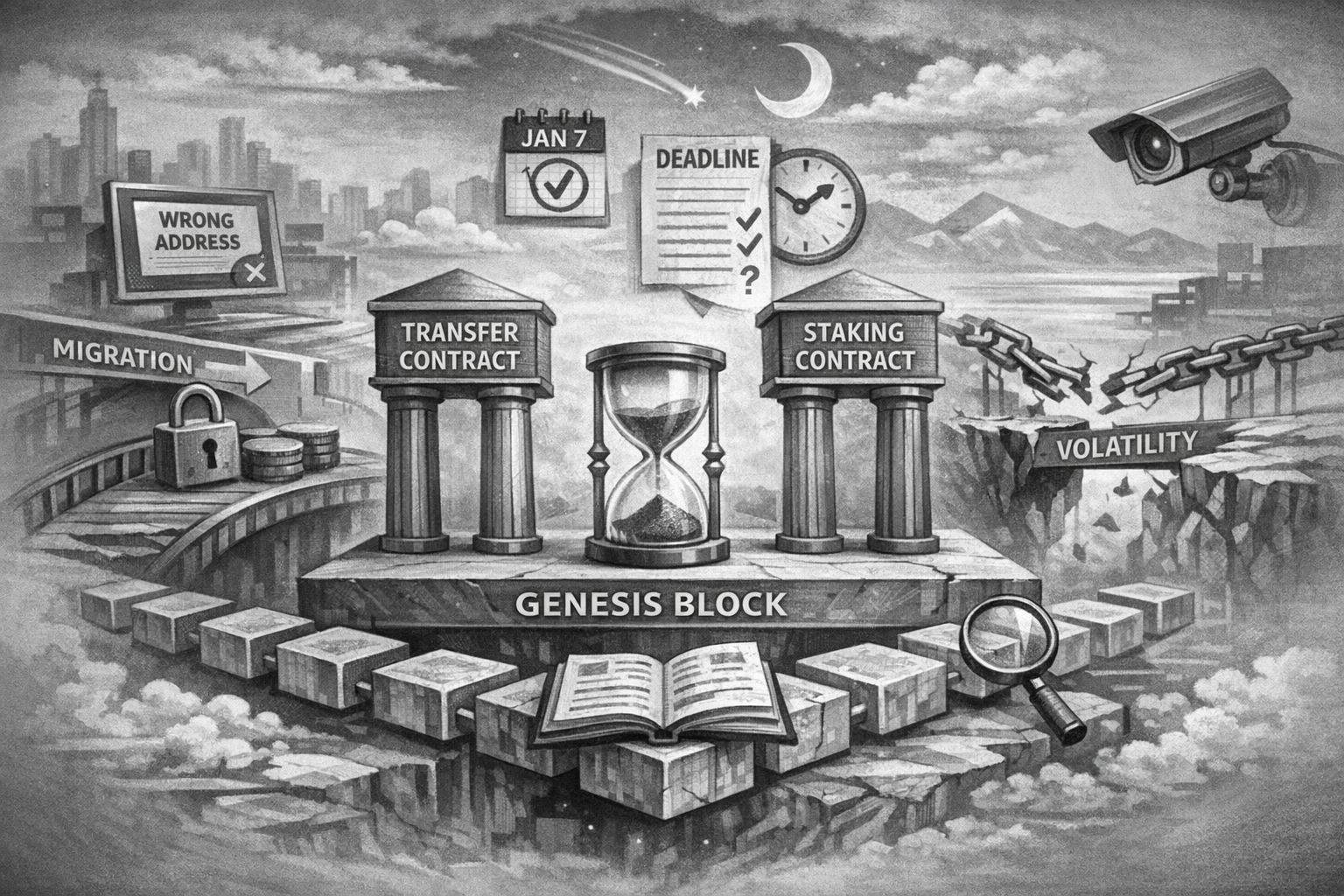
Genesis contracts are where that order becomes enforceable. Dusk documentation is blunt about it: from the moment the network starts, there are two foundational contracts present—one that governs the movement of the native token and one that governs stake.Even if you never read a line of code, you can feel the intent. The chain begins by defining how value moves and how responsibility is bonded. Everything else the ecosystem wants to become—applications, liquidity, culture—has to sit on top of those two promises.
What people often miss is that “governing transfers” is not just about sending coins from A to B. It’s about turning human intent into a deterministic outcome even when the human is tired, rushing, or half-wrong. Under pressure, users don’t make exotic mistakes. They paste the wrong address, misread a network, assume their tokens are “already on mainnet” because an exchange UI said so. The genesis transfer logic is the network’s first opportunity to be kind without being permissive—to be strict in a way that prevents silent loss. That strictness is not cold. It’s a form of care, because predictable rules are what let ordinary people participate without becoming experts in failure.
Dusk’s recent emphasis on migration made this reality loud again. Even now, in early 2026, the most practical “recent update” in the ecosystem is not a flashy new surface feature; it’s the continued existence of an official migration path from ERC-20/BEP-20 representations of DUSK into native DUSK on mainnet. The mechanics matter because they are the opposite of magic: lock tokens in a migration contract on the origin chain, observe the on-chain evidence, and issue native DUSK to the mainnet address provided. It’s almost boring, and that’s exactly why it builds confidence. Boring means you can explain it to a risk team. Boring means you can audit the story when something goes wrong.
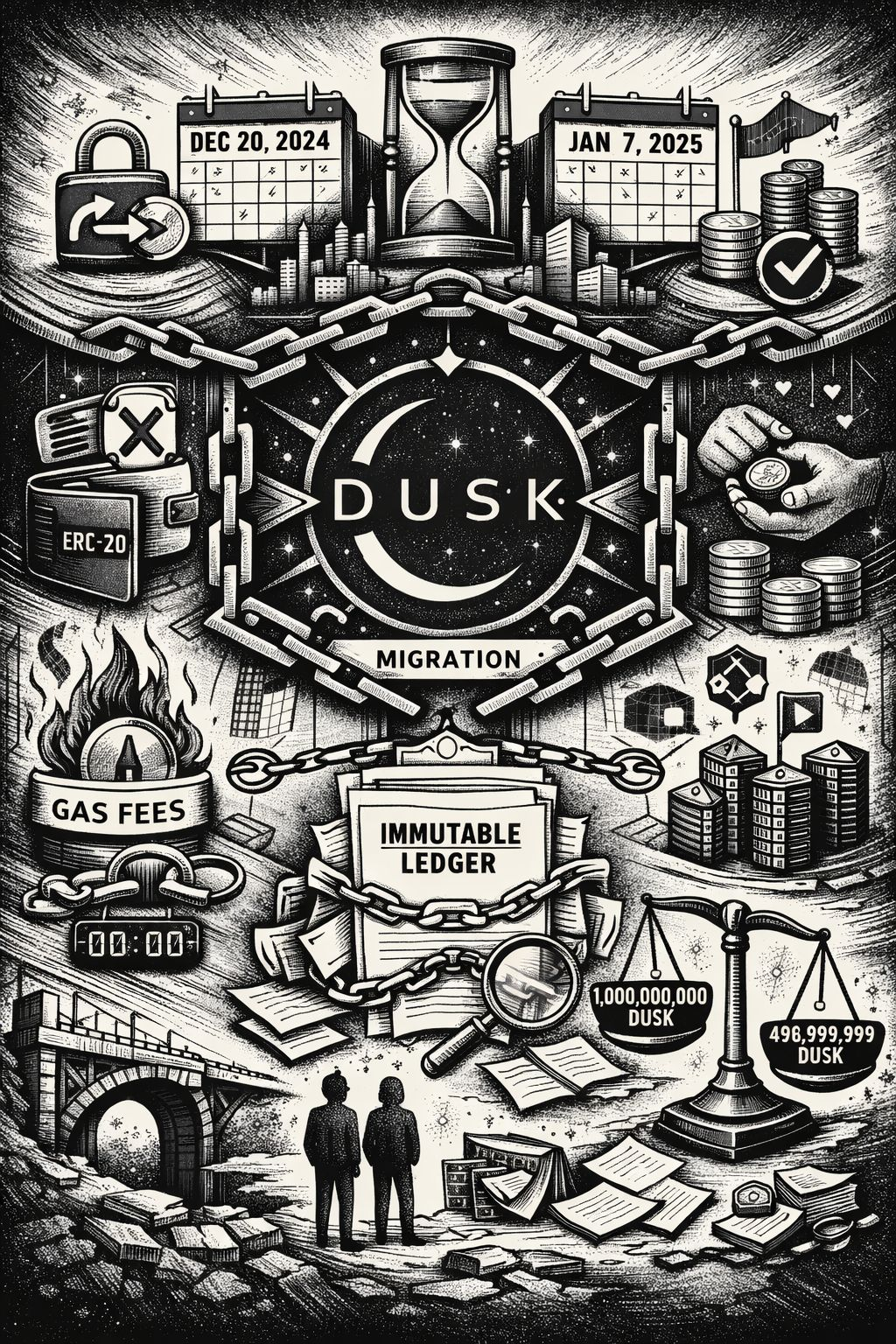
When you zoom out, you start to see genesis governance as a kind of boundary wall between off-chain disagreement and on-chain finality. Off-chain, people argue. Exchanges label assets differently. Wallets abstract network details. Social posts compress nuance into a sentence that can be misread. On-chain, the network cannot afford ambiguity. Genesis contracts are where Dusk insists that, whatever the world claims, the chain will only recognize what it can verify in its own state transitions. That insistence becomes especially important in the moments that are emotionally sharp: when a user believes they migrated but used the wrong wallet, when a validator believes they staked but missed a window, when two parties both “remember” the same event differently.
This is why the onramp period around genesis is worth revisiting as more than history. Dusk’s own archived guide spells out that onramping into genesis ended on specific dates—staking ending December 28 (CET) and deposits ending January 2 (CET)—and that anything not included by then could only be migrated after January 7. Those aren’t just calendar facts. They are commitments about what the chain will treat as its initial truth. The difference between “included in genesis” and “migrated later” is the difference between being part of the first shared memory of the network and arriving after the first memories have already set. For a user, that difference can feel like belonging versus arriving late to a meeting where decisions were already made.
Staking, in this context, stops being a yield story and becomes an honesty story. The genesis staking logic is where Dusk encodes what it means to put skin in the game in a way that is measurable by the chain itself. People outside the ecosystem sometimes talk about staking as if it’s just a knob that increases participation. But the deeper truth is that staking is a social contract turned into math. It creates a cost to careless behavior, and it creates a paper trail for accountability that doesn’t depend on anyone’s mood. When validators fail, or when incentives pull the wrong way, the system has to keep going without asking users to trust a promise made in a chat room.
Gas is part of that same emotional equation, even when nobody wants to talk about it directly. Users don’t experience “fees” as an abstract economic mechanism. They experience them as friction, surprise, and sometimes humiliation—especially when a transfer fails because they didn’t hold the right asset to pay for execution. Dusk’s genesis transfer layer being the entry point for value movement is not just a technical detail; it is where the network can make cost predictable enough that people stop hesitating before they click “send.”Predictability is not convenience. It is psychological safety. It’s the difference between a system that feels like infrastructure and one that feels like a trap.
You can see how seriously Dusk treats these foundations in the way it describes “protocol-level” contracts: certain logic must run next to consensus, close enough that it can’t drift into optionality.That proximity is a statement about responsibility. If the rules governing transfers and stake were merely conventional application code, then every edge case would become a negotiation. But Dusk is trying to build for regulated reality, where disputes do not resolve through vibes. They resolve through evidence, timelines, and consistent enforcement.
Token data is part of this story because economics is the quiet voice in every governance decision. Dusk’s documentation still describes DUSK as having lived as ERC-20/BEP-20 representations, with mainnet migration now available to move into native DUSK. That duality—representation versus native—creates a natural pressure toward mistakes and misinformation, especially in public markets where tickers feel interchangeable. The system’s job is not to prevent confusion by educating everyone perfectly. It’s to remain coherent even when the world is confused.
Even basic supply numbers become grounding points in that coherence. Public market trackers currently show a max supply of 1,000,000,000 DUSK and a circulating supply around 496,999,999 DUSK.I don’t cite those numbers because they’re exciting. I cite them because they anchor expectations. If you’re building or staking or migrating, you are making decisions that depend on whether the system’s incentives can sustain honest behavior over time. Supply, emissions, and migration are not “token talk.” They are part of the trust budget
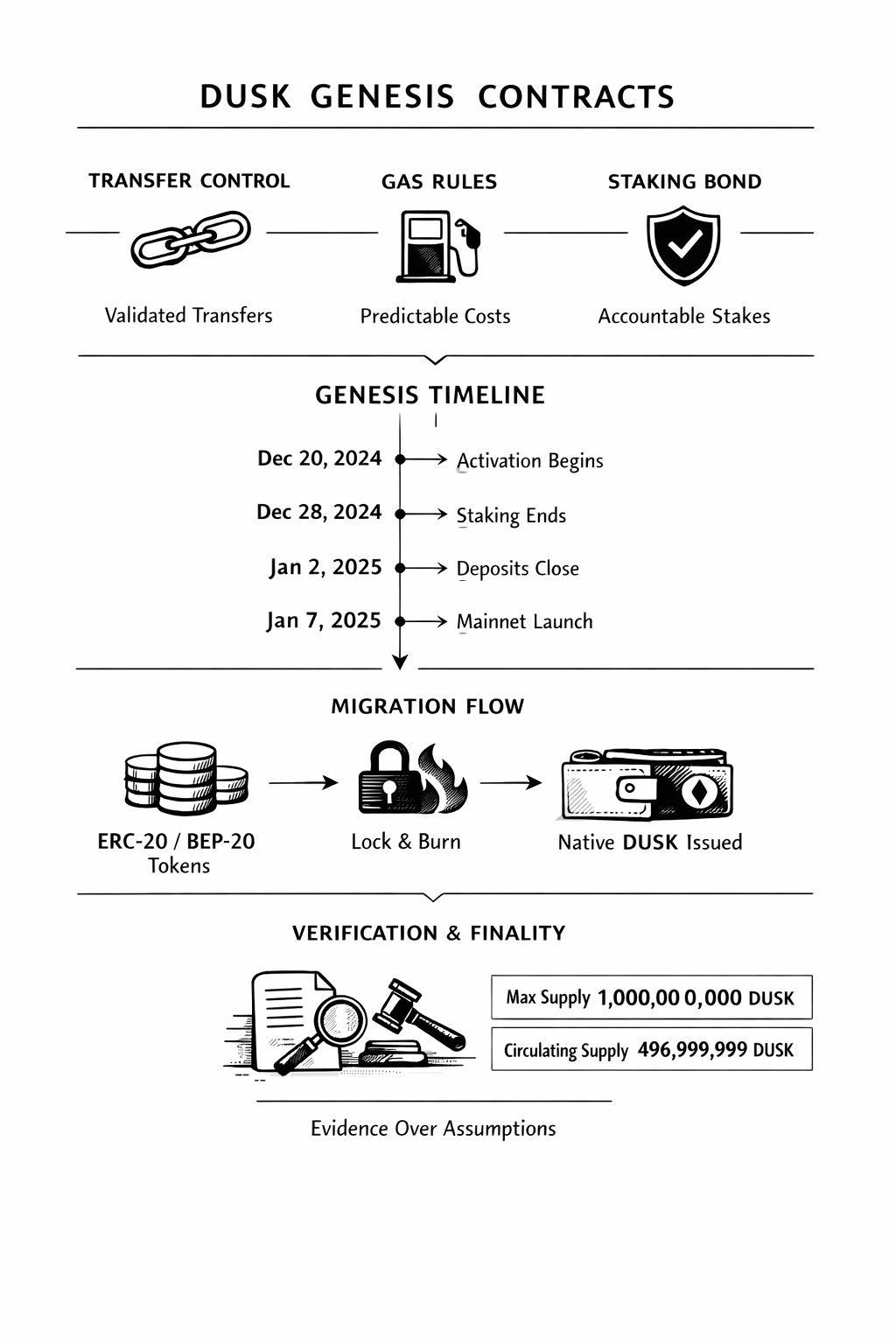
And trust budgets get spent in exactly the places genesis contracts are designed to guard. Someone will always try to rush a migration during volatility. Someone will always interpret a wallet prompt incorrectly. Someone will always assume that because a bridge exists, reversibility exists too. Dusk’s migration repositories and guides make the flow explicit enough that, when something goes wrong, you can reconstruct the sequence: what was locked, what event was emitted, what address was provided, what was issued on mainnet. That reconstruction is a form of justice. It can’t promise a happy ending, but it can promise a clean explanation of the path—what changed, why it changed, and what it led to. What I respect about Dusk right now is that it keeps reminding people of the core principles, instead of pretending they don’t matter once a project “levels up.”In early 2026, community posts and exchange-community updates are still emphasizing the official migration path and what it means now that mainnet is live. That repetition is not noise. It’s maintenance. It acknowledges that ecosystems don’t fail only because code breaks. They fail because humans forget the rules, and then feel betrayed when the system doesn’t bend to their assumption.
If you want to understand how Dusk starts, don’t picture fireworks.
Imagine a few small contracts at the very start of the chain. They quietly make sure transfers match the rules, staking stays answerable, and fees are clear enough that people can’t pretend they didn’t understand the cost. Think of the rollout—December 20, 2024 to January 7, 2025—as a careful, step-by-step move from “we’re launching” to real final settlement. And think of the token move into the native chain as a real-world stress test: can the system help people migrate safely, without confusion or shame? In the end, trust comes from being boring in the right places. When genesis governance works, you barely notice it—and that’s the point.
Dusk doesn’t need its starting point to win attention. It needs its starting point to withstand pressure, disagreement, and human error without turning confusion into catastrophe. Reliability is not the loudest virtue in this industry, but it’s the one that lets everything else exist without fear.
