


Vanar Chain sits in a lane that many projects talk about but very few can actually make practical, because it is trying to make a Layer 1 feel like it belongs in mainstream products where users care about experience first and technology last, and the project keeps anchoring that direction around consumer facing verticals like gaming, entertainment, metaverse experiences, AI, eco initiatives, and brand solutions, with the VANRY token acting as the economic layer that makes participation and usage possible across the network.
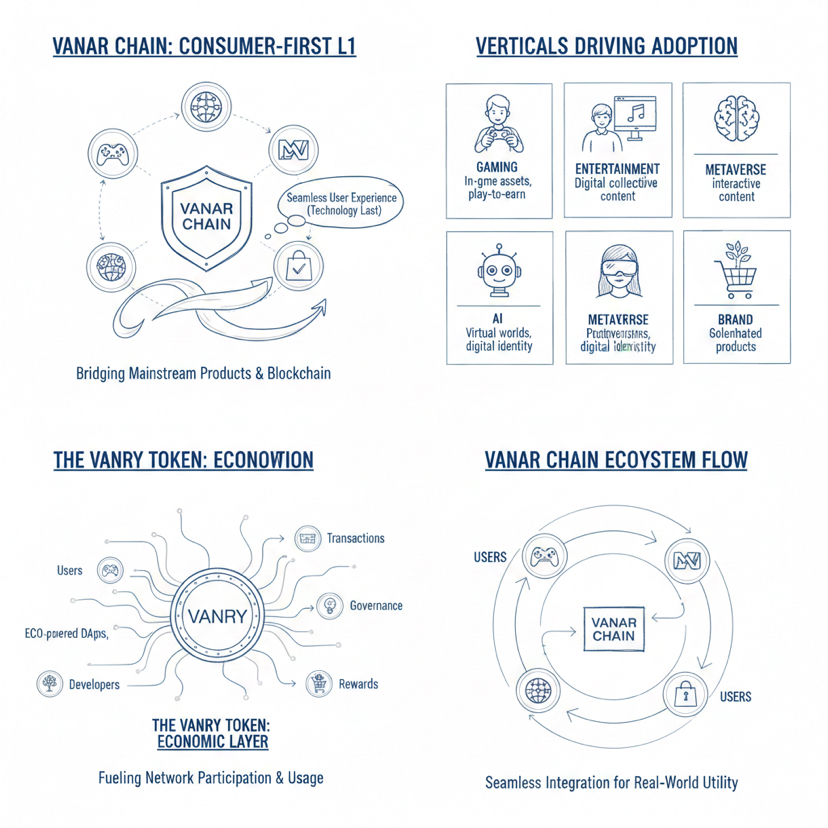
What makes Vanar matter is not just the usual promise of speed or low cost, even though the token page itself describes Vanar as a high speed and low cost chain built with mainstream entertainment in mind, but the bigger point is that the team is attempting to package the chain as part of a wider stack where intelligence and context are treated like first class infrastructure, because if Web3 is going to reach billions of consumers then apps cannot feel like stitched together crypto tools, they need to feel like modern software where identity, content, automation, and intelligent behavior are native rather than bolted on later.
When you look at what they are doing behind the visible narrative, Vanar frames itself as an AI powered blockchain platform designed for PayFi and real world assets, and it describes the base layer as being built for AI from day one with elements like semantic operations and built in vector storage and similarity search, which is important because it signals that the project is trying to move beyond the standard smart contract approach where most intelligence lives offchain, and instead is attempting to make the chain and its supporting layers capable of handling richer context so applications can reason over verifiable data more directly.
That direction becomes clearer when you follow the way Vanar presents its product layers, because the main site routes builders into Vanar Chain, Neutron, and Kayon, while also marking Axon and Flows as coming soon, and this matters because it shows a deliberate sequence where the base chain is meant to be the execution and settlement layer, Neutron is positioned as a semantic memory layer, Kayon is positioned as an AI reasoning layer for natural language queries and compliance style automation, and the next steps are meant to extend that into automation and packaged industry applications rather than leaving every team to rebuild those pieces on their own.
Neutron in particular is described as transforming static data into AI ready Seeds with an emphasis on preserving context and making data searchable and actionable, which is a strong claim but also a very specific one, because it suggests Vanar wants to treat knowledge as something that can be compressed, stored, and queried in a way that compounds over time instead of being scattered across tools and platforms where it becomes hard to trust and hard to use, and when a chain tries to solve that problem it is usually because it wants to enable a generation of apps that feel intelligent without relying on a fragile web of external services.
Kayon then becomes the layer that tries to make that stored context usable for real workflows, because the project describes Kayon as an enterprise reasoning layer that supports natural language blockchain queries and contextual insights, and it explicitly frames this as something that can connect blockchains and enterprise backends, which is exactly the kind of positioning you would expect from a team that wants the chain to sit underneath real products rather than only living inside crypto native loops.
The most recent project updates that are easy to verify publicly are coming through the official Vanar blog cadence and the official site activity, because Vanar has been publishing weekly recap style posts that repeatedly reinforce the theme that intelligence needs reliable data, compression, and validation rather than just more models, and the site itself is also actively promoting upcoming ecosystem presence at major events in February 2026 and March 2026, which typically signals that the team is leaning into partnerships, builder acquisition, and distribution conversations at the same time they keep pushing the product narrative forward.
On the network participation side, Vanar has highlighted staking milestones in its weekly recaps, including a recap that states the network crossed a threshold of VANRY staked within a short window along with a larger staked figure and TVL snapshot, and while staking numbers alone never prove product market fit, they do matter because they are one of the cleanest visible indicators of whether a community is willing to lock capital into the system to secure it and align with its long term incentives.
The token story is straightforward in the way it needs to be for a consumer oriented Layer 1, because VANRY exists as a live ERC20 contract on Ethereum at the address you shared with 18 decimals, and it is presented as the official token of the Vanar blockchain, which makes it the bridge between the narrative and the real mechanics, since fees, staking based security, and participation incentives are usually the backbone of how an L1 keeps itself alive while it pushes for adoption in competitive markets.
If you want the benefits of VANRY described in a way that stays grounded, the value comes from utility and alignment rather than speculation, because a token that is used for network interaction makes the chain usable, a token that is staked makes the network harder to attack and gives participants a reason to support reliability, and a token that sits at the center of builder incentives can help attract the teams that ship real products, which is especially relevant for a project like Vanar that aims to serve consumer apps where uptime and smooth execution matter more than ideology.
The hardest part for Vanar, and also the part that can make it interesting if it lands, is that the project is not only competing against other Layer 1s, it is competing against the default architecture most builders use today, where blockchains handle value transfer and offchain stacks handle memory, content, and intelligence, so the real win condition is not just saying AI native, the real win condition is proving that the chain plus Neutron plus Kayon actually reduces friction for builders who want to ship consumer grade apps, because that is how you earn organic adoption instead of renting attention with incentives.
What is next, based on the way Vanar presents its stack today, is the expansion from the current visible layers into the next layers that are explicitly marked as coming soon, because Axon and Flows are positioned as future pieces that extend the system into automation and into packaged industry applications, and if those layers arrive with real integrations then the story becomes less about a chain that promises a vision and more about a stack that turns that vision into product distribution.
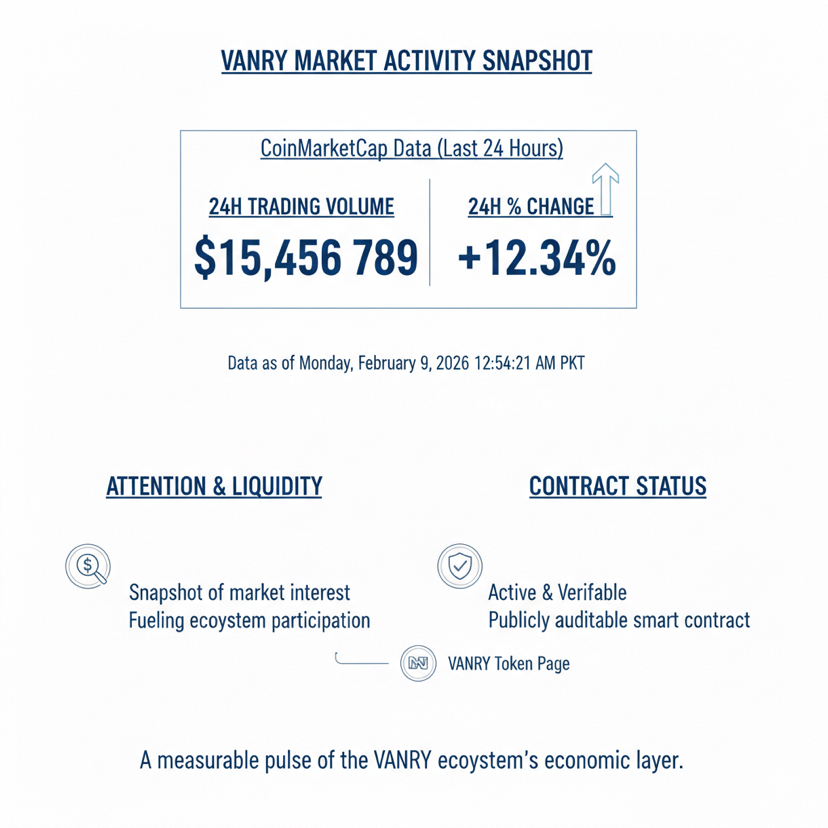
For the last 24 hours, the cleanest public signal you can point to without guessing is the measurable activity around the VANRY market footprint on major trackers, because CoinMarketCap shows a live 24 hour trading volume and a 24 hour percentage change for VANRY, and while this is not a substitute for product progress it is still a useful snapshot of attention and liquidity conditions around the token that powers the ecosystem, especially when combined with the fact that the contract itself remains active and publicly verifiable through its token page.
My takeaway is that Vanar is trying to win through a coherent consumer first thesis rather than a generic chain pitch, because it blends a mainstream adoption background with a newer AI infrastructure narrative that is detailed enough to be tested, and if the team can turn the Neutron memory story and the Kayon reasoning story into tools that developers truly adopt, while keeping the network participation and staking side healthy, then Vanar has a path to become the kind of Layer 1 that users touch without realizing they are using a blockchain, which is ultimately what real adoption looks like.
