

It started with a timestamp.
Not a new feature, not a new token listing, not even a performance update. Just a small cosmetic change in the Plasma explorer: next to every transaction, there was now a second line beneath the block number.
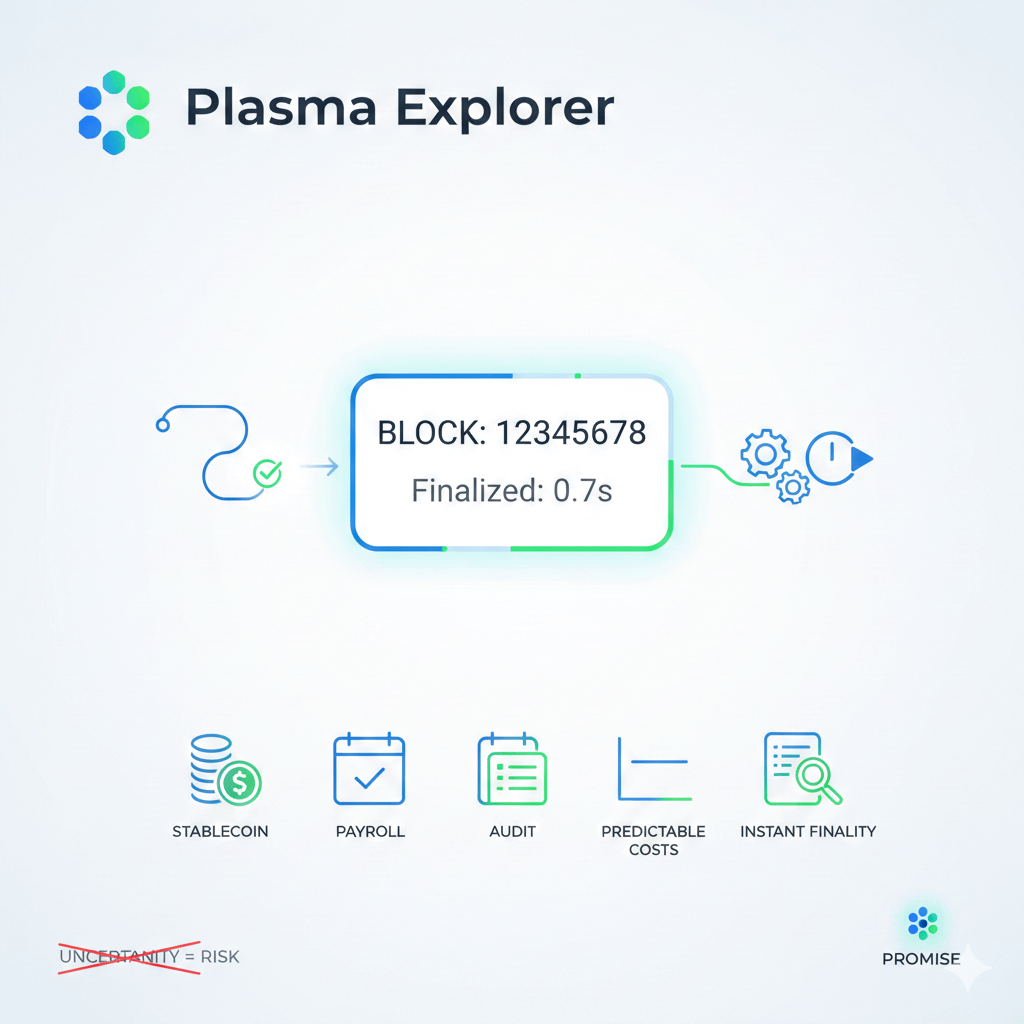
“Finalized: 0.7s”
I stared at it longer than I expected. The number looked almost silly, like someone had added it just to show off. But it didn’t feel like a flex. It felt like a quiet confession: this is what we care about.
I’ve spent enough time around crypto people to know what they usually celebrate. TPS. Throughput. How many transactions a chain can cram into a minute. How high the chart can go before the network starts to choke. The language is always about volume, speed, scale.
But the strange thing is, real financial settlement doesn’t care about TPS in the way crypto communities do.
Real settlement cares about one question:
When is it done?
That’s what finality is. Not the transaction being broadcast. Not the transaction being “likely included.” Not a status that says pending while the user refreshes the screen. Finality is the moment when the system stops being probabilistic and starts being real.
And once you’ve dealt with institutions, you understand why that moment matters more than raw throughput.
A few months ago, I was talking to someone who manages stablecoin treasury operations for a mid-sized payment business. They weren’t a DeFi trader or a crypto enthusiast. They were the kind of person who sees stablecoins as a tool, the way a logistics company sees shipping containers.
Their job wasn’t to speculate. Their job was to move money cleanly.
They told me something simple: “We don’t care if a chain can do 50,000 TPS. We care if we can close our books without guessing.”
That line stayed with me.
Because it explains why finality speed becomes more important than TPS. A chain can process a huge number of transactions, but if the settlement isn’t deterministic, you can’t treat it like financial infrastructure. You can’t build payroll around “probably confirmed.” You can’t pay suppliers around “it might revert.” You can’t move millions in USDT and then sit in uncertainty while the network negotiates itself.
In institutional settlement, uncertainty isn’t a small inconvenience.
Uncertainty is risk exposure.
If you’re sending USDT across a corridor and finality takes too long, you have to make assumptions. You have to add buffers. You have to delay reconciliation. You have to hold extra liquidity “just in case.” You build a system around waiting, because the chain cannot give you closure quickly enough.
And every second of waiting is a financial cost.
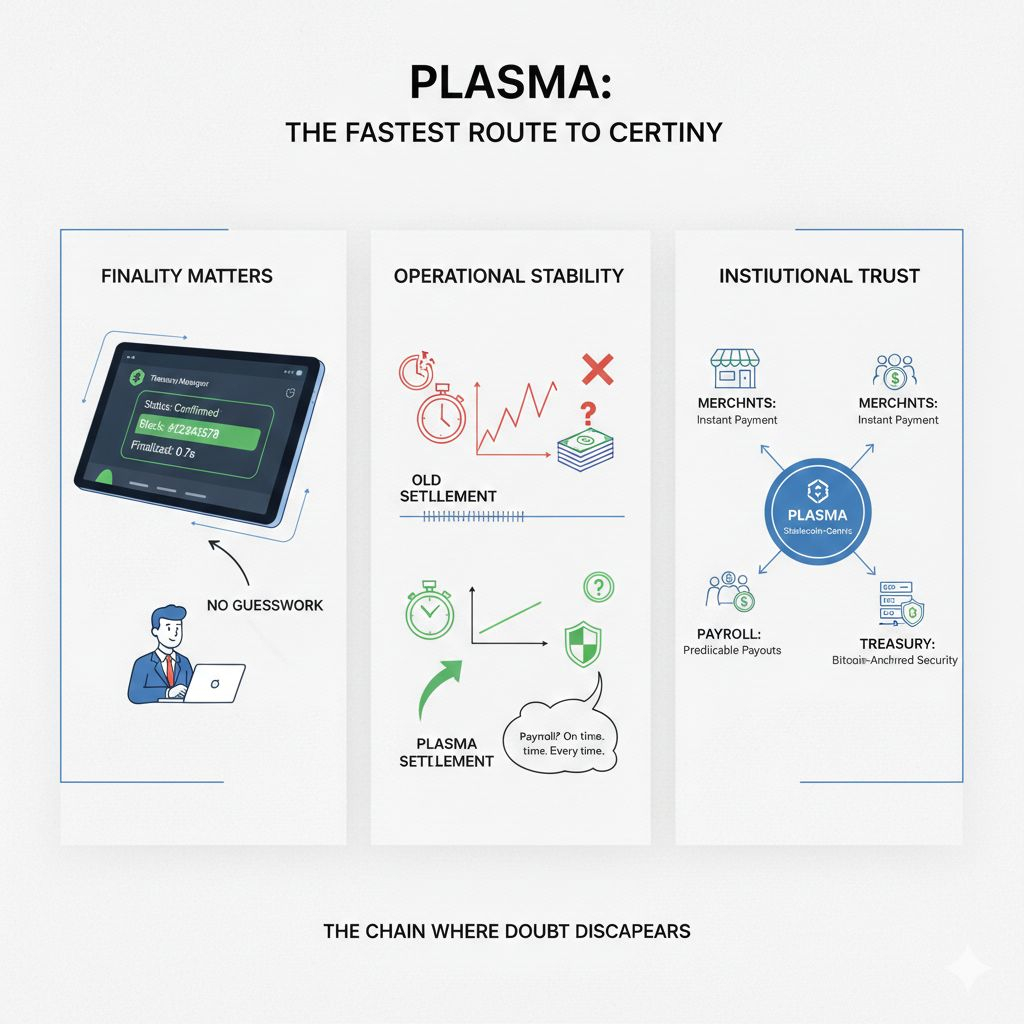
It’s not always visible on-chain, but it shows up in operations: slower batching, delayed payouts, more support tickets, more manual intervention, more hedging.
Sub-second finality changes the emotional texture of settlement. It turns a transaction from an event you monitor into something you accept and move past.
That’s why PlasmaBFT feels like it exists for a different audience.
It isn’t trying to win the TPS race. It’s trying to reduce the number of moments where a human has to hesitate. It’s trying to make finality feel like a light switch, not a weather forecast.
And institutions need that. Payment processors especially.
Payment processors avoid chains without deterministic settlement because their entire business model depends on certainty. When a merchant gets paid, the processor has to know whether the payment is truly irreversible. If there’s even a small chance the transaction can be reorganized or reversed, then the processor becomes the insurer of that risk.
No one wants to insure blockchain uncertainty.
This is why you rarely see serious payment infrastructure built on chains where finality is vague. It’s not because those chains are “bad.” It’s because the settlement behavior doesn’t match the standards of real finance.
A merchant doesn’t care about decentralization narratives. They care that the payment is final before the customer walks away.
A payroll department doesn’t care about ecosystem hype. They care that salaries arrive on time, with predictable fees, and with clean accounting.
That’s where Plasma becomes interesting to think about as a payroll chain.
Payroll isn’t like DeFi trading. Payroll is repetitive, scheduled, and unforgiving. It’s the same action every week or every month: hundreds or thousands of USDT transfers going out, with no tolerance for “network congestion” excuses.
The employees don’t want to hear that gas spiked. They don’t want to hear the chain was busy. They want their money.
For Plasma to be usable for salary payments, it needs to behave like infrastructure that doesn’t change mood. And its stablecoin-first design is clearly aimed at that. If fees are paid in stablecoins—or certain transfers are gasless—then payroll becomes operationally simpler. The payroll system doesn’t need to keep a volatile fee token on hand. It doesn’t need to constantly rebalance gas reserves. It doesn’t need to explain why the cost of paying employees fluctuates with token speculation.
That’s one of the ugliest parts of blockchain-based payments today: your fee mechanics are tied to market volatility.
A business might budget payroll settlement costs assuming a stable environment, but then the chain’s fee token pumps, and suddenly the same batch of payments costs 3x. Nothing about the business changed. Nothing about the employees changed. The only thing that changed was the price of a token they never wanted to hold.
That’s not innovation. That’s operational fragility.
Stablecoin treasuries need stable and transparent fee mechanics because treasury teams are not gamblers. They need predictable costs, predictable settlement times, predictable accounting. They need the ability to explain to auditors and internal finance teams exactly why something cost what it cost.
And they need it to be repeatable.
Plasma’s approach—stablecoin-centric gas and fast deterministic finality—points toward that kind of repeatability. The chain isn’t asking institutions to “understand crypto.” It’s trying to behave like something institutions already understand: settlement rails.
Even the Bitcoin-anchored security angle starts to make more sense in that context. For institutional money movement, neutrality isn’t a slogan. It’s a requirement. The more value moves through a stablecoin settlement chain, the more it matters that the network can resist arbitrary interference and maintain consistent behavior under pressure.
When I looked again at that explorer timestamp—“Finalized: 0.7s”—it didn’t feel like a performance metric anymore.
It felt like a promise.
Not a promise that the chain can handle a million transactions per second in a lab. But a promise that when real money moves, it moves into certainty quickly enough that businesses can operate without hesitation.
Because in real settlement, speed isn’t about how fast the network can run.
It’s about how fast doubt disappears.