
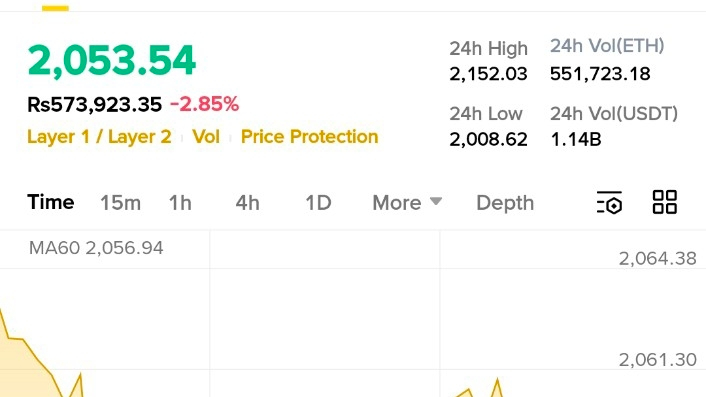
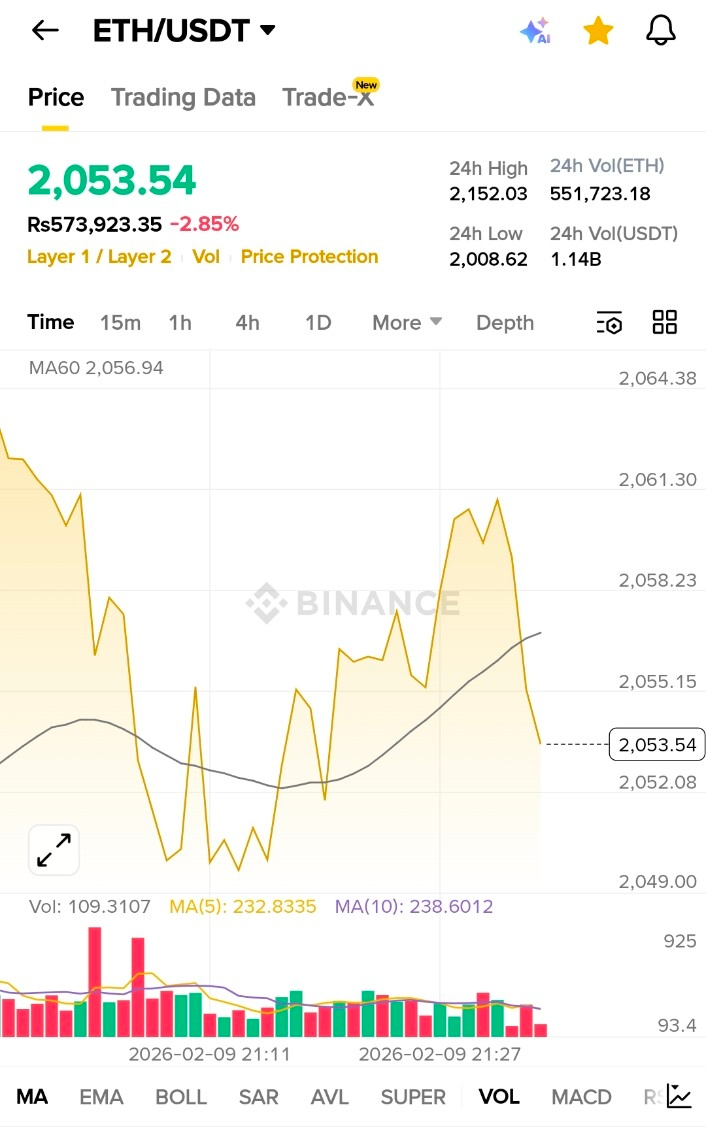
Price Action: After a difficult January, ETH has seen a sharp decline in early February, recently touching a psychologically critical level around $2,000.
Volatility: The market has been shaken by massive liquidations—notably a high-profile $686 million loss from a leveraged "long" bet that collapsed when ETH slid below $2,000.
Support & Resistance: * Immediate Support: $2,000 (a break below this could signal a move toward $1,750).
Resistance: $2,230 and $2,700 are the hurdles ETH needs to clear to reclaim its bullish momentum.
2. Fundamental Outlook (2026 Roadmap)
Despite the price turbulence, the network’s underlying technology is entering a "scaling supercycle":
The "Glamsterdam" Upgrade: Expected in the first half of 2026, this upgrade aims to overhaul execution to handle parallel transactions, pushing the network toward a theoretical 200,000 TPS (transactions per second).
Institutional Adoption: Major players like BlackRock and Franklin Templeton continue to focus on Real-World Asset (RWA) tokenization on Ethereum. Institutional inflow remains a primary long-term "bull case" for reaching new all-time highs later in the year.
Privacy & Scalability: The 2026 roadmap heavily emphasizes ZK-EVMs and privacy-preserving tools to make Ethereum more viable for corporate and sensitive financial use.$ETH

3. Sentiment: The "Disconnect"
There is currently a "stark disconnect" between price and potential:
Bearish Short-term: Traders are cautious due to recent liquidations and a "risk-off" environment across the broader crypto market.
Bullish Long-term: Many analysts (including those from Standard Chartered and Citi) maintain end-of-year targets ranging from $7,500 to $10,000, betting on the "scarcity" created by ETH $ETH staking and the expansion of Layer-2 ecosystems.
Summary: Ethereum is currently a "battleground" asset. If it holds the $2,000 floor, the upgrades scheduled for later this year could catalyze a massive recovery. If it fails to hold, we may see a period of consolidation at lower levels before the next major network milestone.