
Plasma isn’t trying to be a “new playground chain.” It’s trying to feel like a piece of financial plumbing that can move stablecoins all day, every day, without drama. That’s a bold lane to pick because payments don’t forgive mistakes. People can tolerate a DeFi app being glitchy for an hour. They don’t tolerate a settlement rail that randomly slows down, freezes, or surprises them right when volume spikes.
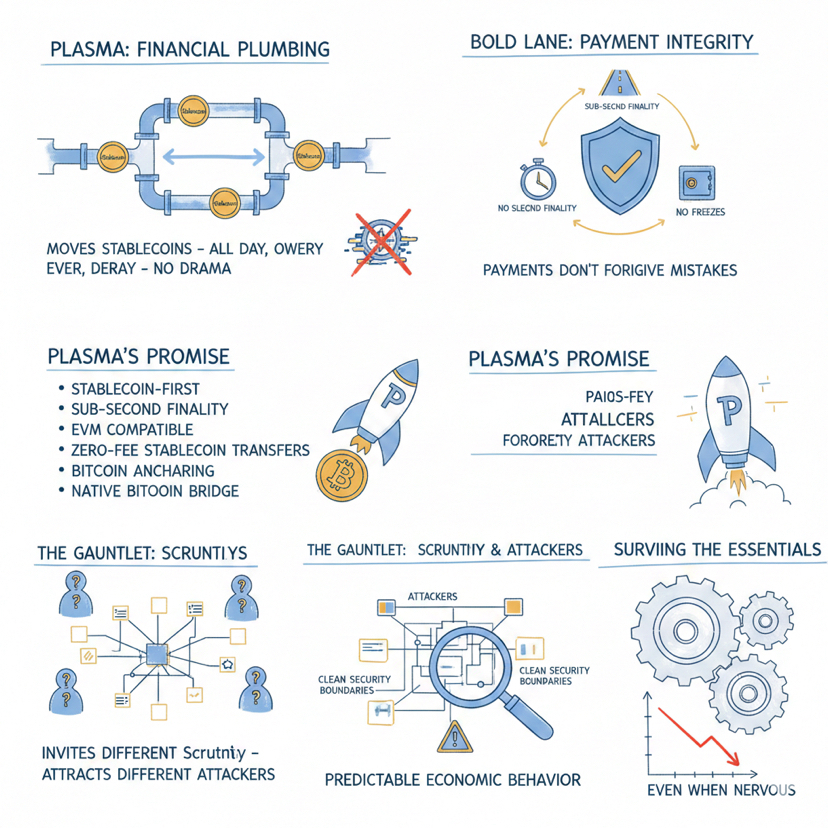
The bear case starts the moment Plasma’s message reaches real users: “stablecoin-first,” “sub-second finality,” “EVM compatible,” “zero-fee stablecoin transfers,” and a security story that leans on Bitcoin anchoring and a native Bitcoin bridge. Those aren’t small claims. They invite a different kind of scrutiny, and they attract a different kind of attacker. If Plasma wants to survive, it has to survive the boring stuff: operational reliability, clean security boundaries, and predictable economic behavior, even when the market is red and everyone is nervous.
One of the quickest ways Plasma could get hurt is through the bridge surface. When a chain becomes known for settlement, the biggest target is rarely the execution environment. It’s the path that moves value across boundaries. Anything that touches BTC liquidity becomes a magnet because the upside for an attacker is massive. But the deeper risk isn’t only theft. It’s trust damage. People build mental models based on a project’s language. If they believe the bridge is “trust-minimized” in a way it isn’t, or they assume Bitcoin anchoring means something stronger than it does, then even a small incident can turn into a reputational injury that takes years to heal. The survival response is simple to say but hard to execute: be brutally clear about what the bridge guarantees, what it does not guarantee, and what happens under stress. Put limits in place early. Design a safe mode that can slow exits and flag anomalies without turning into silent, centralized control. Treat bridge security like its own product line, not like a feature that ships once and is forgotten.
Then there’s the issue nobody likes to talk about in the early days: who really controls the chain when it matters. A phased validator rollout can be a smart engineering choice, because you want stability before you open the doors. The bear case is when “phase one” quietly becomes the permanent state. If the same small circle ends up controlling block production, delegation, and policy decisions, the chain can start to feel like a managed network. That doesn’t automatically mean it’s useless, but it changes what it is. It becomes easier to pressure, easier to influence, and easier to censor. A settlement chain gets punished for that perception because counterparties want neutrality. They want to know the rules don’t suddenly shift based on who is in the room. The only way to survive this pressure is to make decentralization a trackable process. Not “we plan to expand validators,” but “here’s what needs to be true before expansion, here are the milestones, and here’s how anyone can see we’re actually doing it.” If neutrality is part of the story, the chain should make inclusion and liveness visible enough that selective behavior can’t hide in the shadows.
Validator incentives are another place where a project can accidentally build a future problem. Plasma talks about being friendly to institutional expectations and reducing penalty risk, including an approach that emphasizes slashing rewards rather than slashing stake, and not punishing liveness failures. The intention is understandable: you don’t want operators living in fear of random penalties. But the bear case is that the deterrence becomes too soft in adversarial conditions. When money is flowing, attackers don’t need to “destroy” the network to win. They just need to degrade reliability or distort ordering enough to make the chain feel unsafe for settlement. If the cost of misbehavior isn’t strong enough, you can end up with a network that works in good weather and struggles in storms. Survival here means having an escalation ladder. Mild mistakes shouldn’t be catastrophic, but repeated instability shouldn’t be treated like background noise. A payments chain needs standards that feel closer to infrastructure than hobbyist validation.
The “zero-fee stablecoin transfer” idea is a perfect example of something that sounds incredible and can still backfire if it isn’t engineered with defensive thinking. Free transfers are irresistible for users, but they’re also irresistible for spam. If moving value costs almost nothing, then creating load costs almost nothing too. That doesn’t only create technical strain. It creates economic strain: more bandwidth, more infra, more monitoring, more operational pressure. And if the network starts feeling slow or inconsistent, the thing Plasma is selling—smooth settlement—starts to fade. The survival move is not to abandon the “free” promise, but to shape it into something realistic: free under normal conditions with clear guardrails, budgets, throttles, and attack-mode behavior. The best payment systems always have a plan for what happens when traffic turns abnormal. Plasma has to think that way if it wants to be taken seriously in that lane.
Token dynamics can be an even quieter killer because they don’t look like a security breach. They look like “market behavior,” and by the time the damage is obvious, it’s already baked in. Plasma describes a fixed total supply and a distribution that includes significant allocations to ecosystem growth, team, and investors, plus a public sale portion, and it also describes validator rewards starting with inflation and stepping down over time, alongside a burn mechanism designed to counterbalance dilution as usage grows. The bear case isn’t “these numbers are bad.” The bear case is timing plus psychology. In weak conditions, steady unlocks and emissions can create a constant supply drip that overwhelms organic demand. If usage isn’t already strong, burn won’t feel meaningful, and the token can get pinned under a story of “endless selling.” That story can become self-fulfilling because it makes partners hesitate, builders hesitate, and long-term holders hesitate.
Survival here is mostly discipline. Ecosystem allocations have to be handled like a long-term infrastructure budget, not like a marketing cannon. If incentives are sprayed too aggressively, you may get activity, but you might not get loyalty. You get volume that disappears the moment rewards fade, and you keep the sell pressure permanently. If incentives are designed around retention—repeat payment behavior, real merchants, durable corridors—then the system can gradually carry its own weight. The second part is transparency. The market punishes surprises more than it punishes unlocks. Clear schedules, visible wallets, and consistent policies reduce panic. It doesn’t make selling vanish, but it makes the chain’s future easier to price.
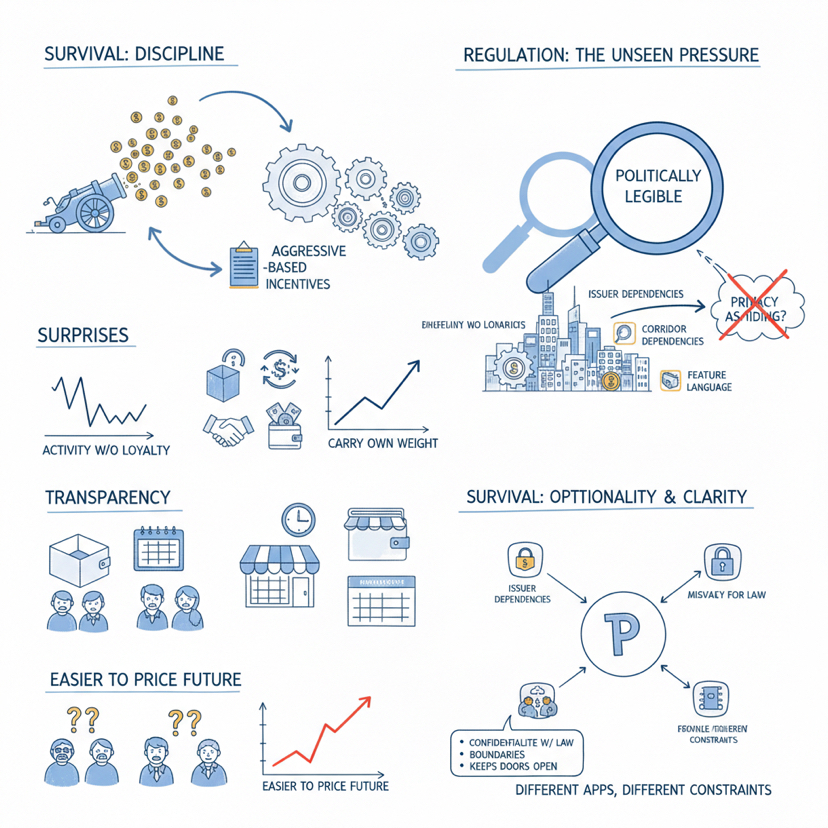
Regulation is the pressure you don’t feel until you do. A chain that succeeds at stablecoin settlement becomes visible and therefore politically legible. That means issuer dependencies matter. Corridor dependencies matter. Even feature language matters. Anything that sounds like “privacy for payments” can be misread as “hiding for payments” if it’s not explained carefully. Plasma can survive this by building optionality into the system. Instead of one narrow compliance posture, it needs the ability for different applications to operate within different constraints without forcing the entire chain into a single mode. It also needs to communicate clearly about what confidentiality means in practice, how it can remain compatible with lawful requirements, and where the boundaries are. Survival in this lane is less about winning arguments online and more about keeping doors open with serious counterparties.
If you zoom out, Plasma’s bear case is basically the cost of choosing the “payments chain” identity. That identity raises the bar on everything. The survival path is not flashy. It’s engineering and governance choices that look conservative from the outside: tighter controls around bridge risk, measurable decentralization, deterrence that works under stress, anti-abuse mechanics for free transfers, and token policies that minimize chaos during unlock windows. If Plasma executes that, it doesn’t need perfect market conditions. It can grow slower, steadier, and more credibly—because the people who run money rails don’t chase hype. They chase the system that keeps working when nobody is cheering.