

Ethereum staking has blown past 30% of the total supply. That’s an all-time high, and it’s changing the network’s security, liquidity, and the future of ETH itself.
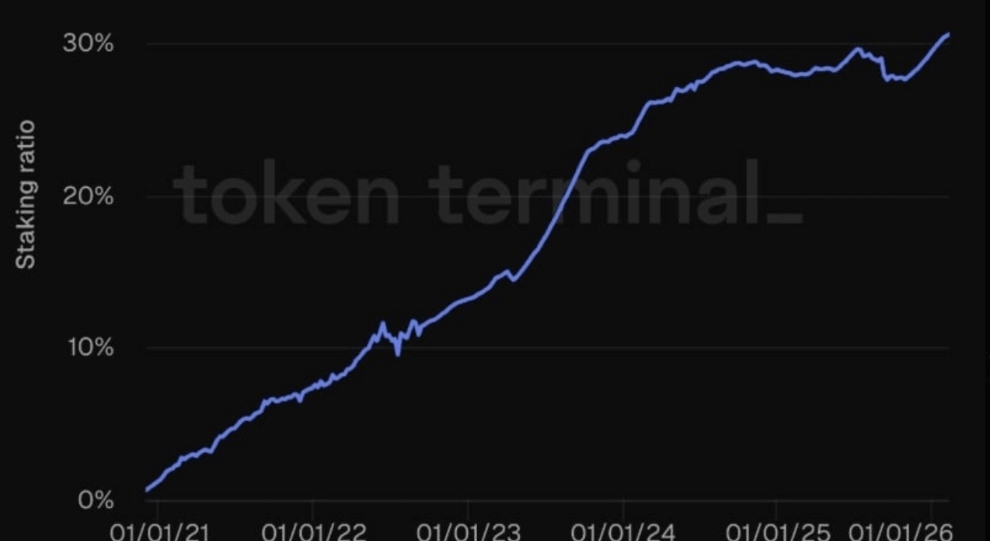
More people than ever are staking ETH. This isn’t just a numbers game — it shows real faith in Ethereum’s future and the rewards of playing an active role.
Introduction — Why This Matters Right Now
Ethereum just hit a big milestone: over 30% of all ETH is locked up in staking. This isn’t just another stat. It’s a signal. People are betting on Ethereum to last — and to pay off.
When so much ETH is staked, the network itself changes. Security gets a boost. There’s less ETH sloshing around, so markets tighten up. For everyone involved — users, developers, investors — this feels like a real shift.
Core Thesis — What’s Really Going On
The rising staking rate isn’t just a technical detail. It’s about ETH turning into something more than a trading chip.
Now, ETH is a productive asset. It earns yield. It powers network security. More holders want to participate and help secure the network, not just sit on the sidelines and speculate.
Problem Statement — The Balancing Act
Ethereum’s always tried to walk a fine line:
Not enough staking? The network gets weaker.
Too much ETH locked up? Markets lose liquidity.
Too much power in a few hands? The network gets risky.
In the past, staking was tough to access and too centralized. That kept a lot of people out and raised some red flags.
The Technology Stack — How This All Works
Proof-of-Stake Consensus
Validators lock up ETH to validate transactions and keep Ethereum running smoothly. They get rewarded for it. This setup is way more energy-efficient, with security powered by real people staking real ETH, not miners burning power.
Validator Network
Thousands of independent validators all over the world stake ETH and keep the network honest. The more people do it, the harder — and pricier — it gets to attack the system.
Liquid Staking Infrastructure
Liquid staking lets people stake ETH and still use it in DeFi, thanks to tokenized versions. You get yield, network security, and flexibility all at once.
Reward & Penalty Mechanisms
Validators earn for doing their job right. Slack off or cheat, and they lose out. The rules are baked into the protocol, keeping things fair without a central boss.
Addressing Anxiety — What If Staking Gets Too Concentrated?
People worry about a few players taking over staking. But Ethereum’s got some guardrails:
Anyone can run a validator.
If groups act up together, protocol rules hit them with penalties.
The community has tools to keep an eye on who’s controlling what.
Keeping things decentralized is still a top priority.
Distribution Strategy — Why More People Are Joining In
Staking’s getting easier. You can do it through exchanges or wallets. Liquid staking means you don’t have to give up flexibility. Big institutions want in, too, since ETH now offers real yield.
It’s not just crypto diehards anymore — the door’s open to a lot more people.
Historical Context & Evolution
Ethereum started out using Proof-of-Work, like Bitcoin. Switching to Proof-of-Stake changed who secures the network and how they get paid. As the tech improved and confidence grew, more people jumped in. Now that staking tops 30%, it’s clear: this isn’t a fringe thing anymore. It’s becoming the norm.
Ethereum’s not just something to trade. It’s evolving into a yield machine — a backbone secured by people in it for the long haul.
Speculator / Builder Checklist
Keep an eye on these over the next few months:
Is the staking ratio still climbing?
Are more independent validators popping up?
What’s happening with liquid staking?
How’s DeFi using staked ETH?
Any big upgrades to decentralize validators further?
Conclusion — What This Means Day-to-Day
More staked ETH means stronger security and tighter supply. It shows people want to be part of Ethereum for the long run, not just to flip coins.
For developers, it’s a stronger base to build on. For users, ETH isn’t just a token — it’s network infrastructure and a way to earn, all rolled into one.
Dive into an Ethereum staking dashboard or validator explorer. See for yourself how the network’s changing — and maybe find your own way to get involved.
FAQs
Q1: Does more staking make ETH scarce?
It cuts down on liquid supply, but staked ETH can come back into circulation whenever people withdraw.
Q2: Is staking risk-free?
No. Validators can get penalized, and there are always some risks with smart contracts.