

Blockstream CEO Adam Back has opposed a proposal aimed at reducing Ordinals-like “spam” on Bitcoin, warning that the fix could do more harm than good to the network’s credibility.
Bitcoin Improvement Proposal (BIP-110) was proposed by pseudonymous Bitcoin developer Dathon Ohm in December. Nearly 7.5% of Bitcoin nodes — all of which are Bitcoin Knots clients — have signaled readiness for BIP-110, according to data.
The proposal seeks to temporarily shrink how much data can be stored in Bitcoin transactions to reduce the amount of images, videos, audios and other “data abuse” flooding the network.
While Back agreed that Bitcoin should act as “sound money,” he said in a post to X on Sunday that it wasn’t worth a consensus-level change, adding that BIP-110 would be “an attack” on Bitcoin’s credibility as a store of value and secure monetary network.
“It’s a lynch mob attempt to push changes there is not consensus for,” he said, adding that spam is “just an annoyance” that poses no real security threat to the network.
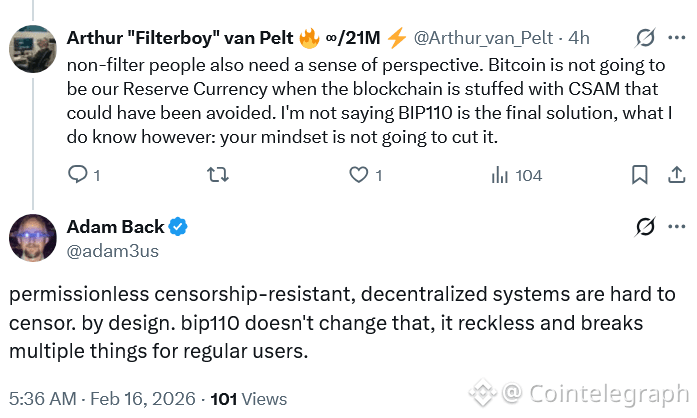 Source: Adam Back
BIP-110 is only a temporary fix to reduce arbitrary data, aimed at giving the Bitcoin community the ability to evaluate the impact for 12 months while developers work on a longer-term solution.
BIP-110 has gained more support from validators running Bitcoin Knots, which started taking market share from Bitcoin Core in the back half of 2025, when Bitcoin Core developers removed the 80-byte limit on the OP_RETURN function in late October, enabling more non-financial transactions to flood the Bitcoin network.
Bitcoin Core’s market share of Bitcoin nodes has fallen from about 98% to 77.2% since the controversial OP_RETURN function sparked debate in the Bitcoin community over what transactions should be allowed on the network, with Bitcoin Knots' share rising to 22.7%.
Back is among many who opposed removing the 80-byte limit on the OP_RETURN function, stating in September that Ordinals-like spam has “no place in the timechain.”
However, he flagged that a solution like BIP-110 has the potential to freeze funds by rendering certain unspent transaction outputs (UTXOs) unspendable.
Ohm acknowledged that it is theoretically possible for funds to be frozen, but added: “This proposal goes to great pains to avoid affecting any known use cases.”
Related: Bitcoin holders are being tested as inflation eases: Pompliano
Those in favor of non-financial transactions, like Bitcoin Ordinals leader Leonidas, have noted that the Ordinals and Runes ecosystems have contributed over $500 million in transaction fees to strengthen Bitcoin’s security — something which has become an increasing concern as the mining block subsidy continues to halve every four or so years.
Bitcoin Ordinals activity has tanked
However, Dune Analytics data shows that Ordinals inscription fees were consistently netting less than $10,000 per day for Bitcoin miners by the end of 2025, making it difficult for them to rely on non-financial transactions for revenue.
Ordinal activity reached its peak more than two years ago, with Bitcoin miners collecting almost $10 million in fees on Dec. 16, 2023.
Since then, fees have trended downward except for a few short-lived spikes.
Magazine: Did a Hong Kong fund kill Bitcoin? Bithumb’s ‘phantom’ BTC: Asia Express