Why a trading-first chain may quietly reshape where markets live
When people evaluate a new blockchain, the conversation almost always starts with speed — latency, throughput, finality. But speed alone has never moved liquidity. Traders don’t migrate because a chain is faster; they migrate because markets become better there.
The more interesting question about Fogo today is not how fast it is, but whether it creates conditions that make liquidity want to relocate.
The emerging case: liquidity follows execution quality
Across crypto markets, we’re seeing a familiar pattern: liquidity concentrates where execution quality is highest. On centralised exchanges this meant co-location, low-latency matching engines, and deep order books. On-chain, that equivalent has been missing — until chains began optimising specifically for trading.
Fogo’s architecture suggests a thesis:
if on-chain execution becomes predictable, fair, and institution-grade, liquidity migration becomes possible.
That’s a different proposition from “high TPS.”
Case observed today: MEV-sensitive flow prefers batch environments
One of the most notable behavioral shifts in DeFi over the past year is how professional flow reacts to MEV risk. Large traders increasingly prefer venues where execution is:
price-deterministic
time-fair
resistant to sandwiching
latency-neutral
Fogo’s dual-flow batch auction model directly targets these preferences. By clearing trades at a uniform price per block, competition shifts from speed advantage to price quality.
For sophisticated flow, that’s a meaningful difference. It reduces the need for defensive routing, private relays, or execution splitting — all costs that currently fragment on-chain liquidity.
If traders trust execution, they consolidate size.
If size consolidates, liquidity migrates.
Why Fogo’s “follow-the-sun” validators matter more than advertised
Most discussions frame Fogo’s rotating validator regions as a latency optimisation. But the deeper implication is market proximity.
Traditional finance learned decades ago that geography still matters. Exchanges cluster near financial centres for a reason: the closer matching engines are to participants, the tighter spreads become.
Fogo effectively recreates this dynamic on-chain:
Asia session validators near Asian exchange infrastructure
EU/US overlap near transatlantic liquidity
US session near American market hubs
This isn’t just technical design — it’s market microstructure translated into blockchain form.
The result: execution characteristics shift with global trading hours, aligning blockchain behaviour with real-world liquidity cycles.
Infrastructure maturity: the quiet adoption driver
Another factor often overlooked in early chains is operational continuity. Traders and developers rarely adopt systems that require workflow reinvention.
Because Fogo runs the Solana VM, existing trading infrastructure can port with minimal friction:
same programs
same tooling
same transaction model
same indexing patterns
This lowers migration cost dramatically. In markets, reduced switching cost is often the trigger that unlocks movement.
Liquidity rarely jumps; it slides where friction is lowest.
Today’s sentiment: cautiously constructive
Market perception around Fogo currently sits in a familiar early-infrastructure phase:
Positive signals
clear specialisation (trading-first positioning)
differentiated execution model
credible technical lineage (SVM)
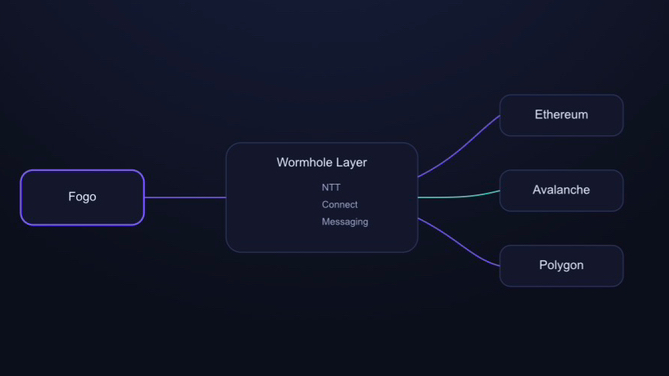
strong infrastructure stack (RPC, oracle, bridges)
Constraints
validator centralisation during early rollout
high hardware barrier
new-chain risk profile
unproven liquidity depth
This combination typically produces cautious but attentive sentiment rather than hype — the same pattern seen in early specialised chains that later found niche dominance.
The bigger question: can markets leave Ethereum-centric gravity?
For years, most on-chain liquidity has remained anchored to a small number of ecosystems because migration risk outweighed execution benefits.
Fogo’s bet is that execution quality can become strong enough to overcome that inertia.
History suggests this is plausible.
Liquidity has migrated before:
from floor trading to electronic venues
from regional exchanges to global ones
from CeFi to DeFi
Each shift followed the same rule:
execution improvement > switching cost
Fogo is one of the first chains designed explicitly around that equation.
Conclusion
Today’s real case for Fogo isn’t speed or TPS. It’s the possibility that on-chain trading environments can reach a level of fairness and predictability where professional liquidity actually relocates.
If that happens, the implications are larger than a new chain succeeding. It would mean blockchain markets are entering a phase where venue quality — not ecosystem gravity — determines where capital lives.
Fogo is still early, still risky, and still proving itself.
But its design points toward a future where liquidity moves not to the biggest chain, but to the best market.
And that would be a structural shift for crypto trading.