

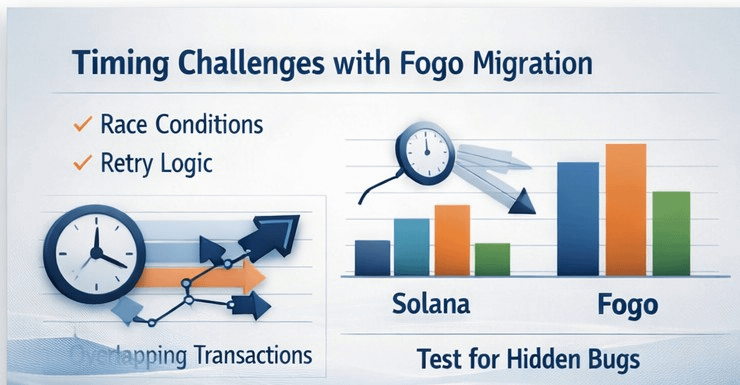
I keep reminding myself that moving a Solana app to Fogo isn’t really about “porting code.” My programs might stay identical, but the assumptions around them—RPC behavior, assets, wallets, user flows—are where things tend to break. Fogo describes itself as fully compatible with the Solana Virtual Machine, and its docs say existing Solana programs can be deployed without modification by pointing familiar tools at a Fogo RPC endpoint. This is getting attention right now because Fogo has moved from an abstract performance story into something people can actually run on. The Block reported Fogo’s public mainnet launch on January 15, 2026, and framed it around low-latency, trading-style workloads. When a network is live, the question becomes less “is it compatible?” and more “does it hold up when my integrations get stressed?” When I’m sanity-checking a migration, I usually start by interrogating my timing assumptions. Fogo’s pitch leans on extremely short block times and quick finality, so I look for bugs that were politely hidden before: two actions that “never” collide on Solana might collide when state advances more quickly, and any place I’m relying on “wait a bit and retry” logic deserves a fresh look. I also watch for anything that depends on rent-exempt balances, compute limits, or specific error paths, because “compatible” doesn’t mean “identical under all edge conditions,” especially while a chain is still tuning. Then there’s the ecosystem layer, which is where migrations often get messy in ways that aren’t glamorous. Token mints, program IDs, oracle feeds, and liquidity sources don’t automatically follow me. If my front end is sprinkled with Solana mainnet addresses, I need to replace them deliberately, and I need a plan for the cases where the equivalent contract simply isn’t deployed on Fogo yet. Even basic funding and onboarding can be a constraint: Fogo’s community docs currently describe bridging that focuses on USDC transfers, with additional assets not yet available. That single detail can change whether my app feels usable on day one or like a demo. What I find most distinctive, and most worth testing rather than trusting, is the UX primitive Fogo is trying to standardize. Their documentation frames “Fogo Sessions” as a way for users to interact without paying gas or signing every transaction, using account abstraction ideas and paymasters, and it also notes that Sessions are limited to SPL tokens rather than the native token. If my app assumes a wallet prompt per click, or if I rely on native-token fee behavior, I have to rethink permissions, limits, and recovery in a way that’s closer to product design than smart-contract design. I used to think a chain migration was mostly a deployment exercise. Now I see it more like a dependency audit with a new set of failure modes. If I can run the whole thing end to end—deploy, index, bridge, trade, withdraw—without papering over gaps, then I can start believing the “no changes needed” promise in the way that matters: in production, with humans.
@Fogo Official #fogo #Fogo $FOGO
