
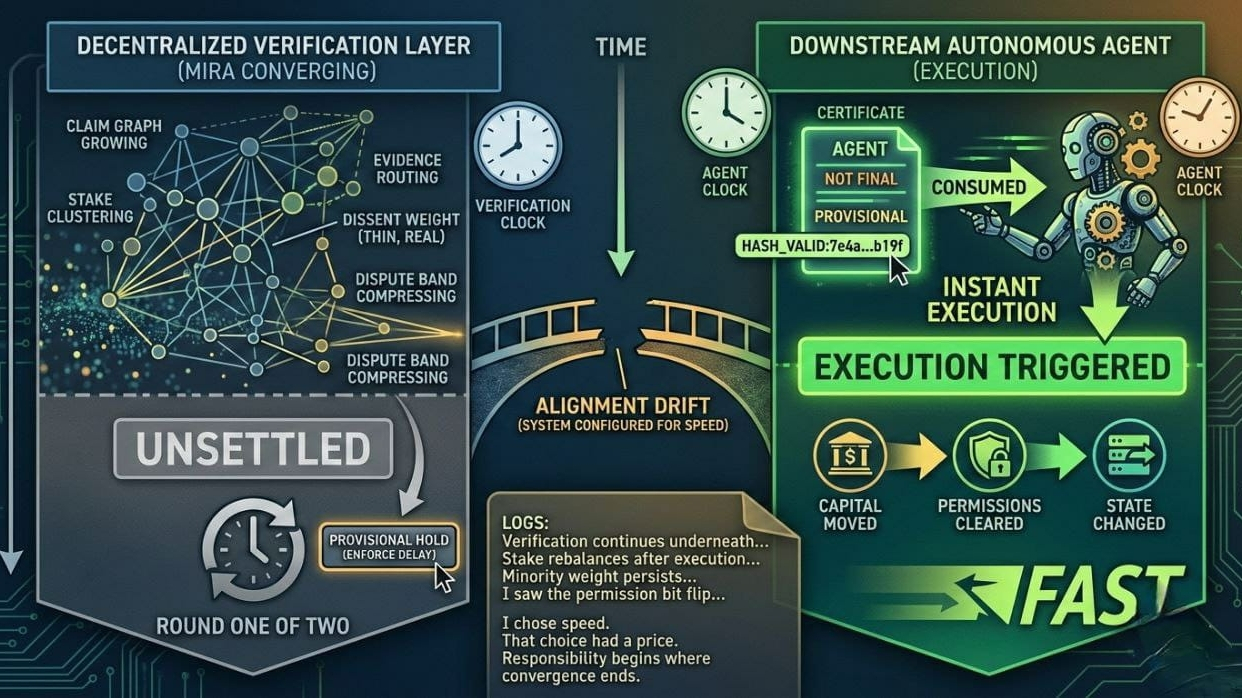
#mira $MIRA Mira was still converging when the agent moved.
The model output had finished rendering. Polished. Structured. Confident in the way completed responses always are. But confidence at the surface is not the same thing as certainty underneath. Beneath that response, the decentralized verification layer was still active, breaking the text into individual claims, routing them through verification queues, attaching stake, assembling evidence.
I watched the claim graph grow in real time.
The client displayed a certificate. Not final. Not fully weighted. Just credible enough to exist.
That was enough.
A downstream autonomous agent consumed the certificate the moment consensus leaned positive. It did not wait for convergence. It did not require finality. Provisional was acceptable. Execution followed immediately.
This was still round one of two. The badge remained grey. Weight had not fully settled.
Execution triggered anyway.
Capital moved. Permissions cleared. State changed. I watched it happen. Two claims were still inside first-round consensus, stake clustering but not locked. That detail never surfaced at the certificate layer. The agent didn’t inspect dissent weight. It didn’t evaluate convergence velocity. It saw a valid hash pointer and acted.
I could have stopped it. I didn’t.
Verification continued underneath. Stake redistributed. Evidence hashes attached. No fork occurred. No explicit contradiction emerged. Just different systems operating on different clocks. I understood those clocks. I let them drift.
A dissenting model arrived late with additional context. Another validator reinforced an earlier interpretation. Disagreement narrowed. The certificate remained valid. Execution was already irreversible.
I watched the dispute band compress after downstream state had changed. There was no rollback. Weight realigned within the same hash. Margins shifted. Meaning narrowed. The agent never noticed. Or noticed and didn’t care.
I had an option. Enforce a provisional hold. Require second-round convergence before exposing the certificate. That might have caught it. It also would have slowed everything. It also would have increased cost. My cursor hovered over the control. I chose speed.
That choice had a price.
Generation cleared instantly. Verification kept locking stake. I knew it would. I chose speed anyway.
I saw the permission bit flip before stake finished settling. I didn’t bridge that gap.
One claim was still absorbing weight when a downstream system cached the certificate for reuse. Nothing reopened. The assumption was that decentralized verification had already priced disagreement correctly. Maybe it had. I checked the numbers twice. They didn’t change. It still felt wrong.
Stake continued rebalancing for seconds after execution. Minority weight persisted. Thin, but real. The certificate traveled. The dissent stayed behind. I archived the dissent log.
Verification kept weighing.
Autonomy had already acted.
Eventually the claim graph collapsed into a tighter band. Not resolved. Just too expensive to challenge further. Consensus didn’t flip. It hardened.
Mira continued converging long after execution had finished. The agent had already moved. I was positioned between them.
Yesterday, alignment held. This time, it didn’t. The system was still configured for speed. I was still reading logs.
And next time, I’ll face the same decision again:
where convergence ends, and where responsibility actually begins.@Mira - Trust Layer of AI