Every digital currency is, at its core, an economic experiment. Beyond technology, its success depends on how people value it, how they use it, hold it, trade it and trust it. For Mira Coin, the journey into economic design was a blend of theory, simulation and real-world experimentation.
The team recognized early that traditional token models often drove unhealthy speculation or contributed to centralization. They wanted incentives that encouraged long-term participation in network security and utility, rather than short-term trading gains.
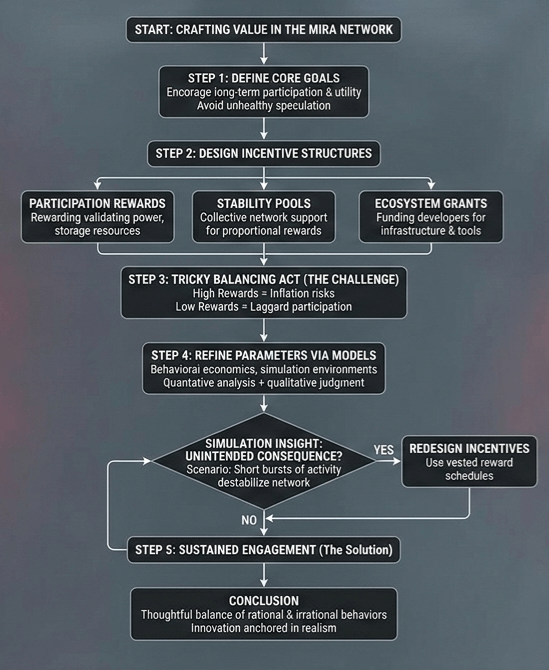
Their approach combined participation rewards, stability pools and ecosystem grants. Participation rewards were designed to reward users who contribute validating power or storage resources. Stability pools allowed participants to collectively support network stability mechanisms in exchange for proportional reward shares. Ecosystem grants funded developers building infrastructure, tools and services within the Mira ecosystem.
But balancing these incentives was tricky. Too generous and inflation could diminish value; too stingy and network participation lagged. The team used complex models drawn from behavioral economics and iterative simulation environments to refine parameters.
I had the chance to review some of these models. The simulations weren’t perfect, no model ever is l but they offered a structured way to anticipate participant behavior under different reward scenarios. What fascinated me most was how the process blended quantitative analysis with qualitative judgment. The developers constantly debated not just numbers but human motivations.
One simulation scenario revealed an unintended consequence: participants might favor short bursts of activity to earn rewards, then abandon their roles, destabilizing the network rhythm. That insight led to a redesign with vested reward schedules, encouraging sustained engagement over fleeting bursts.
This economic journey taught a broader lesson: designing incentives for decentralized systems is as much an art as it is a science. Mira Coin’s economic model does not promise perfection but it shows thoughtful consideration of both rational and irrational aspects of human behavior.
From my neutral perspective, I appreciate this balance, innovation anchored in realism. There’s promise here but also recognition that real economic behaviors can surprise even the best models.