
The current AI landscape is a bit like the Wild West: it’s incredibly powerful, but nobody knows who to trust. While retail users are having fun with chatbots, big institutions banks, healthcare providers, and legal firms are watching from the sidelines with a mix of FOMO and genuine fear.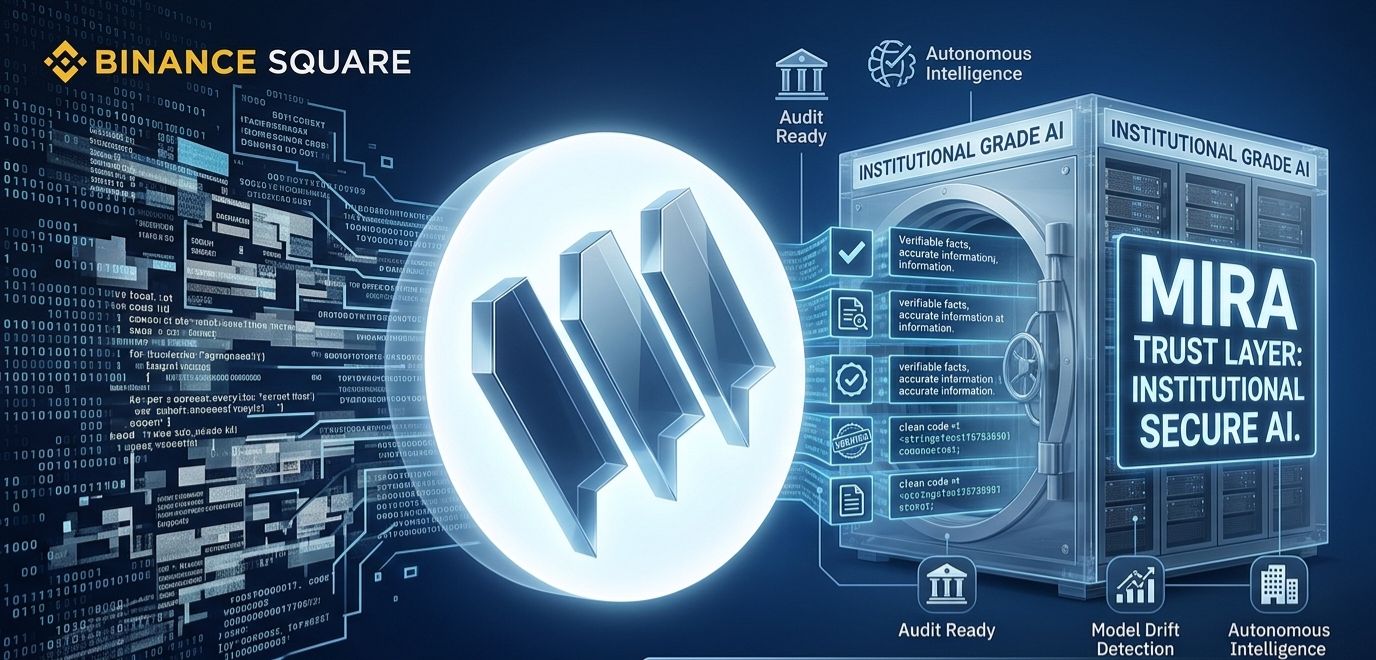
They can’t afford hallucinations. They can’t afford a $100 million trade based on a confident guess from a black box model. This is where @Mira - Trust Layer of AI enters the room, and why it’s catching the eye of the smart money.
Moving from Probability to Verification
Most AI today works on probability. It predicts the next most likely word or data point. For a hedge fund or a hospital, "likely" isn't good enough.
Mira’s Trust Layer changes the game by treating AI outputs as a series of discrete claims. Instead of just accepting a response, Mira breaks it down and routes it through a decentralized network of independent verifier nodes. It’s essentially a Consensus of Intelligence. Institutions love this because it mirrors the auditing processes they already use in the real world.
Solving the "Hallucination" Liability
For an institution, an AI hallucination isn't just a glitch; it’s a legal liability. Mira’s architecture has shown the potential to increase the factual accuracy of LLMs from roughly 70% to 96%, reducing hallucinations by up to 90%.
When you can mathematically verify an output before it triggers a smart contract or a medical prescription, you remove the biggest barrier to institutional adoption: Risk. $MIRA provides the "receipt" that proves the work was checked.
Model-Agnostic Infrastructure
Institutions don’t want to be locked into one AI provider. What if GPT-5 becomes censored, or Claude 4 goes down?
$MIRA is model-agnostic. It sits as an infrastructure layer that can validate outputs regardless of which AI generated them. This flexibility is key for enterprise-grade "Model Drift Detection." If a specific AI starts underperforming or showing bias, Mira’s decentralized consensus catches it in real-time.
The Economic Prerogative: AI-Native Capital
We are moving toward a world of Autonomous AI Agents managing treasuries and lending risks. Without a verification layer, these agents are too dangerous to run at scale.
By using $MIRA as a decentralized judge, institutions can finally deploy AI-native capital. It turns AI from a supervised tool into autonomous intelligence. In the eyes of an institutional investor, $MIRA isn't just another AI token, it’s the security guard for the entire AI economy.
💡 Personal Thought: The "Chainlink" Moment for AI
Remember how DeFi couldn't grow until Chainlink provided reliable price feeds? I believe AI is at the same crossroads.
We have the compute (the engine) and the data (the fuel), but we lack the trust (the brakes and steering). Mira is building that essential infrastructure. It’s not trying to build a better chatbot; it’s building the decentralized auditor that makes AI safe for the trillion-dollar players.
The trend is clear: The next phase of the bull run won't just be about AI apps it will be about the infrastructure that makes those apps reliable enough for the world's largest banks and corporations.
What do you think? Is decentralized verification the "missing link" for institutional AI, or will they stick to centralized gatekeepers?
If you found this insight helpful, don't forget to Like, Share, and Follow for more.