
Recent military developments in the Mediterranean have captured global attention, as strategic positioning by U.S. forces suggests increased operational readiness and surveillance coordination. According to 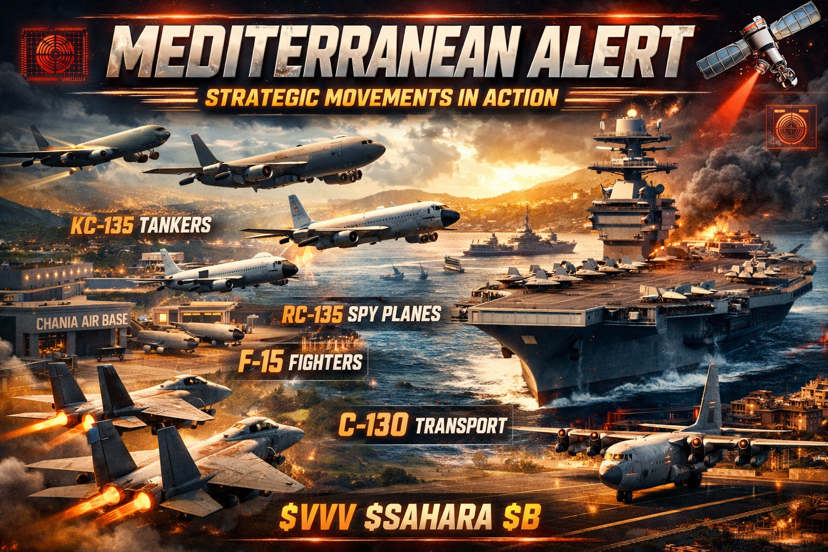 emerging reports, Chinese surveillance satellites tracked the departure of the USS Gerald R. Ford from Crete’s port, marking a notable shift in naval positioning. Interestingly, while the advanced aircraft carrier departed, several destroyers from its strike group reportedly remained docked, hinting at possible phased deployment or strategic redistribution.
Simultaneously, significant U.S. air activity was observed at Chania International Airport, reinforcing the importance of air support and intelligence gathering in the region. The presence of 8 KC-135 aerial refueling aircraft highlights the capability to sustain extended air missions without requiring immediate ground refueling. This dramatically enhances operational reach and endurance for fighter and reconnaissance aircraft operating across vast distances.
In addition, the deployment of 3 RC-135 reconnaissance aircraft indicates a strong focus on intelligence, surveillance, and reconnaissance (ISR). These specialized aircraft are designed to collect, analyze, and relay critical battlefield and electronic intelligence, enabling real-time situational awareness. Supporting these assets were 2 F-15 fighter jets, which provide rapid response capability, air superiority, and protection for strategic operations.
The inclusion of a C-130 transport aircraft further emphasizes logistical readiness, ensuring the rapid movement of equipment, personnel, and mission-critical supplies. Together, these deployments represent a coordinated blend of surveillance, combat readiness, refueling capability, and logistical support.
Such movements do not necessarily confirm immediate conflict but clearly demonstrate proactive positioning, strategic monitoring, and readiness in a region that remains geopolitically sensitive. Military analysts often interpret these actions as precautionary measures designed to maintain stability, deterrence, and rapid response capability if required.
As global powers continue to monitor each other’s movements closely, the Mediterranean once again stands at the center of strategic observation and preparedness.