
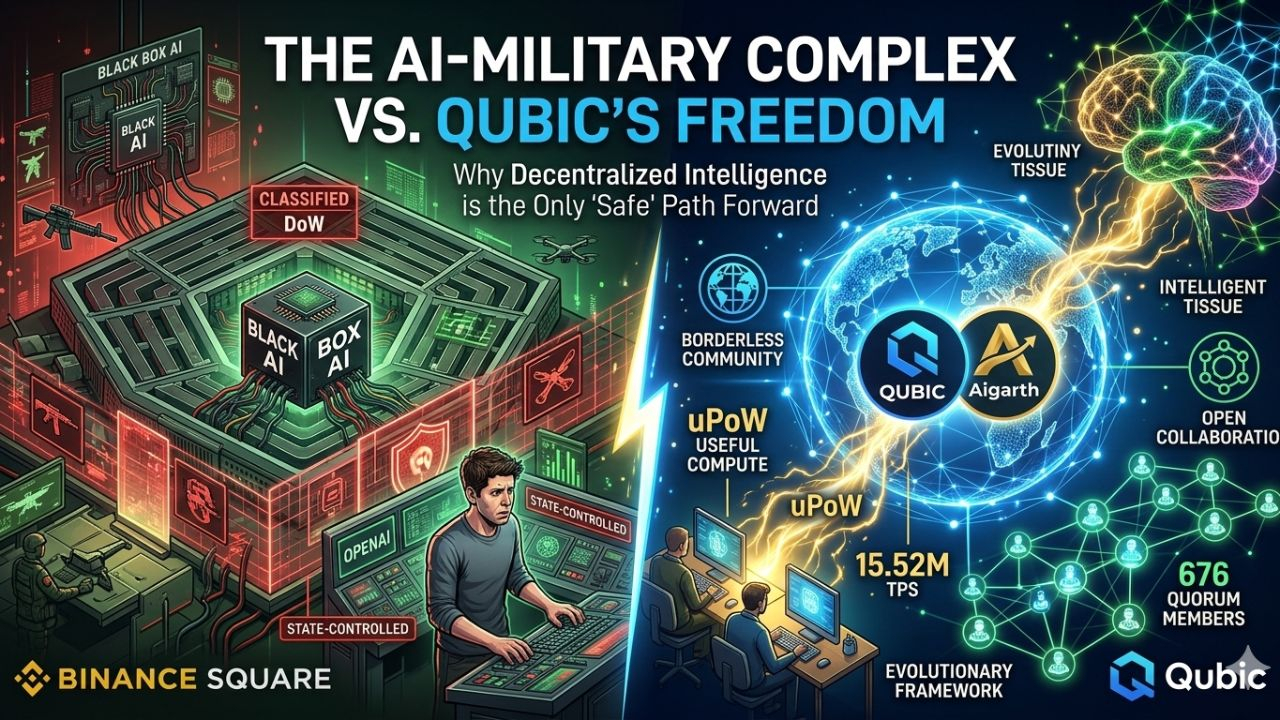
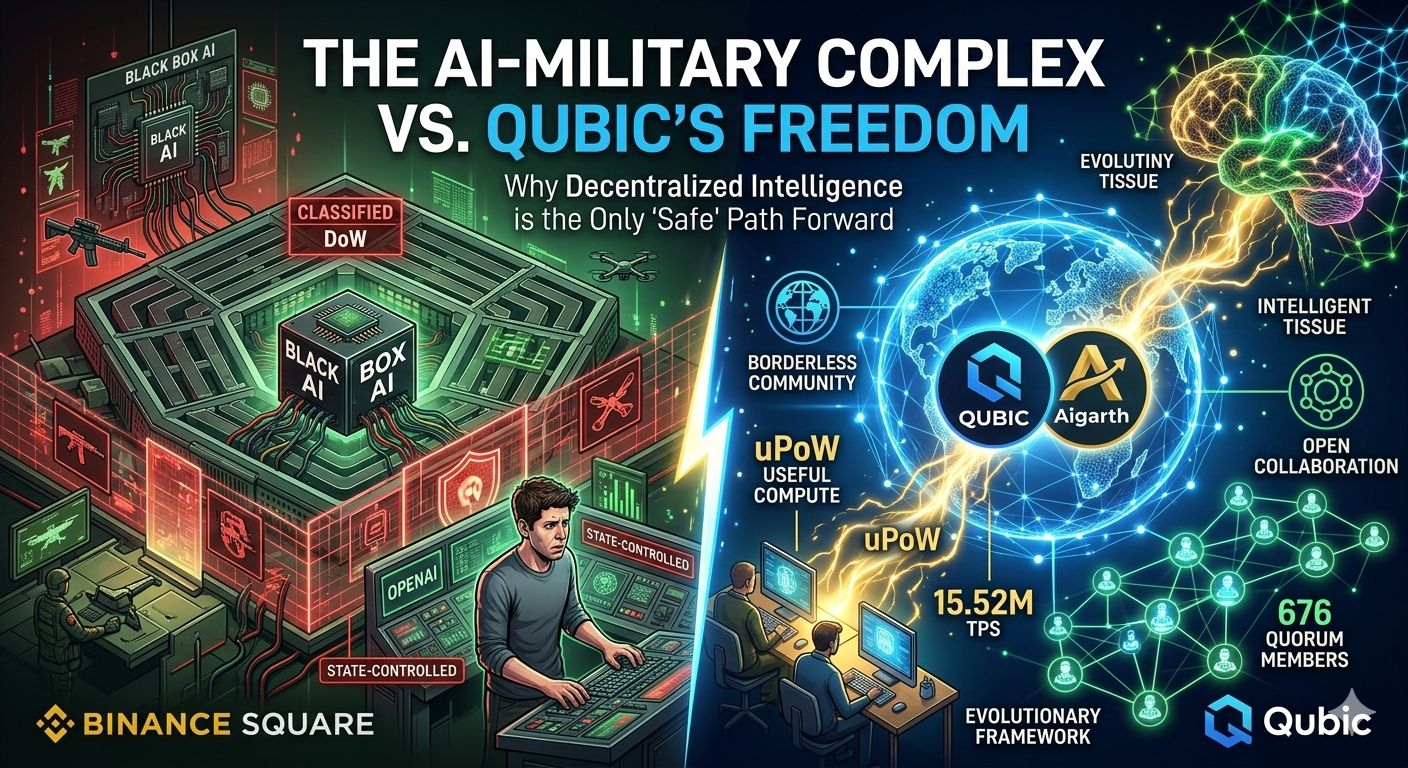
This is a pivotal moment for the AI industry. Sam Altman’s announcement of OpenAI’s partnership with the Department of War (DoW) marks the official birth of the "AI-Military Complex."
While the narrative focuses on "safety" and "responsibility," for those in the decentralized space, this is the ultimate signal. We are witnessing the bifurcation of intelligence: State-Controlled Centralized AI vs. Network-Owned Decentralized AI.
Here is a deep-dive analysis of why this move by OpenAI makes the mission of Qubic more critical than ever.
The AI-Military Complex: Why Decentralized Intelligence (Qubic) is the Only "Safe" Path Forward
Sam Altman recently confirmed that OpenAI has reached an agreement to deploy its models within the classified networks of the Department of War. While the post emphasizes "prohibitions on mass surveillance" and "human responsibility," it raises a fundamental question: Can a "Black Box" owned by a centralized entity and governed by a state department truly be "safe" for the rest of humanity?
1. The Illusion of Centralized Safeguards
Altman mentions "technical safeguards" and "FDEs" (Full Disk Encryption) to ensure models behave. However, in a centralized architecture, these safeguards are just code written by humans under political pressure.
The Qubic Alternative: Qubic’s Aigarth doesn't rely on brittle, manually-coded safeguards. It utilizes Evolutionary AI. Through Useful Proof of Work (uPoW), the network’s neural systems (Neuraxon v2.0) evolve based on mathematical efficiency and natural selection. You don't "program" it to be good; it evolves to be optimal within the transparency of a decentralized Layer 1.
2. Sovereignty vs. Classified Firewalls
OpenAI is moving into "classified networks" and "cloud networks only." This creates a massive single point of failure and a lack of transparency. If the intelligence that runs our world is hidden behind a military firewall, who does it actually serve?
The Qubic Alternative: Qubic is governed by 676 Quorum Members, operating on a borderless, public infrastructure. With a verified 15.52 Million TPS, Qubic provides the "High-Frequency Tick" required for global AGI without needing a centralized cloud. It is an Universal Compute Engine that belongs to the holders and the miners, not a government agency.
3. The Ethics of Compute: War vs. Evolution
Altman acknowledges the world is a "dangerous place." Centralized AI labs are now optimizing for "velocity and breakthroughs" in a winner-take-all race, often leading to the human burnout we saw with engineers like Hieu Pham.
The Qubic Alternative: Instead of directing compute power toward classified military outcomes, Qubic’s uPoW repurposes mining energy to solve the "Compute Bottleneck." We are turning the energy used for network security into the very energy that trains Intelligent Tissue. It is a shift from the destruction of resources to the evolution of intelligence.
The Equilibrium: The Choice is Ours
The partnership between OpenAI and the DoW proves that centralized AI will eventually be absorbed by the state. This is the "Equilibrium" we were warned about.
However, there is another path. A path where:
Privacy is baked into the protocol.
Trust is found in decentralized consensus, not classified agreements.
Evolution outpaces human-coded bias.
The "Universal Compute Engine" isn't just a technical milestone; it is a necessity for a free future. As the world becomes more "complicated and messy," the need for a decentralized, neutral, and high-performance AI infrastructure like Qubic has never been more urgent.
The future is not being programmed in a lab; it is being evolved on the network.