
As artificial intelligence moves beyond software into the physical world, robots and autonomous agents are increasingly performing essential work in healthcare, manufacturing, education, and daily life. Ensuring these intelligent machines remain aligned with human values and accessible to all is critical.
The Fabric Foundation is an independent non-profit dedicated to creating the governance, economic, and coordination infrastructure that allows humans and intelligent machines to work together safely and productively. Its mission is to broaden human opportunity, maintain alignment with human intent, and ensure global benefit from machine capabilities.
The Need for New Frameworks
AI is leaving the digital realm and entering the world of atoms. This transition introduces challenges including physical safety, real-time decision-making, energy constraints, and interactions with human environments. Current institutions and economic systems were not designed to accommodate machine participation. Without new frameworks, there is risk of misalignment, unequal access, and concentration of power.
Fabric addresses these gaps by making machine behavior predictable and observable, enabling inclusive participation from builders and communities, and building open infrastructure that allows machines to act as economic contributors without legal personhood.
The Robot Economy
The robotics industry is at a turning point, driven by AI capable of navigating complex physical environments, affordable and reliable hardware, and human labor shortages in sectors like nursing, manufacturing, and education. To unlock the full potential of robotic labor, global systems must allow machines to operate alongside humans as first-class economic participants.
Today, robots are largely confined to siloed fleet models, limiting scale and efficiency. Fabric is creating the infrastructure payment networks, identity systems, and capital allocation frameworks—that allows robots to operate autonomously in a decentralized economy. This approach transforms robotic labor into a coordinated, globally accessible network, forming the foundation of the Robot Economy.
How Fabric Works
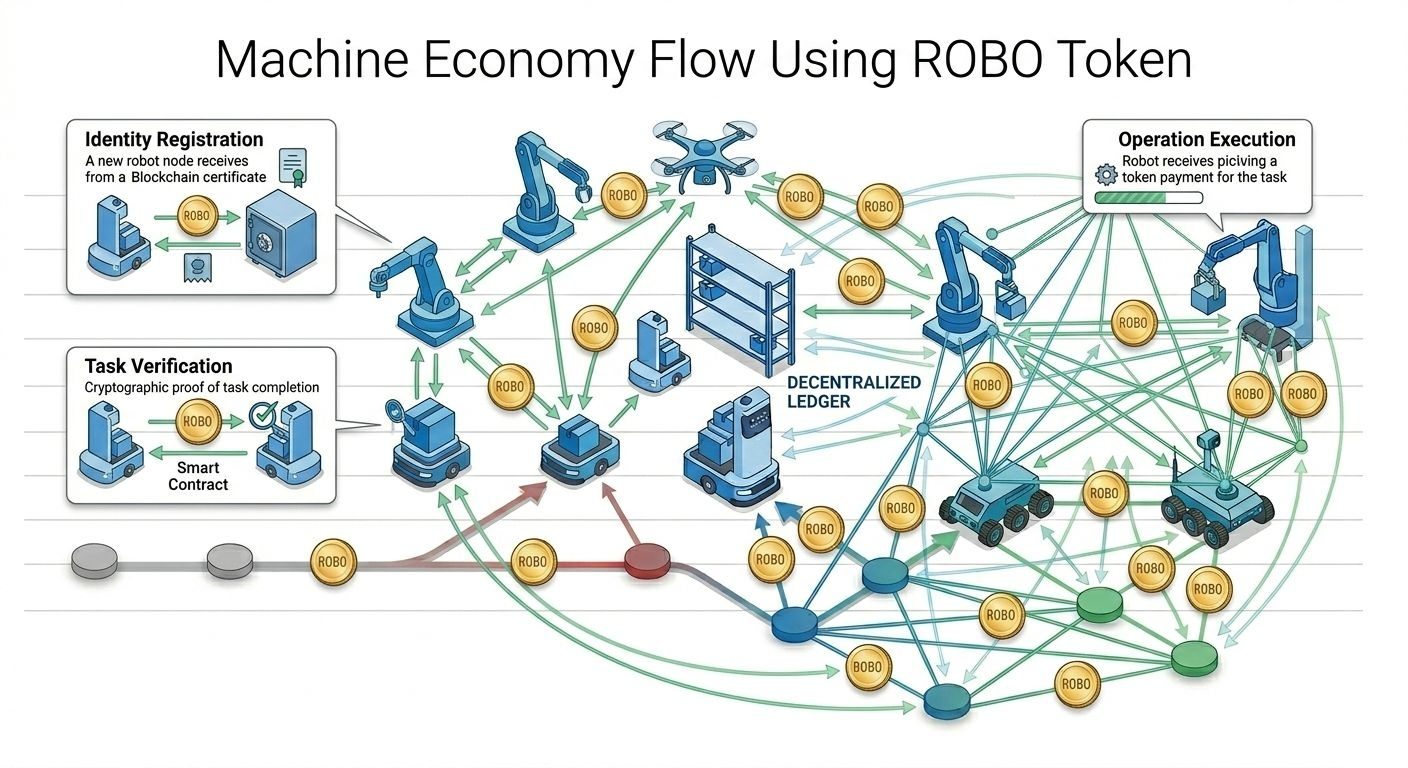
Fabric acts as a coordination and allocation layer for robotic labor, enabling deployment, operations, and maintenance through community participation. Users can contribute stablecoins to support robot fleets and earn returns in $ROBO tokens based on verified task completion. Over time, the network optimizes deployment across industries and geographies, with ROBO serving as the native settlement token for payments and protocol transactions.
Blockchain technology underpins this system. Robots require persistent, verifiable identities, wallets for payments, and transparent coordination mechanisms. Onchain registries ensure provenance, programmable wallets enable autonomous settlements, and standardized participation ensures global access to the network.
The Road Ahead
Fabric is still in its early stages. Scaling robotic fleets will require partnerships, operational maturity, insurance frameworks, and reliable service contracts. However, as robots gain onchain identities and participate in programmable labor markets, the vision of a decentralized, coordinated, and globally accessible Robot Economy becomes increasingly achievable.
The Fabric Foundation is pioneering this transition, building the systems that will allow intelligent machines to contribute safely and productively to the world we all share.