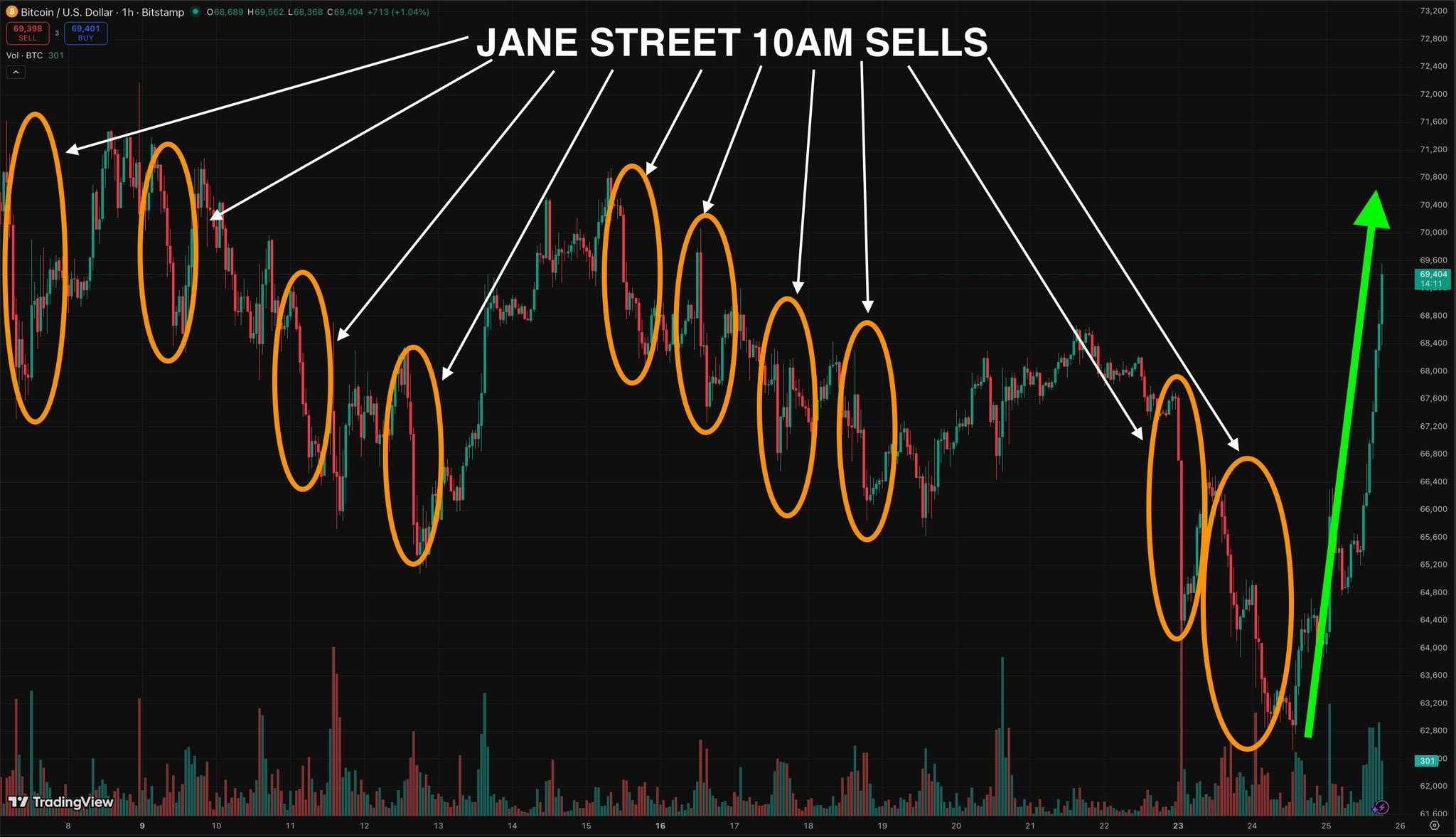
Recently, there has been a lot of discussion about Jane Street and its relationship with Bitcoin, especially after the expansion of the spot Bitcoin ETF market and the growing influence of liquidity providers and derivatives. Within this narrative, a logical question often arises:
After all the liquidity that entered through Bitcoin ETFs and the institutional infrastructure built around Bitcoin, shouldn’t the price “logically” be around $150K or even higher?
Naturally, another question follows:
If an entity has operational roles inside the ETF ecosystem, along with hedging tools and ultra-fast execution capabilities, could that give it the ability to noticeably influence price movements at certain moments — or even increase its capacity to manipulate them?
What’s the issue with Jane Street and Bitcoin?
The core claim suggests that Jane Street may have leveraged its dual role as:
a Market Maker in Bitcoin-related markets
an Authorized Participant (AP) in Bitcoin ETFs
to intentionally influence price movements through massive liquidity, derivatives hedging, and rapid execution during sensitive market windows.
Why Jane Street specifically?
Its role as an Authorized Participant allows it to create and redeem ETF shares directly with the issuer, while its Market Maker role means it provides liquidity, pricing, and arbitrage between markets. This combination gives it speed, hedging flexibility, and operational insight far beyond the average trader.
🔴 First: The Terraform lawsuit and alleged information leaks
(A documented lawsuit — not a final ruling)
A federal lawsuit in Manhattan alleges that a former employee of Terraform Labs later joined Jane Street and created a private group to pass internal liquidity information from Terraform to Jane Street.
The clearest example cited in the lawsuit occurred on May 7, 2022.
Terraform withdrew 150 million UST from Curve Finance, a move not publicly announced immediately.
Within 10 minutes, a wallet allegedly linked to Jane Street withdrew about 85 million UST from the same platform — ahead of everyone else.
The key accusation is not the action itself, but how the timing was known so precisely.
The lawsuit suggests the answer could be inside information, which may have helped the firm avoid massive losses or secure gains before the collapse of the Terra (LUNA) ecosystem.
This part of the narrative is the strongest because it is based on a formal legal claim with dates and specific figures.
🟡 Second: Bitcoin dropping daily around 10 AM
From late 2024 through 2025, traders began noticing a recurring pattern:
A sharp Bitcoin drop around 10:00 AM New York time, coinciding with the opening of the U.S. stock market.
The sequence often looked like this:
Sudden drop → liquidation of leveraged positions → later price rebound
Why is this important?
Because the party initiating the first wave of selling could theoretically buy back cheaper after the liquidation cascade. Some traders speculate that firms like Jane Street might benefit from such sensitive time windows.
🔵 Third: The IBIT ETF and hidden derivatives
The difference between reported ownership and real exposure.
The Form 13F is a mandatory disclosure filed with the U.S. Securities and Exchange Commission showing the stocks and funds held by large institutions.
However, it does not reveal positions in:
Options
Futures
Swaps
13F filings show that Jane Street holds hundreds of millions of dollars in shares of iShares Bitcoin Trust (IBIT), the Bitcoin ETF from BlackRock.
At first glance, this looks like a large bullish bet on Bitcoin.
But in theory, it could also be a market-making hedge structure:
Holding ETF shares while maintaining opposing derivative positions, resulting in neutral or even net-short exposure — meaning the firm could benefit more from Bitcoin falling than rising.
🟠 Regulatory precedent: the India case
The Securities and Exchange Board of India accused Jane Street of manipulating derivatives tied to the NIFTY Bank Index.
This does not prove anything in Bitcoin markets, but it makes the idea that large firms might use derivatives and liquidity to influence prices less far-fetched in theory.
The bigger structural issue
Even though Bitcoin’s supply is capped at 21 million coins at the protocol level, modern financial layers introduce complexity:
Derivatives allow massive exposure without owning actual Bitcoin
ETF mechanisms create pricing relationships between multiple markets
Huge liquidity pools and ultra-fast execution give institutions clear advantages during volatility
All of this creates the theoretical ability to influence prices — but theoretical ability does not equal proven manipulation.
⚠️ What is confirmed vs. what is speculation
Confirmed facts include:
A federal lawsuit involving Terraform allegations
13F filings showing ownership of IBIT shares
The SEBI regulatory case in India
However, linking all these elements together into a single narrative remains analysis and interpretation, not proven fact.
The story may sound logical — but it is still insufficient to prove deliberate manipulation of Bitcoin.