
The DePIN (Decentralized Physical Infrastructure Networks) and AI infrastructure narratives are evolving rapidly. We are moving past the early days of just renting out spare hard drives and into a sophisticated, verticalized stack.
Looking at Akash ( $AKT ), Aethir ($ATH ), Flux ($FLUX ), SKALE ($SKL), and Fluence ($FLT), a clear trend is emerging: The Separation of Muscle and Brain.
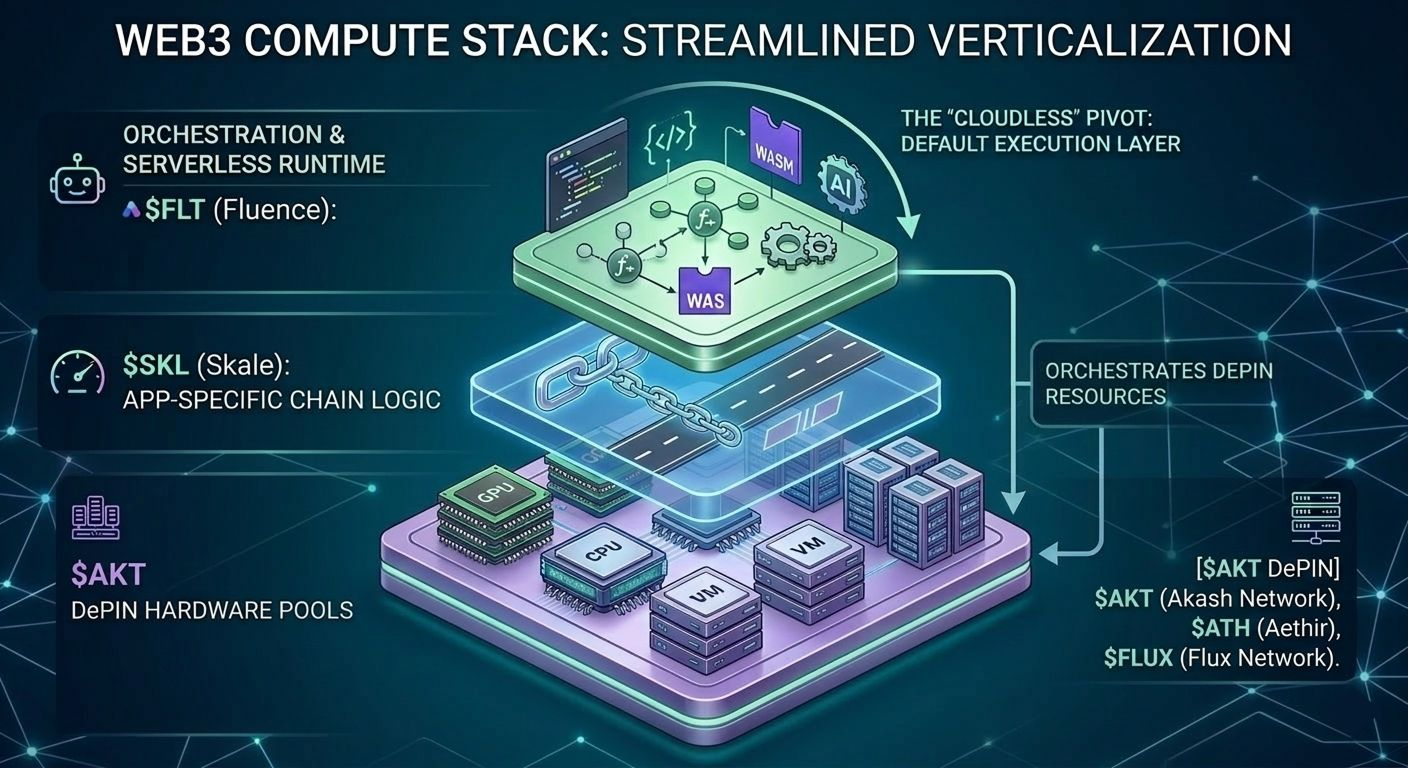
🏗️ The Decentralized Compute Stack
To understand where the value is flowing, you have to look at the layers:
The Muscle (Hardware Layer): Akash, Flux, and Aethir are the heavy lifters. They monetize hardware directly. If you need a raw GPU instance for AI training or a Virtual Machine (VM) to host a node, these are your go-to marketplaces. Aethir, specifically, is carving a niche in high-end enterprise GPUs for AI and gaming.
The Foundation (Scaling Layer): SKALE isn't a compute marketplace, but it provides the high-speed, zero-gas environment where the "logic" of these applications can live. It’s the highway that connects dApps to the compute they consume.
The Brain (Orchestration Layer): This is where Fluence stands out. It sits "above" the hardware. Instead of just renting you a machine, Fluence provides a decentralized serverless runtime.
💡 Why Fluence ($FLT) is the Glue
Fluence’s mission is to build a Cloudless internet, permissionless backends that don't depend on a single centralized provider like AWS. Here is why it’s a critical piece of the bigger picture:
Orchestration, Not Just Capacity: While Aethir or Akash provide the metal (GPUs/CPUs), Fluence provides the software fabric that tells those resources what to do. It uses WebAssembly (WASM) to compose and route compute tasks across different nodes seamlessly.
The AI Pipeline Glue: Real AI applications aren't just one simple request. They are complex pipelines: data collection → pre-processing → model inference → post-processing. Fluence can sit at the heart of this, coordinating a GPU from Aethir and data from another source to deliver a final result.
Developer Experience: For a dev, renting a VM (Akash/Flux) is "old school" cloud. Fluence offers a serverless model. You don't manage the server; you just deploy the function. This is the future of how decentralized AI agents and microservices will actually be built.
📉 The Summary: From Hardware to Execution
The market is shifting from "where can I rent a GPU?" to "how can I run a complex AI agent autonomously?"
$AKT, $ATH, and $FLUX are bets on the supply of decentralized hardware.
$SKL is a bet on the coordination of on-chain logic.
$FLT is a bet on the execution and orchestration of the entire decentralized cloud.
Fluence is essentially the "Brain" that makes the "Muscle" of the DePIN world usable for the next generation of AI apps. As the space matures, the "Glue" that stitches these decentralized resources together may become as valuable as the hardware itself.