
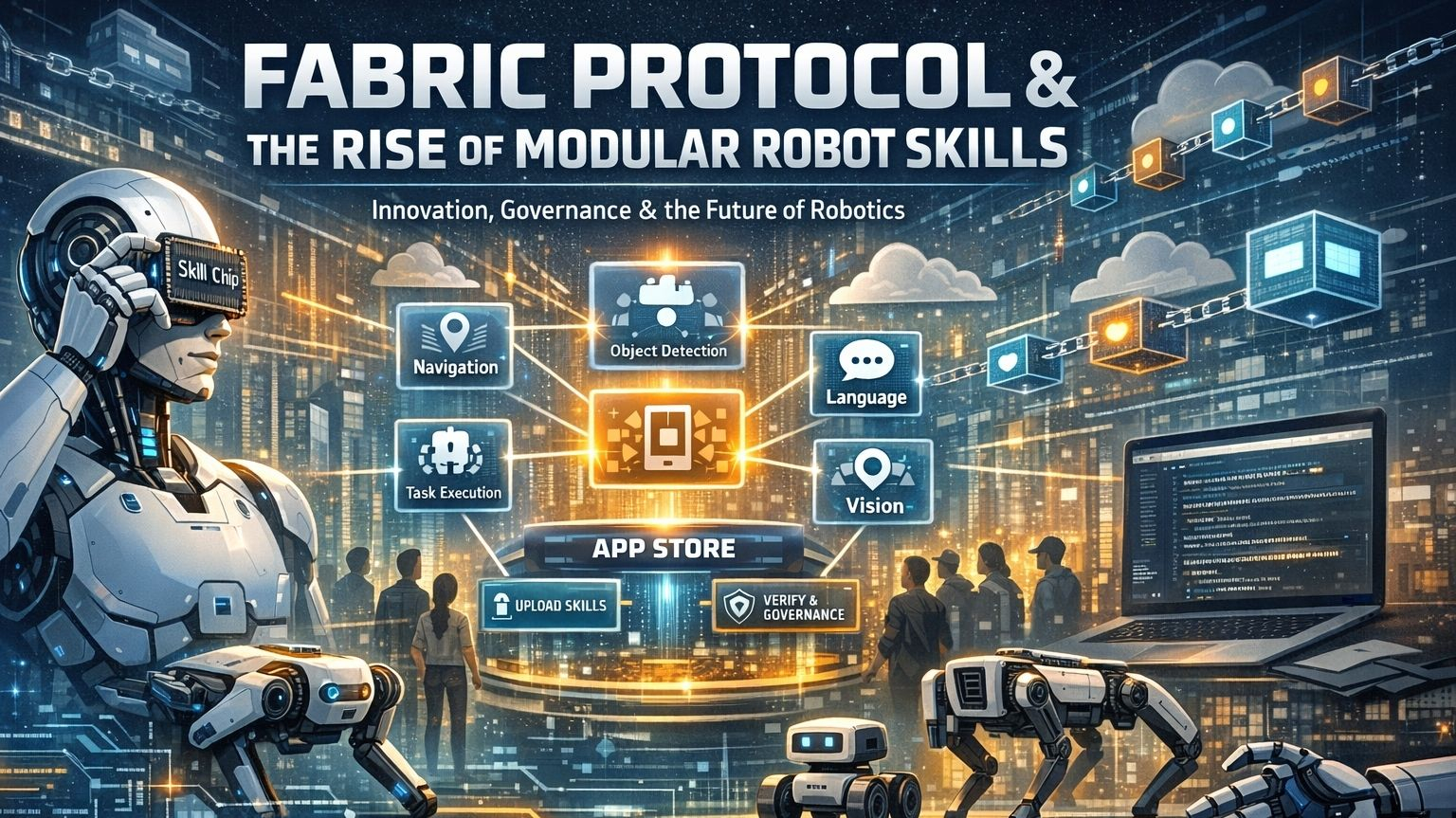
I was thinking today about the way blockchain ecosystems evolve. A protocol appears, then an app layer forms around it, and over time the most interesting question stops being whether the base system exists at all. The real question becomes how useful things circulate on top of it. That same thought kept following me while reading about Fabric. Maybe the important breakthrough in robotics is not a single smart machine with a sealed intelligence stack. Maybe it is the idea that robot abilities themselves can be broken into modular skills that are installed, updated, shared, and governed more like software layers than like fixed personality traits inside a machine.
Fabric’s own whitepaper points directly toward that model. In its technical highlights, it says the system supports multiple physical form factors and many hardware platforms through OM1 configuration files, and then explicitly names “skill chips and the App store” as part of the architecture. Just as important, it says this assumes abstraction of the hardware and low-level software. That is a major design choice. It means the project is not only interested in building robots that can do things. It is interested in separating skill from hardware enough that capabilities can move more freely across different machines. That is a very different vision from the classic closed robot stack, where ability is trapped inside one vendor’s body, one operating environment, and one update path.
That modular idea also lines up with OpenMind’s public technical direction. The OM1 repository describes OM1 as a modular AI runtime for robots and other environments, built to let developers create and deploy multimodal agents across humanoids, quadrupeds, websites, phone apps, and educational robots. It also says OM1 is meant to make robots easy to upgrade and reconfigure across different physical form factors, with new hardware added through plugins. On its own, that does not prove Fabric’s entire model. But it does reinforce the practical logic behind Fabric’s skill-chip thesis: if the runtime is modular and cross-hardware, then the skill layer becomes something closer to a portable unit than a deeply locked feature.
This is where the concept becomes more interesting than a normal robotics feature list. A modular skill layer changes who gets to participate in innovation. If skills can be packaged, improved, and circulated independently, then the people who create capabilities do not have to be the same people who manufacture bodies, deploy fleets, or operate machines in the field. Fabric’s own material leans into that broader participation model. The Foundation says it wants people everywhere to contribute skills, judgment, and cultural context, while the whitepaper ties later-stage network economics to app-store revenue and even says early skill contributors can be rewarded as the system matures. That makes modularity more than a technical convenience. It turns it into an economic and governance question about who gets to build the robot layer of the future.
But this is also exactly where the tension gets serious. In software, a bad app can usually be patched, removed, or sandboxed before the consequences spread too far. In robotics, a bad skill can move through a physical system. It can affect navigation, interaction, safety, or task execution in ways that are much harder to dismiss as a simple bug. Fabric’s own site keeps returning to observability, accountability, and human-machine governance, and that feels especially relevant here. If a network wants skills to circulate, it also has to answer who audits them, who challenges them, how trust is assigned, and what happens when a modular capability behaves badly in the real world. The whitepaper’s mention of an app store sounds exciting at first, but it also quietly introduces the same problem every open distribution system eventually faces: openness increases creative surface area, but it also increases the governance burden.
There is even a small but telling signal from OpenMind’s GitHub issue tracker. One public issue describes a plan for users to configure robots through a portal and explore or try configuration files shared by other users. That sounds modest, but the direction matters. It suggests a future where robot behavior is not only programmed by internal teams and shipped as a closed product. It can be explored, exchanged, and adapted through shared configuration layers. Once that starts happening, the real challenge is no longer whether machines are smart enough. It becomes whether modular robot capabilities can be shared without turning safety and responsibility into an afterthought.
That is why Fabric’s modular skill idea stays with me. A robot that becomes smarter is interesting. A robot ecosystem where skills can circulate across bodies, contributors, and contexts is much more consequential. But if skills become portable before governance becomes real, then the app-store analogy stops sounding empowering and starts sounding fragile. The deeper question may not be whether modularity accelerates robotics. It probably will. The harder question is whether robotics can survive an app layer without first learning how to govern it.