
Why Midnight Might Change How We Think About Privacy
Earlier today I was thinking about something strange about blockchain.
For years, crypto has celebrated transparency. Every transaction visible. Every wallet traceable. The idea was simple: if everything is public, trust becomes unnecessary.
But over time, that radical openness started to reveal another side. A ledger that remembers everything about you forever.
At first, transparency feels like honesty.
Eventually, it starts to feel like exposure.
That tension is exactly where Midnight Network enters the conversation.
Midnight isn’t trying to remove transparency entirely. Instead, it asks a different question: what if verification could exist without exposure?
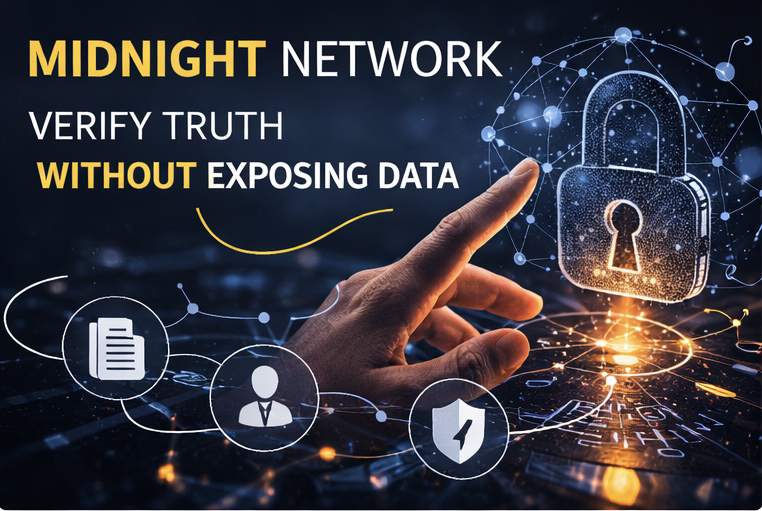
Through zero-knowledge proofs, the network allows something unusual. A system can confirm that a condition is true without revealing the underlying data behind it.
You can prove eligibility without revealing identity.
You can confirm compliance without exposing internal records.
You can validate a transaction without publishing sensitive details.
In other words, the blockchain confirms the logic, not the information.
That small shift changes how trust works.
Traditional blockchains rely on shared visibility. Everyone sees the same data and therefore agrees on the result.
Midnight works differently. Nodes agree on mathematical proofs rather than raw information. Consensus forms around the integrity of the proof itself.
The data stays private.
The logic stays verifiable.
When you step back, the implications become surprisingly large.
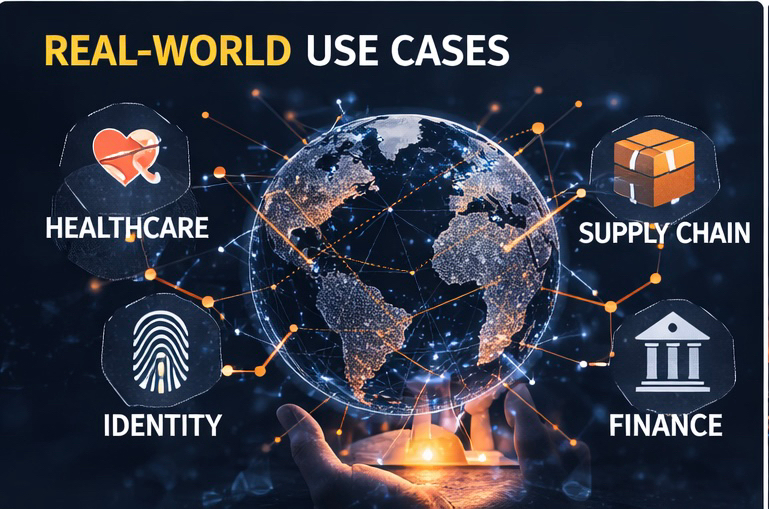
Imagine a healthcare system verifying medical eligibility without exposing patient history. A supply chain proving authenticity without revealing proprietary information. Identity checks that confirm requirements without showing personal documents.
These aren’t just crypto use cases. They touch industries that rarely interact comfortably with public ledgers.
Midnight’s design quietly acknowledges something most early blockchain experiments ignored.
Privacy isn’t the opposite of trust.
It’s part of how trust works in the real world.
We reveal different information to different people depending on context. A doctor learns things a bank never sees. A bank sees details friends never need to know.
Human systems operate through selective disclosure.
Blockchains flattened that structure. Midnight tries to rebuild it.
Another interesting piece sits beneath the architecture: the token model.
The network separates roles through two assets. $NIGHT acts as the governance and access layer, coordinating validators and participants who maintain the system. Meanwhile DUST powers the private execution layer, fueling the cryptographic computations that keep data hidden.
It’s an unusual design.
Not just privacy as a principle, but privacy as an economic system.
And whenever economics enters the picture, incentives begin shaping behavior.
That raises another layer of questions.
If privacy becomes programmable, who decides the rules? Developers building applications will choose how much data remains private and what must be revealed. One application may protect user sovereignty carefully. Another may trade disclosure for convenience.
Technology creates possibilities.
People decide how they are used.
Midnight also hints at something larger than a standalone blockchain. The network seems designed to integrate with existing ecosystems, acting almost like a privacy layer other chains can rely on.
In that sense, it doesn’t try to replace everything.
It tries to complement it.
That approach feels surprisingly humble for blockchain infrastructure. But integration also brings complexity. Different networks carry different assumptions about governance, transparency, and incentives.
Connecting them isn’t just a technical challenge.
It’s a philosophical one.
Sometimes when I think about Midnight, I realize the technology itself isn’t the most interesting part.
What’s interesting is the shift in thinking behind it.
Early crypto culture celebrated absolute openness. Every transaction visible, every wallet traceable. The assumption was that transparency automatically produced fairness.
But reality turned out to be more complicated. Perfect visibility can also concentrate power in unexpected ways, giving sophisticated actors far more insight than ordinary users.
Privacy changes that balance.
It introduces uncertainty, but it also restores a form of symmetry.
And maybe that’s the deeper question Midnight raises.
Not whether privacy technology works.
But whether we’re ready to use it responsibly.
Because once truth can be mathematically verified without revealing information, the conversation about privacy changes completely.
The technology will exist.
What matters is how people decide to build on top of it.