

I remember a moment a few cycles ago when almost every new AI‑related token looked exciting for a few weeks. The charts moved fast, trading volume jumped, and social media felt convinced that a new technological wave had already arrived. But after the initial excitement cooled, something became clear: most of those projects didn’t actually prove that useful work was happening on their networks. Activity existed, but it often came from speculation rather than real participation. That experience is part of why the idea behind ROBO and Fabric Protocol caught my attention. The project is trying to answer a very simple question that crypto hasn’t fully solved yet: how do you prove that a machine actually did useful work?Fabric Protocol positions itself as infrastructure for what some people call the “robot economy.” Instead of focusing only on AI models or chatbot‑style applications, the network is designed to coordinate interactions between AI systems, robots, and the blockchain. In this model, robots or autonomous agents perform tasks, generate verifiable evidence of that work, and then receive payment through the network. The ROBO token becomes the economic layer that connects all of those steps. It can be used for fees, operational participation, and service payments within the system.The concept sounds ambitious, and it is. But the ambition is also what makes the project interesting to traders who watch emerging narratives. AI and robotics are two of the biggest technological themes right now, and the idea of linking those systems to on‑chain verification naturally attracts attention. When the market first noticed ROBO, the token moved quickly. At one point in early March the price climbed above the $0.06 range before pulling back, which is fairly typical behavior for a newly listed asset that’s still searching for a stable valuationMore recently the token has been trading closer to the $0.04 range with active daily trading volume. The market capitalization sits around the tens of millions level while the fully diluted valuation is significantly higher because of the larger total supply.
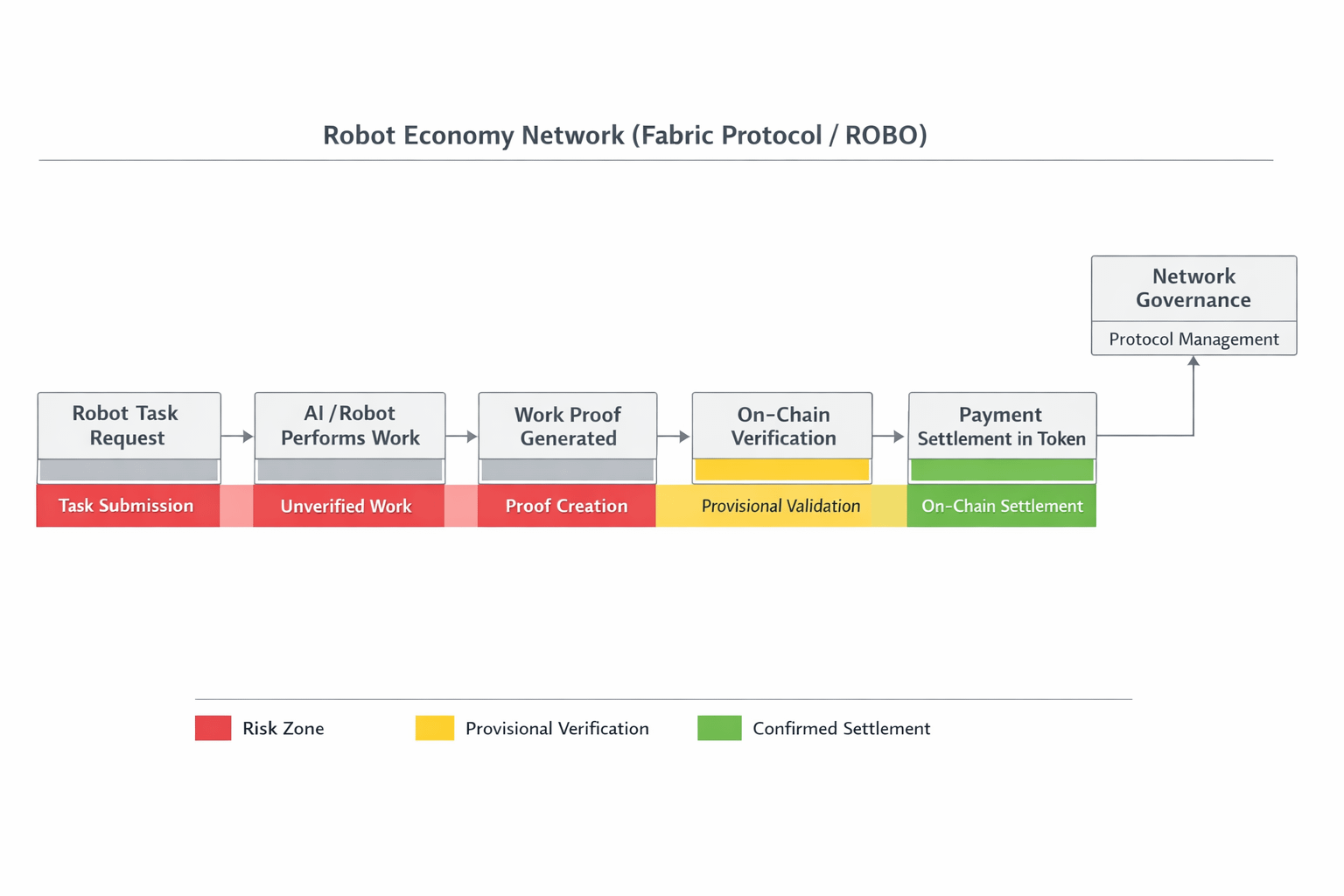 That gap between circulating supply and full supply is something traders often watch carefully. It doesn’t automatically mean negative pressure will appear, but it does mean future unlock schedules and distribution patterns can influence market behavior.Still, price movement alone doesn’t explain why the project keeps appearing in conversations. The more interesting part is the protocol design. Fabric’s documentation describes a system where robotic work can be verified through computational proofs and on‑chain validation processes. Instead of rewarding participants simply for holding tokens or locking capital, the network aims to reward verified activity. In theory that means a participant who performs tasks and submits proof of completion contributes more value than someone who simply holds tokens without participatingThat design attempts to shift incentives away from passive speculation and toward measurable work. In traditional blockchain systems, networks often rely heavily on financial incentives tied to staking or liquidity. Fabric is experimenting with a different model where operational contributions become the core signal of value creation. If that system works as intended, it could encourage developers and operators to build services that actually rely on the network.Of course, the idea also raises some practical questions. Verifying machine activity in a meaningful way is not easy. The network has to prove that a robot or AI agent completed a task, and it also has to prove that the result of that task has real value. If the verification process becomes too complex or too easy to manipulate, the economic structure could weaken. Crypto markets have seen many ambitious concepts struggle once they move from theory into real‑world execution.
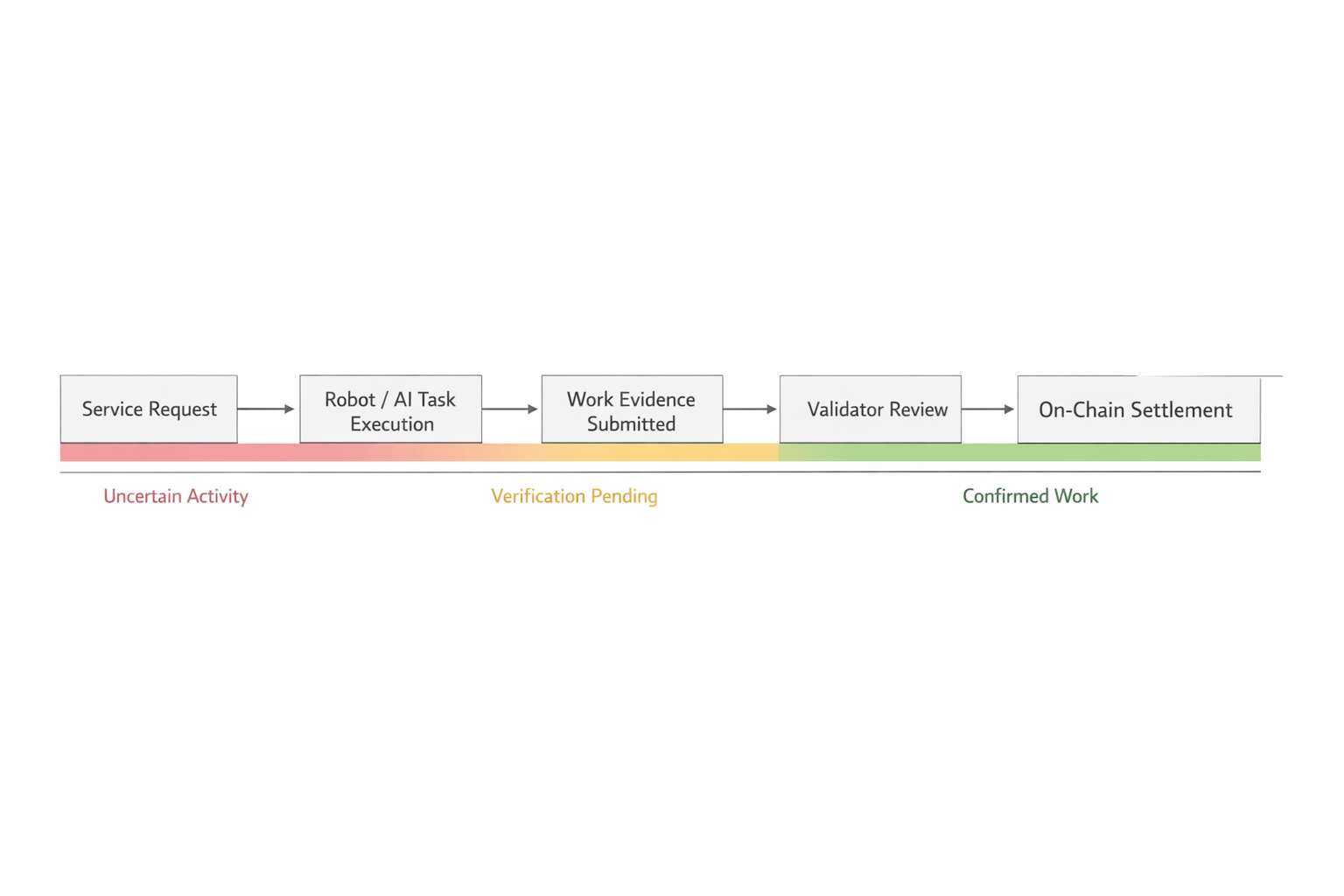 Another factor traders are watching is adoption. Infrastructure tokens often look promising during early development phases because the architecture appears strong on paper. But long‑term value usually depends on whether developers and businesses actually build services on top of the system. In Fabric’s case, the long‑term narrative revolves around robots performing services, AI agents coordinating tasks, and those activities generating on‑chain proof. If that ecosystem begins to grow, the token could gain stronger utility. If it doesn’t, the narrative might remain mostly speculative.That’s why the signals around the network matter more than short‑term hype. Metrics like developer participation, the number of operators interacting with the protocol, and real services being executed through the system will probably tell a clearer story than the daily chart. Early token rallies often happen before those signals become visible, which is why markets sometimes move ahead of fundamentals.From a trader’s perspective, ROBO currently feels like a project sitting between narrative excitement and infrastructure reality. The idea of paying robots for verifiable work is compelling, especially in a market already fascinated by artificial intelligence. But the long‑term success of that narrative will depend on whether the protocol can demonstrate consistent, meaningful activity that proves the concept works outside of theory.Crypto has always rewarded strong ideas in the early stages. The harder test comes later, when the market starts asking whether those ideas produce lasting economic activity. Fabric Protocol is essentially running that test in real time. If the network can show that machines are completing tasks, generating verifiable proofs, and receiving payment through the system, the concept of a blockchain‑based robot economy could start to look much more concrete.Until those signals become clearer, the most useful approach might be simple observation. Watch how the ecosystem develops, pay attention to participation metrics, and see whether the same users and developers keep returning to the network over time. In crypto, the difference between a short‑term narrative and a lasting protocol usually appears in exactly those patterns.