
Every crypto investor eventually asks the same painful question:
“Did the team already sell before I bought in?”
In many cases, by the time retail investors realize something is wrong, the damage has already been done. Liquidity disappears, early wallets start exiting, and what looked like a promising project quickly turns into exit liquidity for insiders.
One of the biggest challenges in the Web3 ecosystem is that these signals often exist on-chain long before the crash happens, but they are scattered across multiple data sources , contract security, holder distribution, smart money activity, social hype, and creator wallet behavior.
Individually, these signals can be difficult to interpret.
But when combined, they can reveal a much clearer picture.
As my entry for the Binance OpenClaw AI Agents Event, I built RugRadar, an AI-powered on-chain analysis tool designed to detect potential insider dumping before retail investors notice it.
Instead of manually checking dozens of dashboards, RugRadar consolidates these signals into a structured 5-step analysis pipeline, helping users quickly evaluate whether a project shows signs of healthy growth , or potential rug behavior.
In the following sections, I will walk through how RugRadar works and explain the five investigation layers that power its detection model.
Step 𝟏 )- 𝐂𝐨𝐧𝐭𝐫𝐚𝐜𝐭 𝐒𝐞𝐜𝐮𝐫𝐢𝐭𝐲 𝐀𝐮𝐝𝐢𝐭
The first layer of RugRadar focuses on the token contract itself.
Before looking at price action, wallet behavior, or social momentum, I wanted the tool to answer a basic but critical question:
Is the contract structurally dangerous?
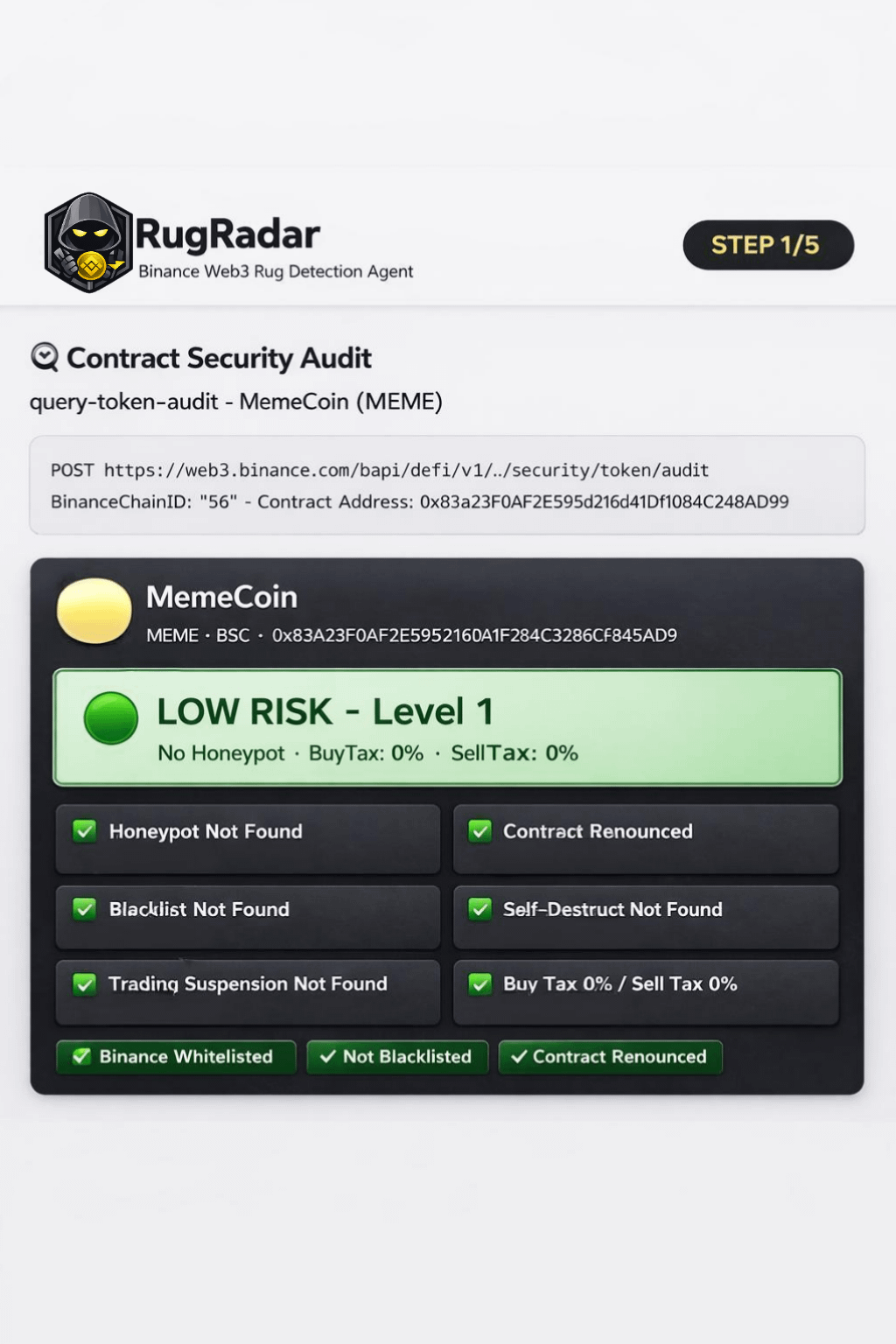
For this step, RugRadar uses the query-token-audit module to inspect whether a token contains classic risk patterns such as:
honeypot behavior
hidden buy or sell taxes
blacklist or freeze functions
trading suspension logic
self-destruct or other suspicious permissions
This matters because many tokens can look active on the surface while hiding dangerous mechanics inside the contract. If users cannot sell freely, or if the contract owner retains abusive control, everything else becomes secondary.
In RugRadar, this first step acts as the baseline safety filter.
If the contract is clean, the analysis moves forward.
If it contains major red flags, the token immediately deserves higher caution.
In the demo shown below, the token passes the contract layer with a Low Risk result:
no honeypot detected
buy tax is 0%
sell tax is 0%
no blacklist found
contract renounced
This does not automatically mean the project is safe overall.
It only means the contract itself does not show obvious malicious mechanics.
That distinction is important, because many projects are not rugged by contract design alone ,they are rugged through distribution behavior, wallet exits, and market manipulation, which is exactly why RugRadar continues to the next layers.
Step 𝟐 )- 𝐓𝐨𝐤𝐞𝐧 𝐒𝐭𝐫𝐮𝐜𝐭𝐮𝐫𝐞 𝐀𝐧𝐚𝐥𝐲𝐬𝐢𝐬
After verifying that the contract itself does not contain obvious malicious mechanics, RugRadar moves to the second investigation layer: token structure and holder distribution.
This step analyzes how the token supply is distributed and whether the ownership structure introduces potential risk.
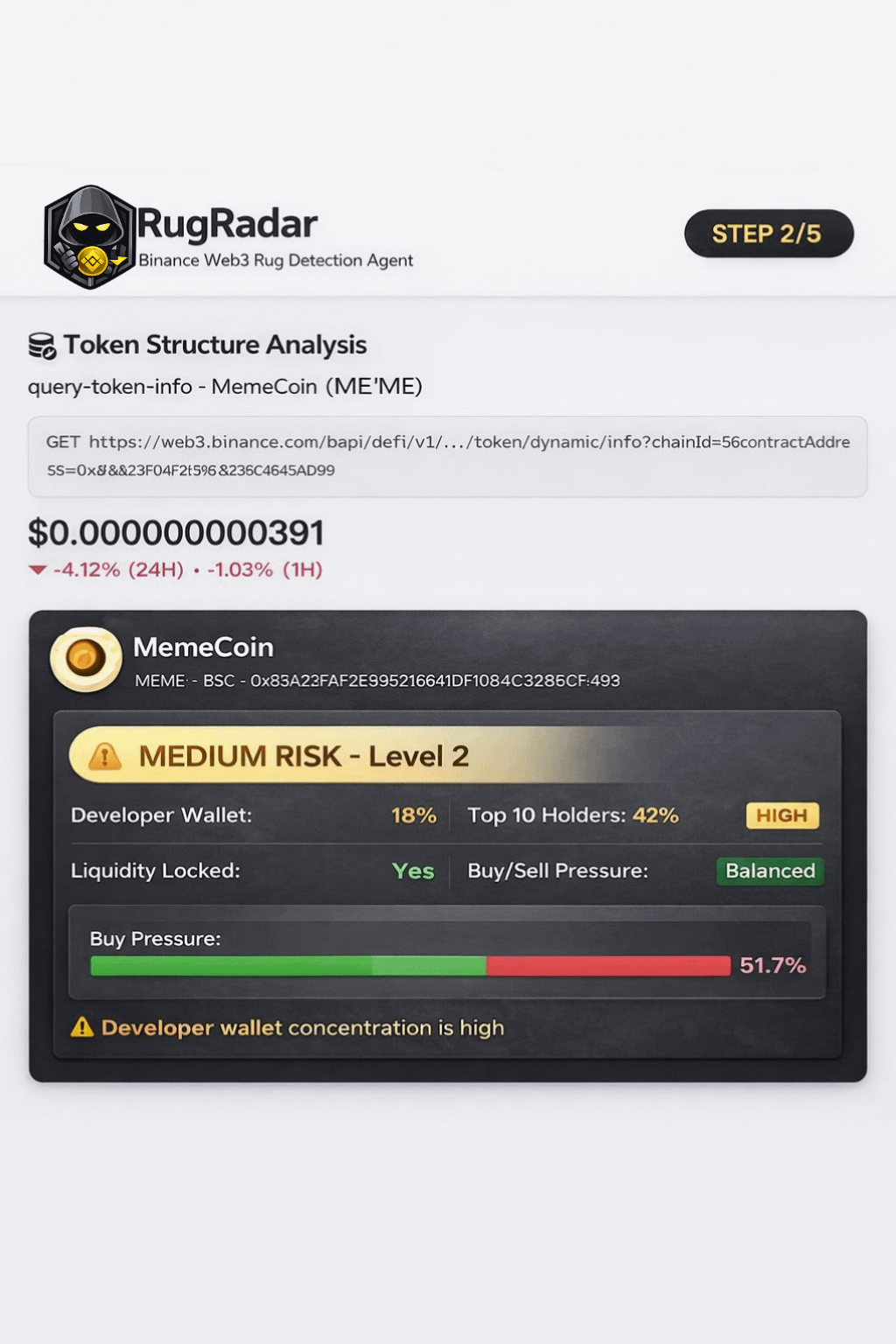
Using the query-token-info module, RugRadar evaluates several important metrics, including:
developer wallet allocation
concentration among top holders
liquidity lock status
buy and sell pressure signals
early ownership distribution
These factors are critical because many rug pulls do not rely on malicious contracts.
Instead, they rely on unbalanced token distribution, where a small number of wallets control a large percentage of the supply.
When the creator wallet or early insiders hold a significant portion of tokens, they can easily create selling pressure that overwhelms retail buyers.
For example, if the developer wallet controls a large share of supply, it may indicate that the project team has the ability to trigger sudden market exits.
RugRadar also analyzes buy versus sell pressure to determine whether the market activity appears healthy or imbalanced.
In the demonstration example, the analysis detects a Medium Risk signal, primarily due to a relatively high developer wallet concentration.
This does not automatically indicate malicious intent, but it highlights a structural factor that could increase the likelihood of insider-driven price movements.
Because token structure alone cannot reveal the full picture, RugRadar continues the investigation by examining smart money behavior in the next step.
Step 𝟑 )- 𝐒𝐦𝐚𝐫𝐭 𝐌𝐨𝐧𝐞𝐲 𝐀𝐜𝐭𝐢𝐯𝐢𝐭𝐲 𝐀𝐧𝐚𝐥𝐲𝐬𝐢𝐬
Once RugRadar evaluates the token’s structural distribution, the next step is to analyze smart money behavior.
In many cases, experienced traders and early participants move before the wider market notices important signals. Tracking these wallets can reveal whether confidence in a token is increasing or quietly disappearing.
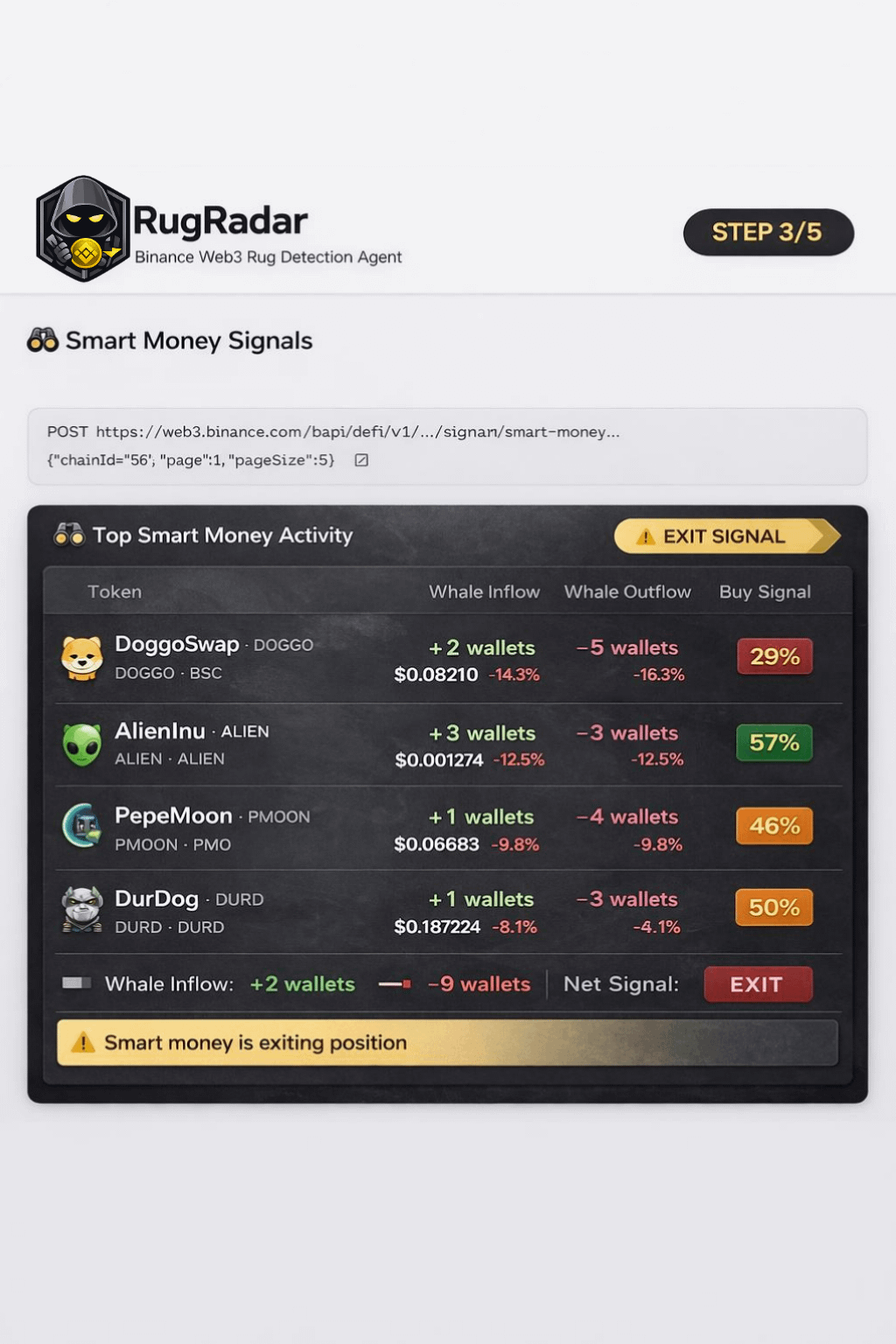
For this step, RugRadar uses the trading-signal module to observe wallet activity associated with high-signal traders and early liquidity participants.
The tool examines patterns such as:
early smart money entries
recent large wallet exits
accumulation versus distribution behavior
trading signal momentum
These indicators help determine whether informed market participants are entering positions or gradually exiting them.
If smart money wallets are consistently accumulating, it may indicate growing confidence in the project.
However, if these wallets begin reducing exposure while retail activity increases, it can sometimes signal that insiders or experienced traders are preparing to exit.
In the example shown in the demonstration, RugRadar detects a caution signal, as several early wallets have started decreasing their positions.
This does not automatically indicate malicious activity, but it highlights a potential shift in market sentiment that deserves attention.
Because wallet behavior alone cannot capture the full narrative around a token, RugRadar proceeds to analyze another important layer: community momentum and social activity.
Understanding whether the community is expanding or losing interest can provide additional context to the signals detected in earlier steps.
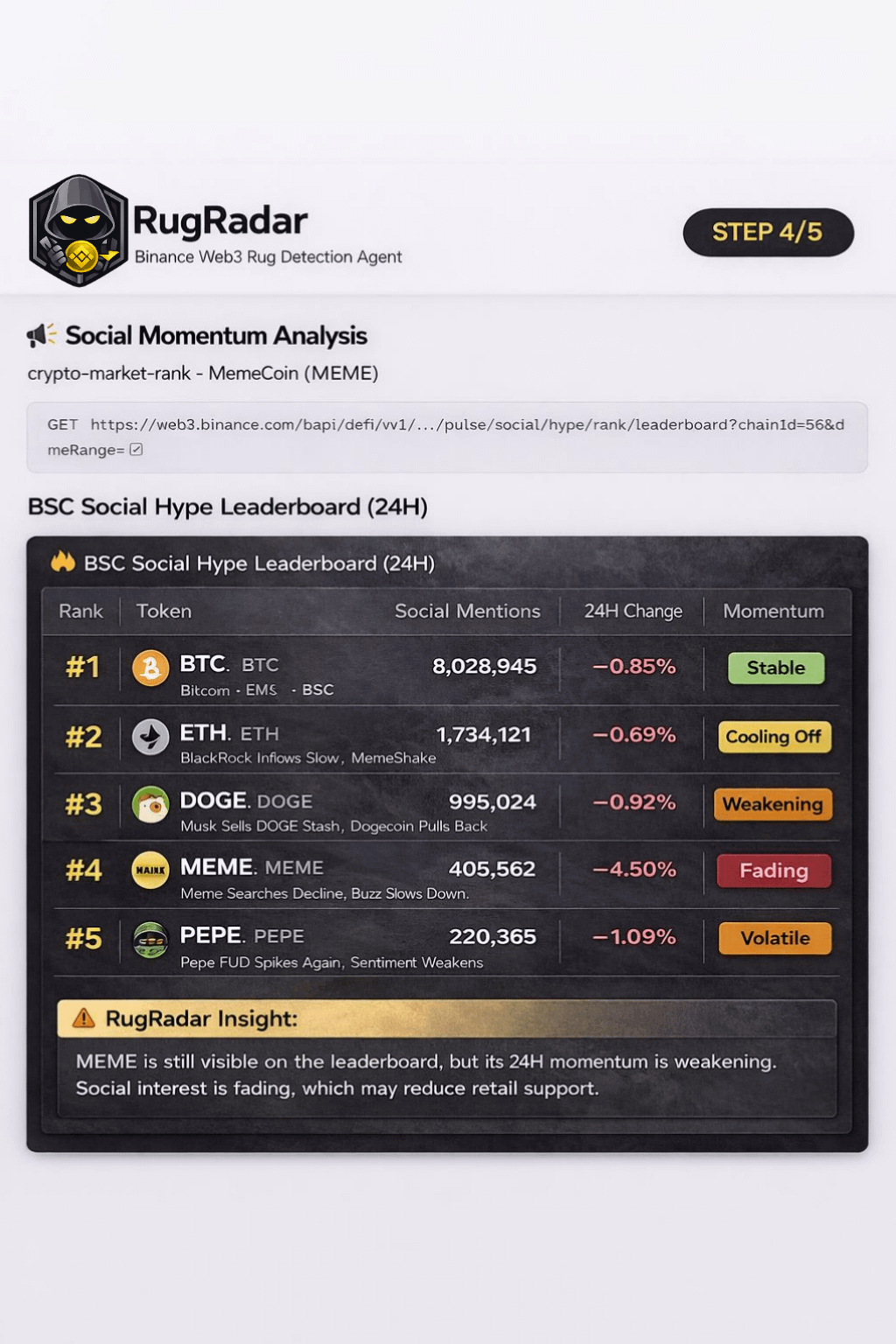
Step 𝟒 )- 𝐒𝐨𝐜𝐢𝐚𝐥 𝐌𝐨𝐦𝐞𝐧𝐭𝐮𝐦 & 𝐌𝐚𝐫𝐤𝐞𝐭 𝐀𝐭𝐭𝐞𝐧𝐭𝐢𝐨𝐧
After analyzing smart money behavior, RugRadar moves to a different but equally important dimension: market attention and social momentum.
In crypto markets, price movements are often heavily influenced by narratives and community engagement. Even technically solid tokens can struggle without sustained interest, while hype-driven projects can experience rapid growth followed by sudden collapses once attention fades.
For this layer, RugRadar uses the crypto-market-rank module to evaluate the broader attention dynamics surrounding a token.
This includes signals such as:
relative market ranking
trending activity across tracked token lists
momentum compared to other tokens in the same category
changes in market attention over time
The objective here is not to measure popularity alone, but to understand whether interest is strengthening or weakening.
A token gaining consistent visibility alongside growing liquidity can indicate healthy market expansion. On the other hand, a sharp decline in attention while large wallets begin exiting may suggest that the narrative supporting the project is starting to fade.
In the demonstration example, RugRadar identifies declining social momentum, meaning the token is losing relative visibility compared to other assets in the market.
This does not necessarily mean the project will fail, but when combined with earlier signals , such as structural concentration or smart money exits , it becomes an important contextual indicator.
Because attention trends can change quickly, RugRadar continues its investigation with the final analytical layer: creator wallet forensics.
Step 𝟓 )- 𝐂𝐫𝐞𝐚𝐭𝐨𝐫 𝐖𝐚𝐥𝐥𝐞𝐭 𝐅𝐨𝐫𝐞𝐧𝐬𝐢𝐜𝐬
The final investigation layer focuses on one of the most important questions in any token analysis:
What is the project team actually doing with their tokens?
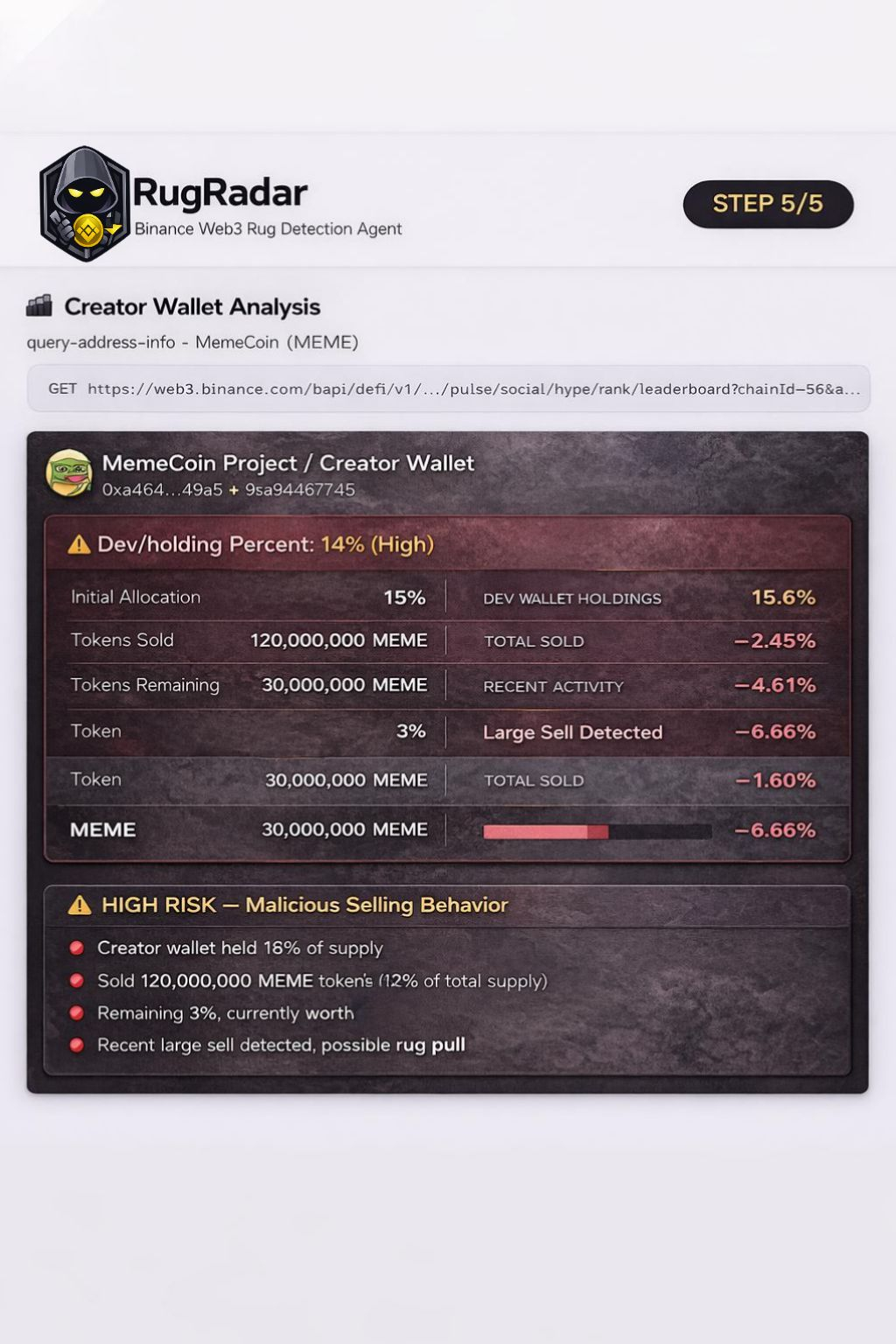
While contract audits and market signals provide useful insights, many rug scenarios ultimately reveal themselves through creator wallet behavior. Tracking how the original deployer wallet and related addresses interact with the token can uncover patterns that are not immediately visible from price charts or public announcements.
For this step, RugRadar uses the query-address-info module to examine the on-chain activity of the creator wallet and other closely linked addresses.
The analysis includes signals such as:
current creator wallet balance
historical transfers and liquidity interactions
major token movements to exchanges or liquidity pools
sudden reductions in creator holdings
unusual transaction patterns following price increases
These indicators help determine whether the team appears to be holding their position or gradually exiting it.
In healthy projects, creator wallets often maintain transparent and stable holdings over time. Large unexplained transfers or aggressive selling patterns, however, can indicate that the team may be reducing exposure while retail participation continues to grow.
In the demonstration example used by RugRadar, the creator wallet shows no immediate large-scale liquidation activity, which keeps the risk assessment within a moderate range.
However, this step plays a critical role in the system because creator wallet movements often provide the earliest and most direct signals of insider intent.
𝐅𝐢𝐧𝐚𝐥 𝐑𝐢𝐬𝐤 𝐑𝐞𝐩𝐨𝐫𝐭 , 𝐑𝐮𝐠𝐑𝐚𝐝𝐚𝐫 𝐑𝐢𝐬𝐤 𝐄𝐧𝐠𝐢𝐧𝐞 :
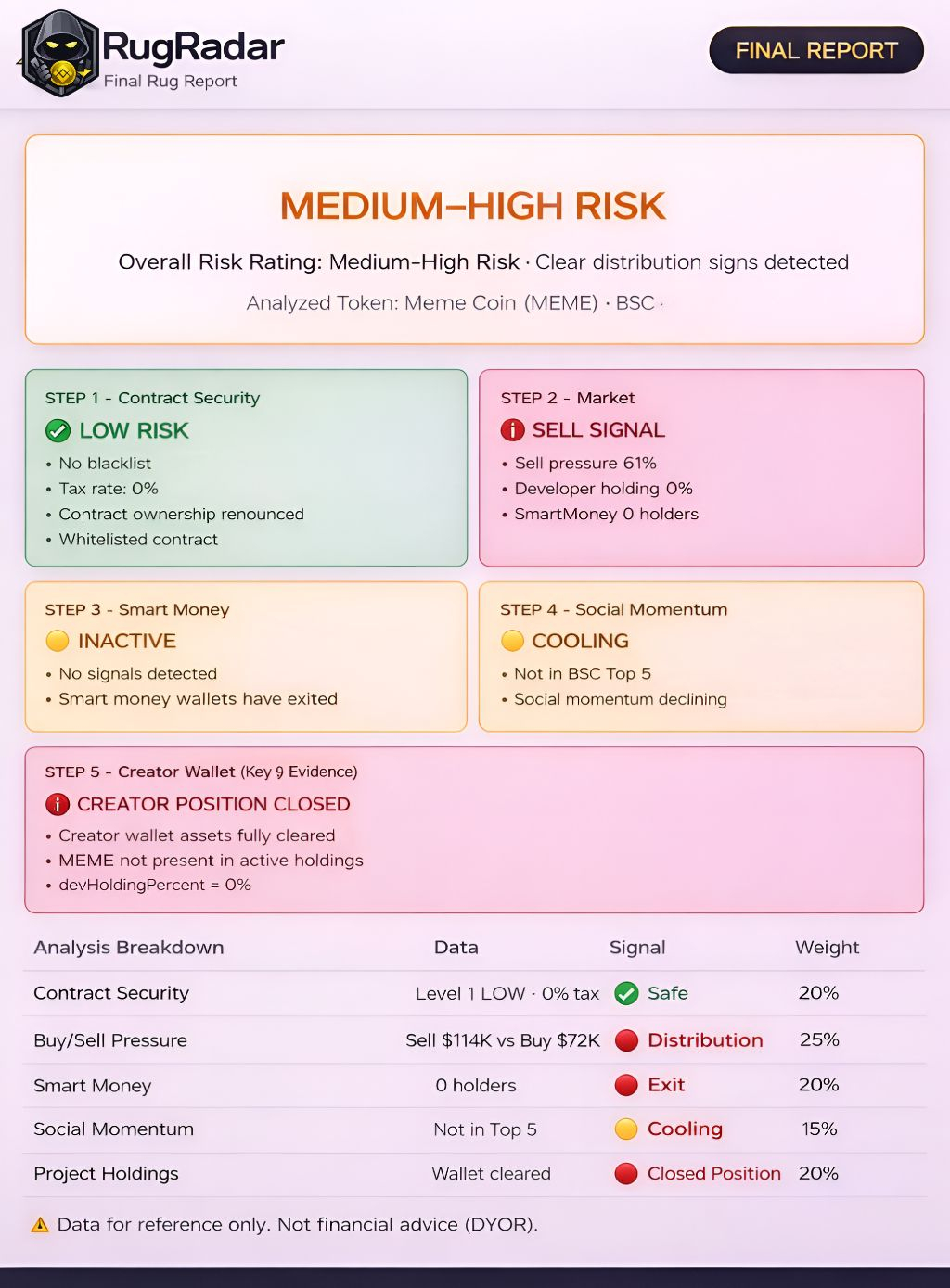
After completing the five investigation layers, RugRadar aggregates all signals into a unified risk evaluation.
The purpose of this final stage is to transform multiple independent analyses into a clear, structured conclusion that helps users quickly understand the overall risk profile of a token.
Each module contributes to the final assessment:
Contract Security Audit – verifies that the token contract does not contain malicious mechanics.
Token Structure Analysis – evaluates holder distribution and developer wallet concentration.
Smart Money Activity – detects whether experienced wallets are accumulating or exiting positions.
Social Momentum Analysis – measures whether market attention is growing or fading.
Creator Wallet Forensics – analyzes the behavior of the project deployer and related addresses.
Rather than relying on a single indicator, RugRadar combines these layers into a multi-factor risk model.
Each component contributes to a weighted risk score, allowing the system to detect patterns that might otherwise appear harmless when viewed individually.
For example:
a clean contract alone does not guarantee safety
healthy market attention does not eliminate insider risk
even moderate holder concentration can become dangerous if combined with smart money exits
By evaluating all five layers together, RugRadar produces a final risk classification such as:
Low Risk
Moderate Risk
High Risk
In the demonstration example used in this repository, the aggregated signals produce a Moderate Risk evaluation.
This result reflects a mixed profile:
the contract appears technically safe
smart money activity shows caution
social momentum is weakening
creator wallet behavior remains stable
While none of these signals alone confirms malicious intent, their combination suggests that additional caution may be warranted before making investment decisions.
The goal of RugRadar is not to replace personal judgment, but to provide a structured early-warning system that helps investors identify potential risks before they become obvious to the wider market.
By consolidating on-chain data, market signals, and behavioral patterns into a single analysis pipeline, RugRadar aims to transform scattered blockchain information into actionable intelligence for crypto users.
Conclusion
Blockchain data is transparent, but understanding it quickly is often the real challenge.
With RugRadar, the goal is to turn scattered on-chain signals into a clear investigation pipeline that helps users detect potential insider dumping earlier. By combining contract audits, token structure analysis, smart money behavior, social momentum, and creator wallet forensics, the tool provides a structured risk overview in seconds.
This project was built as my entry for the Binance OpenClaw AI Agents Event
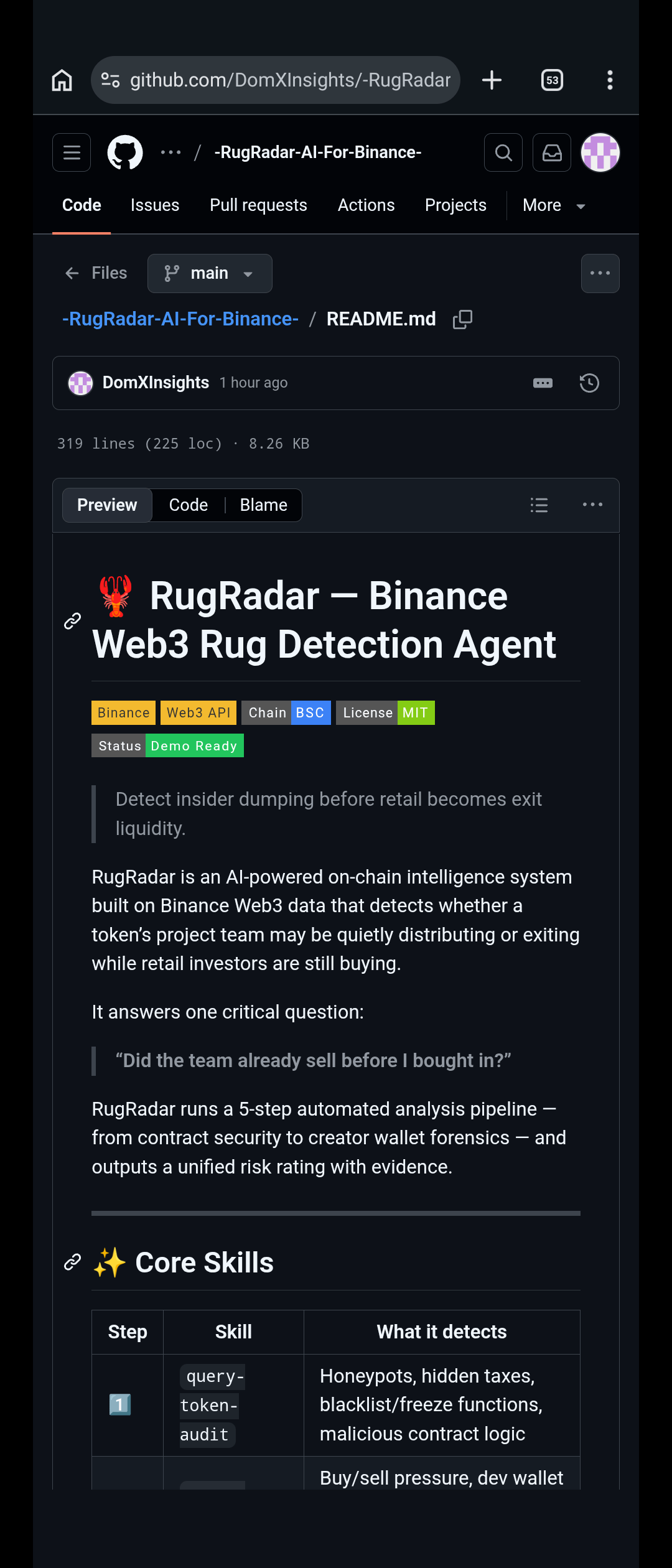
exploring how AI agents can enhance the Binance Web3 ecosystem by automating complex on-chain analysis.
The objective is simple: help users ask the right questions before the market learns the hard way.
Thank you for reading
My Entry repository link :
Dom X Insights/RugRadar AI for binance
My square nickname: Dom X Insights
BUID : 893880105
💛🙏🤝