
I noticed something reading through Midnight's documentation that I kept circling back to. Every privacy blockchain before this one, Monero, Zcash, even Aztec Network, treats privacy as a feature you add to the transaction. Midnight treats privacy as a property of the data architecture itself.
That distinction sounds technical and boring. It has enormous practical consequences.
$NIGHT is the native token of Midnight Network, a Layer 1 blockchain that launched on Cardano in December 2025. The network was built by Input Output Global, led by Charles Hoskinson, the co-founder of Ethereum and founder of Cardano. The token reached an all-time high of $1.81 on its first day of trading, December 9, 2025, then dropped 66% in the same 24-hour window as Glacier Drop recipients cashed out. It now trades at approximately $0.05, with a market cap of roughly $840M and a fully diluted valuation of $1.22B.

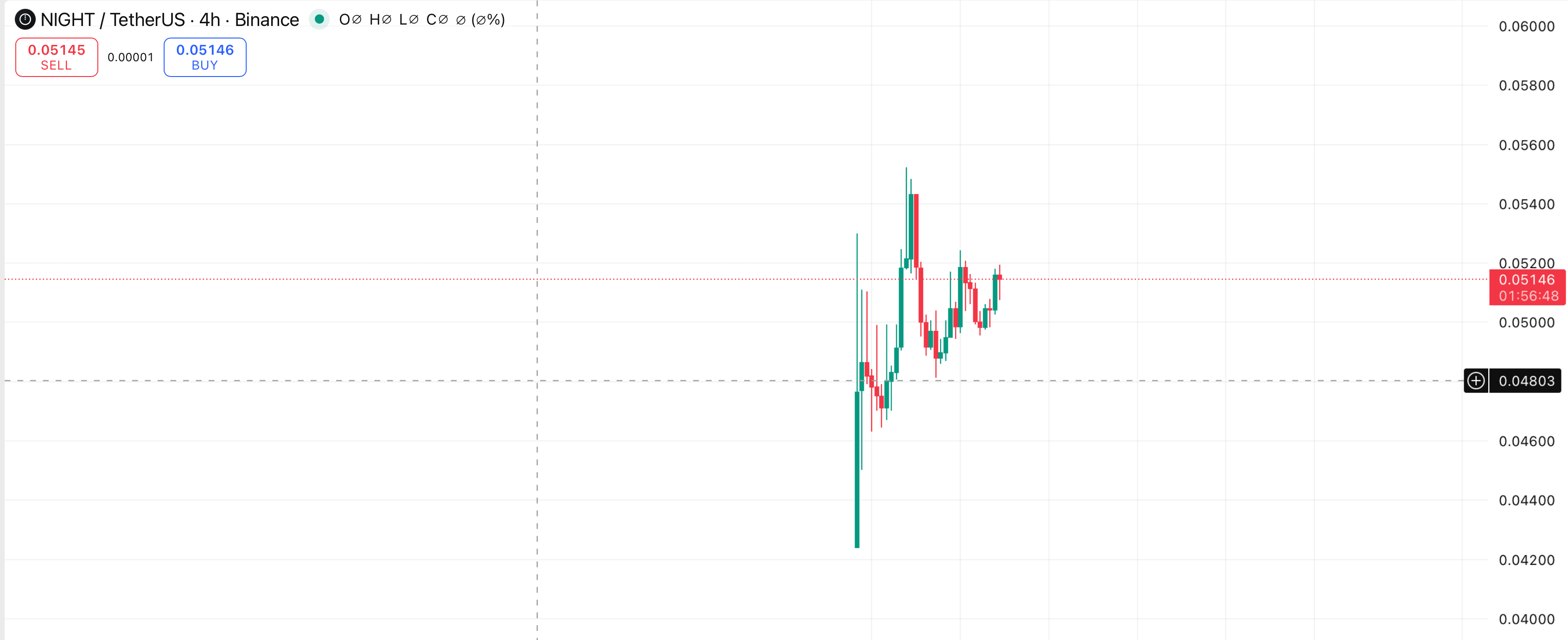
That price chart looks brutal. But looking at it in context of what Midnight is actually building and where it sits right now in March 2026, the week of mainnet launch, the picture becomes more nuanced.
The core architecture is a dual-state ledger. Every public blockchain has a single state: the ledger everyone can read. Midnight runs two states simultaneously, a public settlement layer where NIGHT transactions are visible and auditable, and a private data layer where smart contract state, personal information, and business logic are shielded by zero-knowledge proofs. These two states are linked by ZK proofs that prove the private computations are valid without revealing their contents.
The implications for specific industries are significant. Healthcare: a patient's insurance eligibility can be verified on-chain without publishing their medical history. A hospital can prove a claim is valid without exposing the patient's record to every party on the network. Finance: a DeFi protocol can verify that a user is not on a sanctions list, perform KYC checks, without storing the user's identity on a public ledger that any analyst can query. Supply chain: a manufacturer can prove the provenance of a component without revealing their supplier relationships to competitors who can read the same blockchain.
These aren't hypothetical use cases. They're the reason regulated institutions haven't adopted public blockchains at scale despite years of blockchain-for-enterprise promises. The transparency that makes blockchains trustworthy also makes them unsuitable for any business interaction involving sensitive data.
Midnight's architecture makes a different claim: you can have the verifiability of a public blockchain and the confidentiality of a private database simultaneously. The ZK proof is the bridge between those two requirements.
The technical foundation is the Kachina protocol, developed by IOHK researchers, running on Pluto-Eris curve pairs designed for BLS-type recursive proofs. Recursive proofs matter because they allow you to verify a proof inside another proof, which enables complex multi-step smart contracts without the computational cost growing linearly with the number of steps. The programming language for these smart contracts is Compact, a domain-specific language built on TypeScript, which means the roughly 37 million TypeScript developers globally are potential Midnight builders without needing to learn a new cryptographic language from scratch.
I spent time comparing Midnight to its most direct ZK-native L1 competitors: Aleo, which uses its own Leo language and has a market cap around $300M with a launched but early mainnet; Aztec Network, an Ethereum L2 using Noir language, still in testnet with no token launch yet; and Iron Fish, a privacy L1 focused on transfers rather than programmable smart contracts, with a market cap around $50M. Midnight's differentiation is the combination of TypeScript developer tooling, Cardano ecosystem backing and institutional infrastructure, and a regulatory compliance design that treats audit access as a first-class feature rather than an obstacle to work around.
The question I keep turning over is whether "regulatory compliance as a feature" is a competitive advantage or a compromise. The cypherpunk school of thought says privacy without the option to hide from regulators is not real privacy. Midnight's response is that privacy for data and transparency for settlement are not mutually exclusive, and that building for the world as it actually regulates rather than the world as cypherpunks wish it would regulate is the only path to meaningful scale.
The mainnet launches this week. The technical promise is credible. The team has delivered on technical timelines. Whether the market rewards the thesis depends on what gets built on it in the next 12 months, and that's the part nobody can predict from a whitepaper.