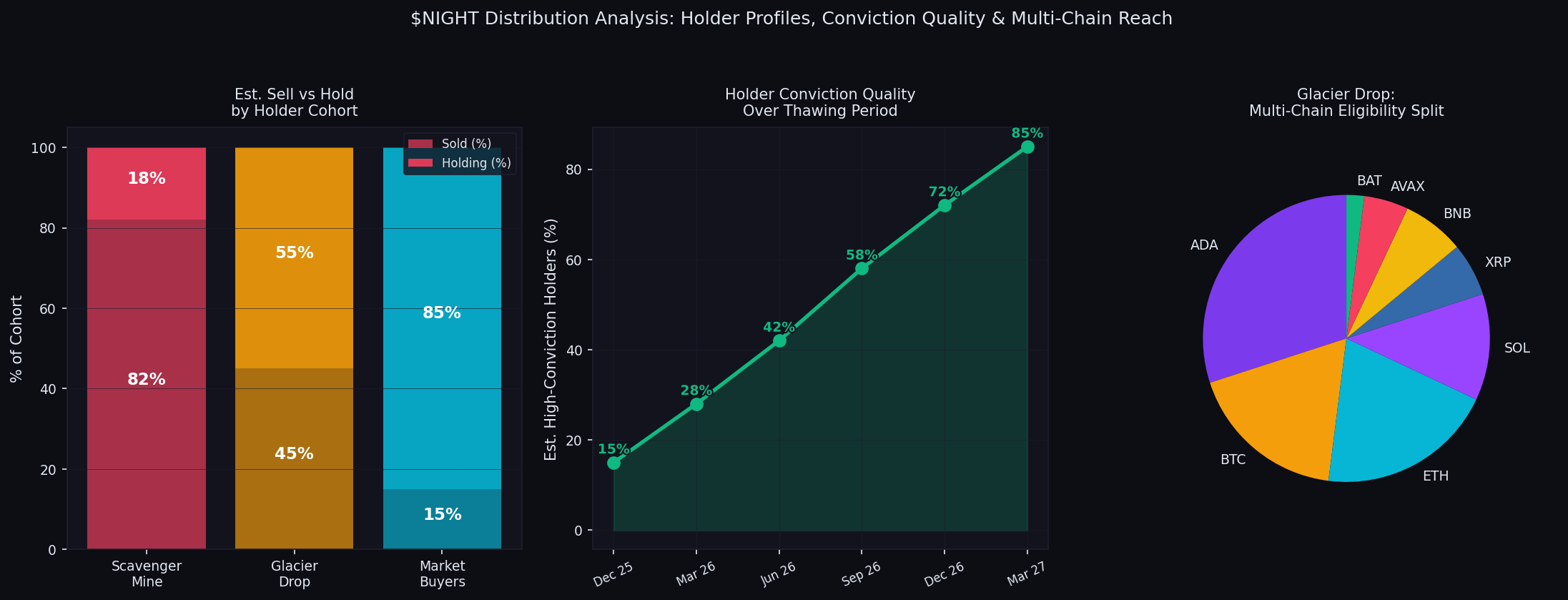
I've been turning the $NIGHT distribution structure over in my head since December 2025 and I've arrived at a view that I think is counterintuitive but important: the same distribution mechanics that created the worst possible launch dynamics are also creating the conditions for an unusually strong long-term holder base, just on a 12 to 18 month delay.
The bad part first. When you distribute tokens to 8 million wallet addresses whose only qualification was running a CPU for 20 days, you create a seller base that is almost entirely motivated by immediate profit-taking. These participants have no prior investment in the project's success, no cost basis to anchor their decision-making, and no reason to think about long-term value. They received free tokens and the rational action is to convert them to something else as quickly as thawing allows. This is exactly what happened on December 9, 2025, and it will continue happening at every unlock event through late 2026.
The good part, and this is the part most people aren't thinking about. The thawing schedule is not a burden unique to Midnight. It is a natural selection mechanism. Every participant who doesn't sell at the first opportunity, or the second, or the third, is demonstrating something about their conviction that is more meaningful than any survey or community metric could capture.
By the time the final unlock tranches complete in late 2026 and early 2027, the remaining holder base will be composed of three groups. People who genuinely believe in the long-term thesis and held through four consecutive opportunities to exit at or above their cost basis. People who accumulated in the open market at post-dump prices and therefore have a real investment thesis rather than a windfall. And ecosystem participants, developers, validators, enterprise clients, who hold NIGHT because they use the network.
That's a qualitatively different community from the 8 million addresses that participated in the Scavenger Mine. It's smaller. It's more concentrated. And it's more likely to generate the kind of organic builder activity and institutional engagement that actually sustains a network long-term.
The Glacier Drop participants are a separate story. The 170,000+ eligible addresses who held qualifying assets across multiple chains as of the June 11, 2025 snapshot are, statistically, more experienced crypto participants. They maintained multi-chain positions through a significant period, suggesting some degree of conviction in the broader ecosystem. Their sell behavior through the thawing schedule has been, in my observation, somewhat more patient than the Scavenger Mine cohort.
The distribution design has a second underappreciated feature: multi-chain eligibility. Including BTC, ETH, SOL, XRP, BNB, AVAX, and BAT holders means NIGHT is not exclusively a Cardano community token. The holder base has organic representation from every major chain ecosystem. That's actually valuable for a project that is trying to position itself as chain-agnostic privacy infrastructure rather than a Cardano-centric product.