

I remember a phase when I started paying close attention to AI-related tokens. At that time, it felt like every project connected to AI was gaining traction quickly. I assumed that strong narratives combined with high trading activity would naturally lead to long-term value. It looked convincing from the outside, especially when communities stayed active and liquidity kept flowing.But after spending more time reviewing how these systems actually functioned, I began to notice a gap. Many of these projects had attention, but very little real interaction happening beneath the surface. Most participants were traders, not contributors. That realization shifted my perspective. Since then, I have focused more on how a system operates internally rather than how it appears externally.That shift in perspective is what led me to look more closely at Fabric Foundation and its token, $ROBO.It was not the AI narrative that stood out. Instead, it was the structure behind it that raised a more interesting question. Can a decentralized system meaningfully coordinate machines, data, and developers in a way that leads to continuous participation rather than short bursts of activity?This naturally leads to a deeper consideration. If the system depends on contributions from different participants, does it create an environment where those contributions remain valuable over time? Or does it risk becoming another cycle where activity fades once initial incentives decline?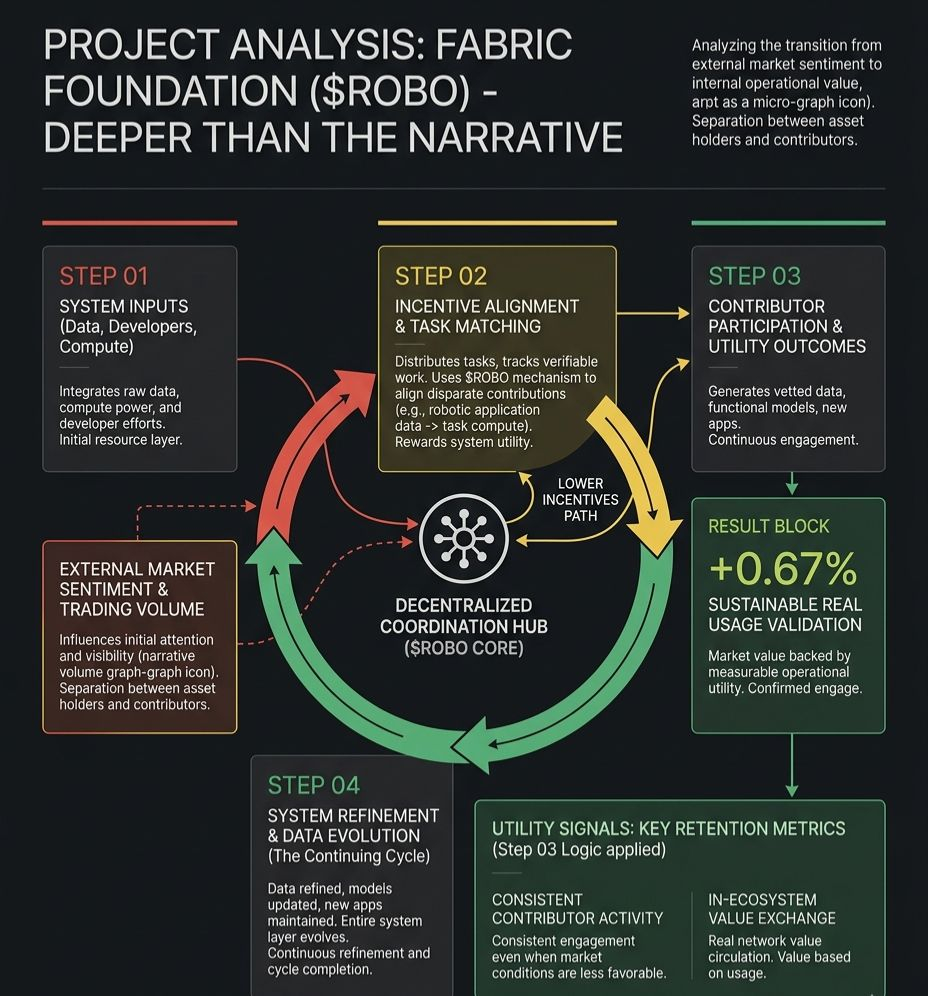
From what can be understood through its design, Fabric Foundation is attempting to build a coordination layer rather than a single application. The idea is to create an environment where different forms of input such as data, computational resources, and development effort can interact in a structured way.The role of ROBO in this system is not limited to simple transfers or speculation. It acts as a mechanism for aligning incentives between participants who may not know each other but still depend on each other’s contributions. A developer building a robotic application might rely on external datasets, while another participant provides computational support. The protocol aims to track and reward these interactions in a way that reflects actual contribution.A useful way to think about this is to compare it with shared infrastructure. In traditional systems, coordination often happens within a single organization. Here, the coordination is distributed. That introduces both flexibility and complexity. The system must not only attract participants but also ensure that their contributions are measurable and fairly rewarded.This becomes particularly relevant in the context of AI and robotics because these fields require continuous input rather than one-time deployment. Data needs to evolve, models need updating, and applications need maintenance. If the network can support that cycle, it moves closer to being infrastructure rather than just a concept.Looking at the market side, it is clear that $ROBO has started to gain attention alongside broader interest in AI-related projects. 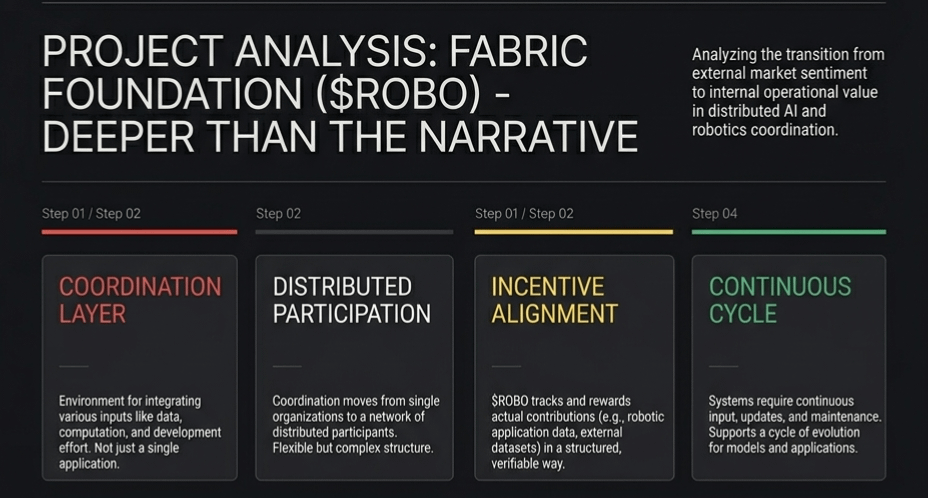
Trading activity tends to increase during periods when the narrative becomes more visible, which suggests that a portion of the demand is still driven by external sentiment rather than internal usage.However, market activity alone does not provide a complete picture. What matters more is how that attention translates into participation within the network. A rising number of holders can indicate growing awareness, but it does not necessarily confirm engagement. In early-stage systems, it is common to see a separation between those who hold the asset and those who actively contribute to the ecosystem.This creates an important distinction. The market may recognize the potential of the idea, but it has not yet fully priced in whether the system can sustain itself through real usage. That uncertainty is where both opportunity and risk exist.The central challenge for Fabric Foundation is not visibility or narrative positioning. $ROBO like $ENJ and $BAN , grows when users and contributors stay active. Its value depends on ongoing participation, not just hype.It is the ability to maintain consistent and meaningful participation across its network.A system built on contributions must continuously justify why participants should remain involved. If contributors only engage during periods of high incentives, the system risks becoming dependent on external stimulation rather than internal value creation. Over time, that can weaken the entire structure.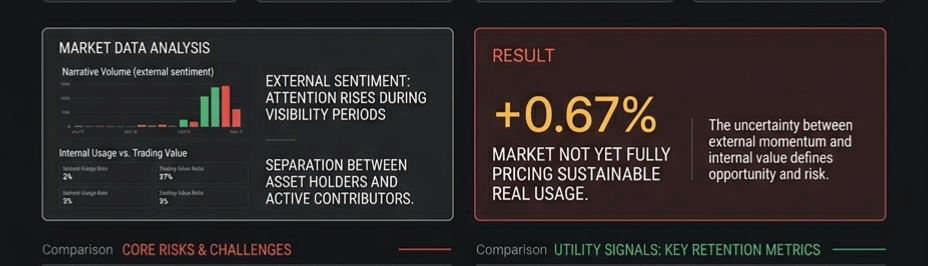
There is also a deeper layer to this risk. In a distributed coordination model, the quality of contributions matters as much as the quantity. If the network attracts activity that is low in value or difficult to verify, it becomes harder to maintain trust in the reward mechanism. Participants need confidence that their effort is recognized accurately. Without that, long-term engagement becomes uncertain.Another factor to consider is the complexity of coordinating multiple roles. Developers, data providers, and infrastructure contributors each have different expectations. Balancing these expectations requires a system that is not only technically sound but also economically stable. If one group benefits disproportionately, others may gradually disengage.This is why retention becomes the defining metric. Not just whether participants join, but whether they continue to find value in staying. A system that retains contributors during periods of lower incentives demonstrates a stronger foundation than one that relies on constant external momentum.To build stronger conviction in a system like this, I would look for signals that go beyond surface-level growth. One of the most important indicators would be consistent activity from contributors even when market conditions are less favorable. That would suggest that participation is driven by utility rather than speculation.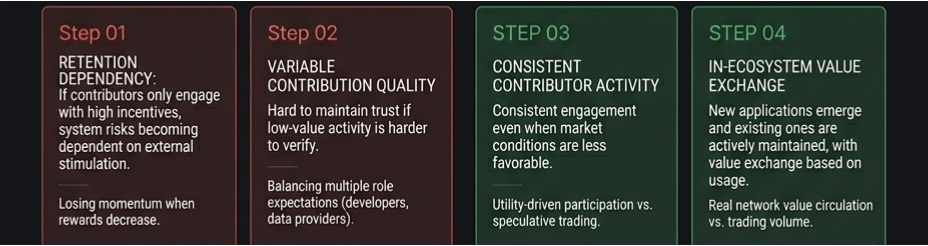
I would also pay attention to the development side. If new applications continue to emerge and existing ones are actively maintained, it would indicate that the network is functioning as intended. Another meaningful signal would be the presence of value exchange within the ecosystem, where participants are rewarded based on actual usage rather than temporary distribution models.At the same time, certain patterns would make me more cautious. A sharp decline in activity after incentive programs end would suggest weak retention. Similarly, if most of the value continues to circulate through trading rather than through the network itself, it would raise questions about long-term sustainability.If there is one thing I have learned from observing early-stage systems, it is that attention often arrives before structure is fully tested.so when looking at $ROBO, the more useful approach is not to focus on how quickly it gains visibility, but on how steadily it builds participation.In systems like this, the difference between an idea and functioning infrastructure is usually not defined by design alone. It is defined by whether people continue to contribute when the initial momentum slows down.That is the point where real value either begins to form or quietly fades.