

I remember pausing before signing a simple transaction.
It was the quiet awareness that every action I took, every interaction, every timing pattern would become part of a permanent public record. Not just visible, but interpretable.
That hesitation felt new to me. Subtle, but persistent.
And once I noticed it, I couldn’t unsee it.
For years, I accepted the idea that transparency was the foundation of trust in blockchains.
If everything is visible, nothing can be hidden. If nothing is hidden, nothing can be manipulated. It sounds complete almost elegant.
But something about it began to feel incomplete.
Not broken, just slightly misaligned with how people actually behave.
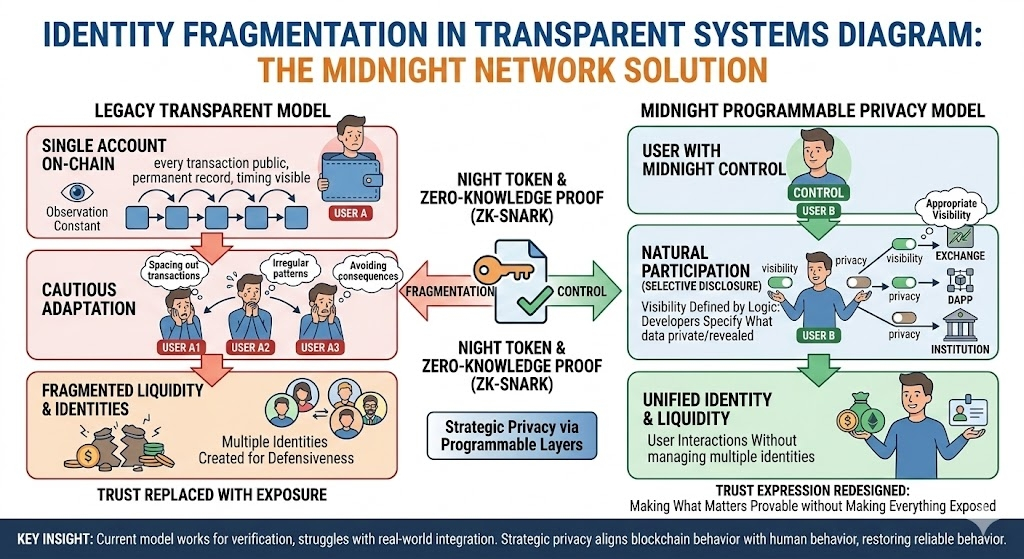
I noticed wallets becoming fragmented. Activity patterns becoming irregular, almost cautious. It wasn’t just strategy, it felt like adaptation.
We built systems assuming people would act openly.
But people don’t.
Not when visibility carries consequences.
At first, when I came across @MidnightNetwork and its concept of programmable privacy, I was skeptical.
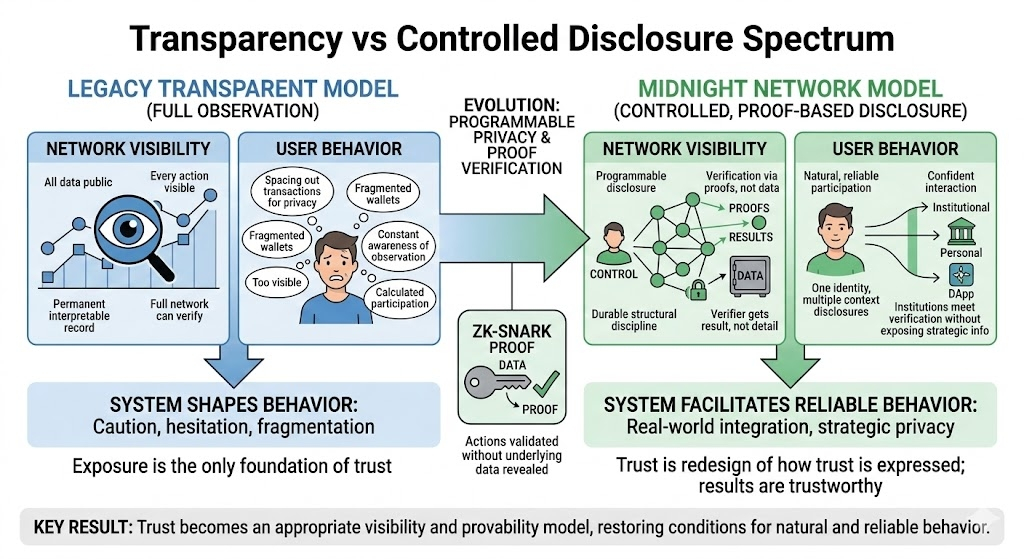
Privacy in blockchain discussions often feels like a binary either everything is hidden, or everything is exposed. And historically, full privacy has struggled with trust, while full transparency has struggled with usability.
So when I first heard about #night Token and Midnight’s approach, it felt abstract. Almost like trying to solve a human problem with a technical switch.
But upon reflection, what stood out wasn’t the privacy itself.
It was the idea of control.
Most systems treat privacy as a setting.
Midnight treats it as a programmable layer embedded directly into how applications are built.
That distinction sounds small, but it changes everything.
Programmable privacy means that visibility isn’t fixed it’s defined by logic. Developers can specify what data remains private, what gets revealed, and under which conditions. Not everything needs to be hidden. Not everything needs to be public.
At first, this felt like added complexity.
But then I realized, this is how people already operate in the real world.
We don’t behave with total transparency or total secrecy. We choose what to reveal, when, and to whom.
What Midnight is doing isn’t introducing privacy.
It’s aligning blockchain behavior with human behavior while still preserving verifiability.
And that last part is where it becomes real. Because this isn’t just about hiding information. With the help of zero knowledge proof, actions may be validated without the underlying data being revealed. The results, therefore, are trustworthy even if the underlying data remains unknown.
The more I think about this, the more I realize that trust in a system is not necessarily about visibility.
It’s about appropriate visibility.
Too much transparency breeds pressure.
Too little transparency breeds doubt.
It allows builders to design applications where sensitive data stays protected, but results remain provable. Privacy is no longer an afterthought, it becomes part of the contract itself.
It allows users to interact without constantly managing multiple identities. And it allows institutions to participate without exposing strategic or regulatory-sensitive information, while still meeting verification requirements.
What stood out wasn’t just the cryptography.
It was the behavioral shift.
When people feel observed, they act differently. When they feel controlled, they withdraw. But when they feel in control, they participate more naturally.
Midnight seems to understand that participation is not just a technical problem, it’s a psychological one.
And quietly, this is where Night Token starts to make more sense.
Not as a speculative asset, but as part of an ecosystem enabling this private yet verifiable execution layer. A system where computation, validation, and access to privacy preserving logic all need to be coordinated and sustained.
We’re entering a phase where blockchain adoption is no longer just about early users.
It’s about everyone else.
And “everyone else” doesn’t behave like early adopters.
They care about boundaries. Context. Selective disclosure.
The current model of full transparency works well for verification, but struggles with real world integration.
That’s where the gap has been.
Not scalability. Not even usability.
But strategic privacy.
Midnight Network doesn’t try to remove transparency. It reshapes it.
It introduces a system where privacy and compliance, openness and discretion, can coexist not by compromise, but by design. Where what is revealed is intentional, and what is hidden is still provable.
And more importantly it gives builders the ability to define that balance at the application level.
I used to think privacy was a defensive feature.
Something you add to protect users.
But now, I’m starting to see it as a strategic one.
Without it, systems quietly shape behavior in unintended ways. They push users toward fragmentation, hesitation, and sometimes even disengagement.
With it, systems can feel more natural.
Less like a machine observing you, and more like an environment you can operate within on your own terms.
At first, this felt like a niche improvement.
But the more I reflect on it, the more it feels foundational.
We often say blockchains are “trustless.”
But maybe what we’ve actually built are systems that replaced trust with exposure.
And maybe the next evolution isn’t removing trust but redesigning how it’s expressed.
I used to believe transparency was the end state.
Now it feels more like a starting point.
Because the real breakthrough isn’t making everything visible
It’s making what matters provable, without making everything exposed.
