

I remember hesitating before interacting with a simple dApp.
Nothing unusual about the transaction itself. But there was this quiet awareness in the background that every click, every approval, every wallet interaction wasn’t just happening, it was being recorded, indexed, and potentially analyzed forever.
It wasn’t fear. It was something subtler.
A kind of behavioral self consciousness I hadn’t signed up for.
And once I noticed it, I couldn’t ignore it.
For years, we’ve been told that transparency is a feature of blockchain.
And to an extent, it is. Verifiability, auditability, open access, these are powerful primitives.
But somewhere along the way, transparency stopped being a tool and started becoming a constraint.
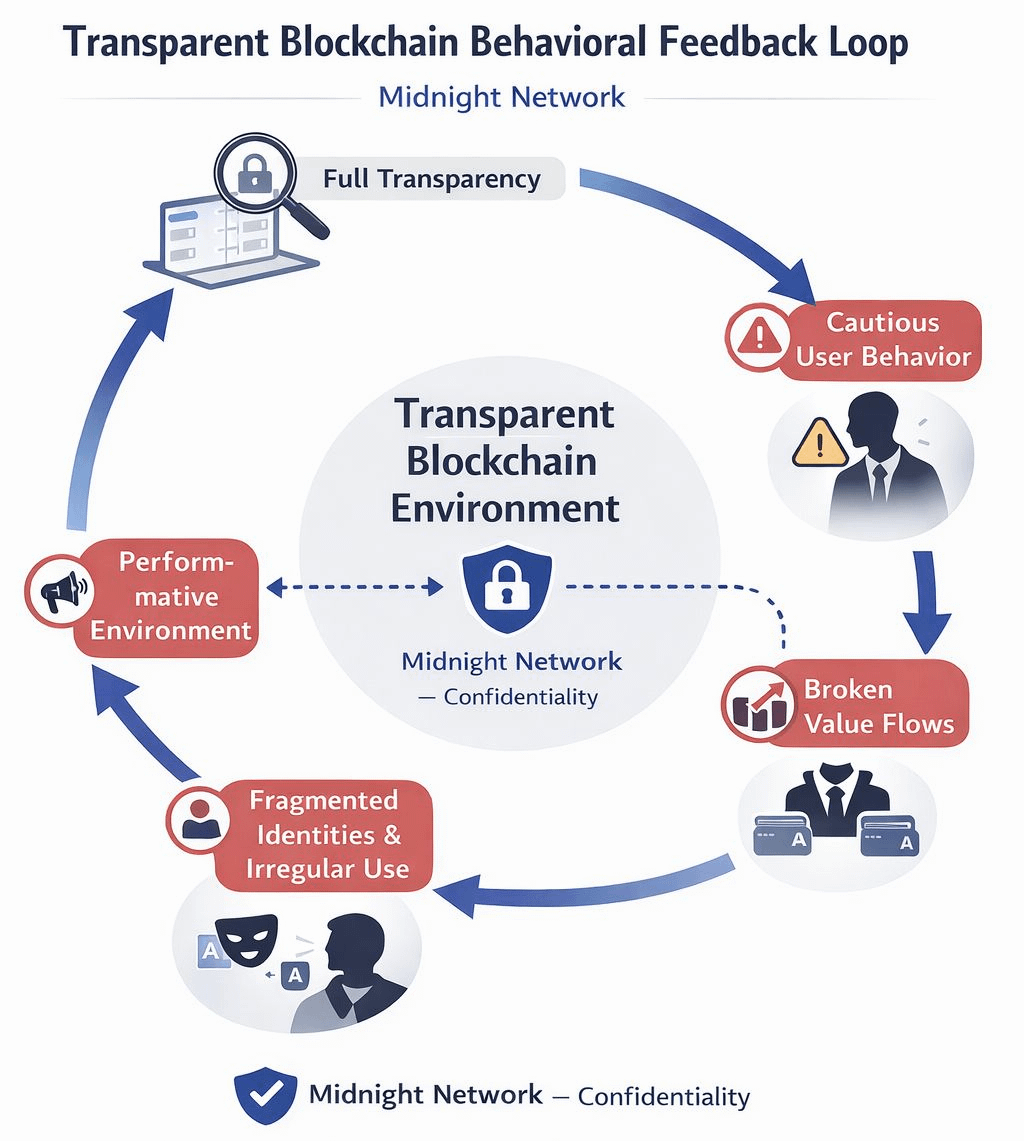
Because transparency at scale doesn’t just reveal systems, it reshapes behavior.
When every action is public:
Users become cautious instead of expressive
Builders optimize for visibility instead of usability
Value flows become predictable, and therefore exploitable
It creates an environment where participation feels observed.
Not unsafe,just exposed.
And that subtle shift changes how people engage.
At first, @MidnightNetwork felt like just another “privacy chain.”
That phrase alone usually signals complexity, or systems that exist slightly outside the mainstream.
Was this just another attempt to layer privacy onto a system that was never designed for it?
But upon reflection, what stood out wasn’t just the promise of privacy.
It was the structure behind it.
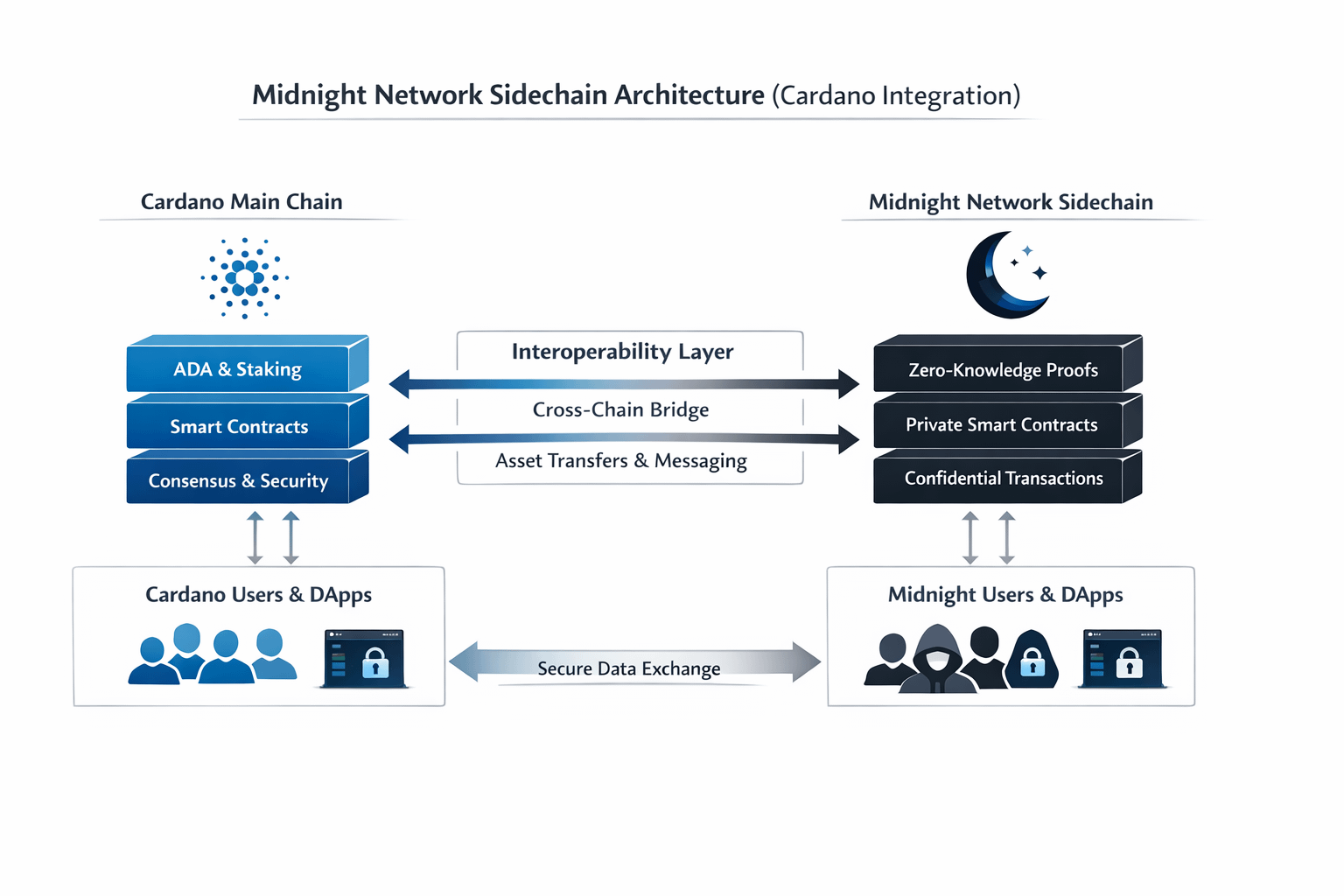
#night is being developed as a data protection focused sidechain within the Cardano ecosystem, designed specifically for confidential smart contracts.
That detail mattered more than I expected.
Because it suggested privacy wasn’t an add on, it was foundational.
Most privacy solutions try to hide everything.
Midnight doesn’t.
Instead, it introduces a model where:
Data can be verified using zero knowledge proofs without being revealed
Smart contracts can execute with confidential inputs and outputs
Information is shared selectively, based on context and permission
This is where the idea of selective disclosure becomes real.
Not everything is public. Not everything is hidden.
It’s programmable.
At first, this felt abstract.
But then it clicked, this isn’t about anonymity.
It’s about control over what becomes visible, and when.
When people know they’re being watched, they act differently.
Transparent systems create performative environments:
Traders signal instead of strategize
Users fragment identities to avoid traceability
Builders design for optics, not outcomes
Midnight changes that dynamic by separating two things we often conflate:
Proof
Data
Through zero-knowledge systems, you can prove something is valid.
Without exposing the underlying information.
That’s a subtle shift, but it changes the psychology of participation.
Users no longer need to choose between:
Trusting the system
And protecting their behavior
They can do both.
What I didn’t expect was how the system reinforces this at an economic level.
Midnight introduces a dual token structure:
$NIGHT ,tied to governance and network participation
DUST, a shielded resource used for private transaction execution
At first glance, this feels like just another token model.
But upon reflection, it aligns incentives with behavior.
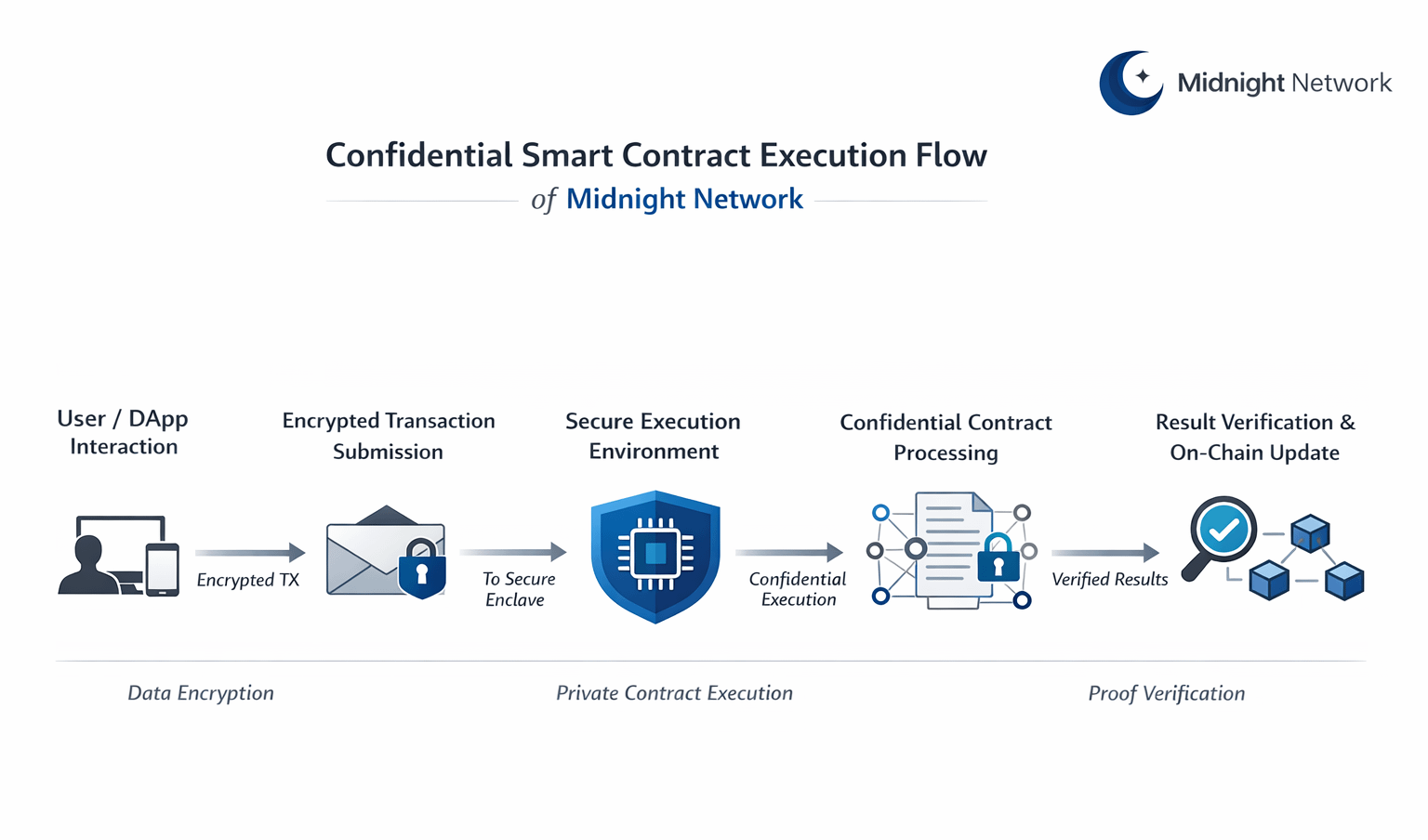
Privacy isn’t just a feature you toggle.
It becomes something the system accounts for a resource tied to how computation and data are handled.
And that’s a different design philosophy.
When everything is public, builders tend to optimize for visibility:
Designing interactions that are easy to track
Structuring token flows that look attractive on-chain
Prioritizing growth signals over meaningful usage
But in a system with confidential smart contracts, priorities shift:
Toward user intent rather than user traceability
Toward outcomes rather than appearances
Toward functionality that doesn’t rely on public exposure
It’s a quieter design space.
Less performative. More deliberate.
And it naturally attracts builders who think long term.
We’re entering a phase where blockchain isn’t just financial infrastructure.
It’s becoming data infrastructure.
And that introduces a tension:
Users want control over their data
Systems still rely on visibility for trust
Midnight sits directly in that gap.
It enables:
Confidential DeFi, where positions aren’t fully exposed
Selective identity systems, where credentials can be proven without full disclosure
Compliance aware applications, where regulators can verify without accessing everything
This isn’t about hiding from the system.
It’s about designing systems that don’t require unnecessary exposure in the first place.
The real issue was never transparency itself.
It was the assumption that transparency must be absolute.
Midnight challenges that by introducing:
Verifiability without overexposure
Trust without total visibility
Participation without permanent data trails
By separating execution from disclosure, it allows systems to remain trustworthy
Without making users fully observable.
I used to think privacy in crypto was mostly defensive.
Protection from tracking. From surveillance. From misuse.
But now, it feels more foundational than that.
It’s about how people behave when they’re not constantly being observed.
Because that’s when real strategies form.
That’s when experimentation happens.
That’s when systems become more than just transparent ledgers, they become environments people are comfortable participating in.
What surprised me wasn’t that privacy is becoming important again.
It’s that we’re finally questioning whether full transparency was ever the right default.
Midnight doesn’t reject openness.
It refines it.
And maybe the next evolution of blockchain isn’t about making everything visible
but about making visibility intentional.