
I keep circling back to something that doesn’t quite resolve.
Sign might not be early in the usual sense.
It might be early in assumption.
Most people still look at $SIGN like it’s another infrastructure token. Listings, integrations, partner logos. The usual surface-level signals we’ve trained ourselves to track.
But that framing feels… off.
Because Sign isn’t really about moving value.
It’s about verifying it.
And that sounds subtle until you realize how little of crypto is actually built around truth instead of execution.
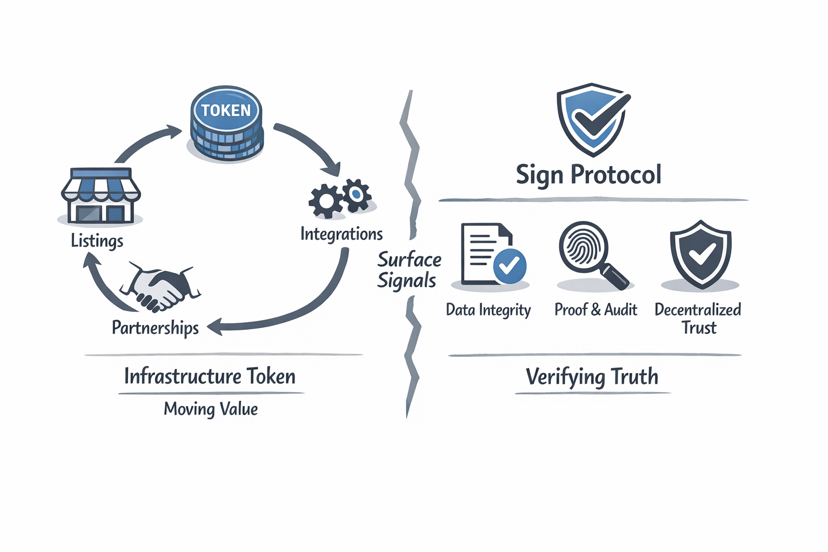
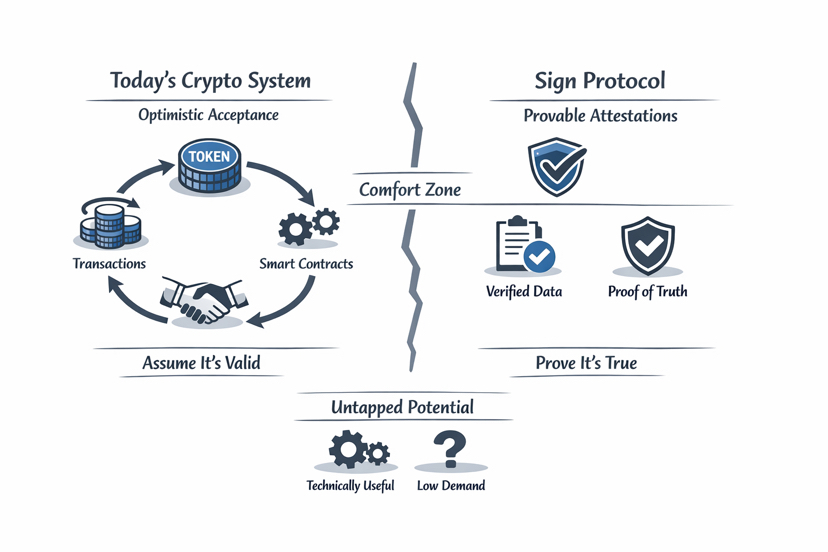
Right now, the system works on a kind of optimistic acceptance. Transactions happen, states update, contracts execute — and we assume the inputs are honest enough to keep things functioning.
Sign challenges that quietly.
It introduces the idea that attestations — not transactions — might be the more important primitive long term.
Not what happened.
But what can be proven to have happened.
That shift doesn’t feel urgent yet.
Most applications don’t break because of missing attestations. They break because of liquidity, UX friction, or distribution problems. So builders optimize for those. Naturally.
Which leaves something like Sign sitting in an uncomfortable position.
Technically useful.
But not yet demanded.
And infrastructure without demand has a strange gravity. It exists, it’s respected, but it doesn’t pull the ecosystem toward it. Not until something forces alignment.
That’s where the tension is.
Because if you look closely, cracks are forming in how we handle off-chain data, identity, credentials, even simple claims. Everything still relies on a mix of trust assumptions and patchwork verification.
It works.
Until it doesn’t.
Sign feels like it’s built for that moment — when “just trust it” stops being acceptable at scale.
But we’re not fully there.
Not across the board.
Another layer that keeps bothering me is how invisible success would look here.
If Sign actually wins, you probably won’t notice it directly. You won’t open an app and think, “this is powered by attestations.” You’ll just assume things are more reliable, more verifiable, less dependent on blind trust.
The system tightens quietly.
And that makes it harder to price.
Because markets don’t reward what they can’t easily see.
They reward narratives. Speed. Obvious demand curves.
Sign operates underneath that.
Which creates this strange disconnect — the architecture might matter more over time, but the timeline for that recognition is unclear.
So the current state feels… suspended.
Not ignored.
Not fully understood either.
Just sitting there as a kind of structural bet on a future where verification becomes a first-class constraint, not an afterthought.
Maybe that shift comes quickly.
Maybe it drags.
But if it does arrive, the projects already thinking in terms of attestations instead of transactions won’t need to adjust.
They’ll already be aligned.
And Sign seems very deliberately positioned for that version of the ecosystem.
The only question is whether that version shows up soon enough for people to care.
#SignDigitalSovereignInfra @SignOfficial $SIGN
