
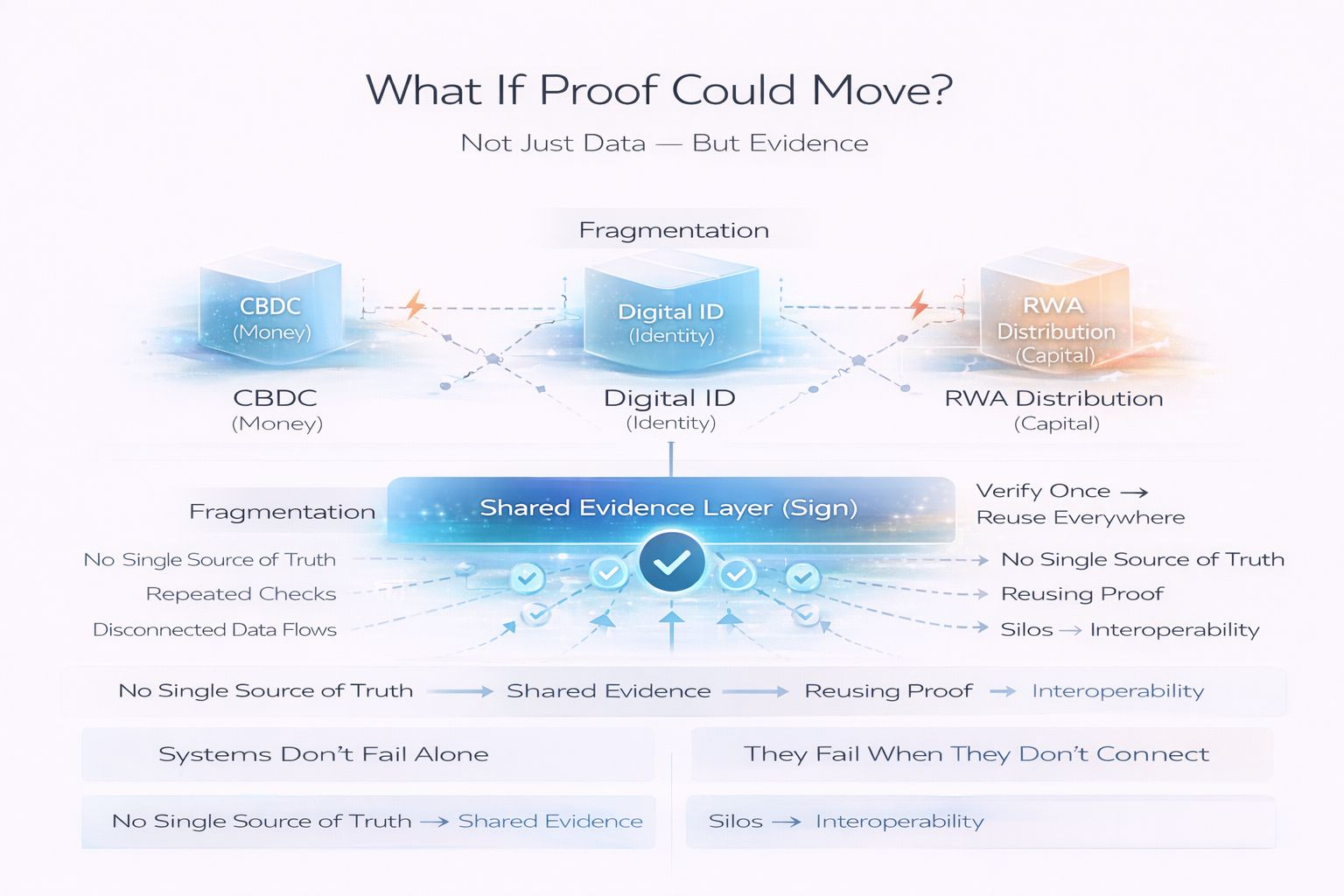
I was going through the S.I.G.N. docs and something kept bothering me a bit. Not in a bad way, more like a question I couldn’t shake off. What actually happens if a government rolls out a CBDC, a national ID system, and some kind of RWA distribution program… but none of them can really share proof with each other in a clean way?
Because I think we usually assume these systems fail at the surface. Like bad UX, bad rollout, corruption, whatever. But the deeper issue might just be that they were never designed to connect. Identity gets verified in one silo, payments move in another, and when funds are distributed there’s no single source of truth that ties everything together end to end. So every time something needs to be checked, it gets rechecked again. It feels inefficient, but also kind of fragile.
And yeah, apparently this isn’t even rare. You’ve got CBDC pilots happening everywhere, RWA narratives getting bigger, and still a huge number of people without proper identity systems. Three massive directions moving at the same time, but not really aligned underneath.
What Sign seems to be doing… at least how I understand it right now… is not picking one of those lanes. They’re going one layer below that. Instead of building a better payment system or a better ID system, they’re trying to define how “evidence” itself gets recorded and shared.
Sign Protocol is the piece that clicked for me after a while. It’s basically turning actions into attestations. A payment happens, that becomes a verifiable record. Someone gets their identity checked, that becomes another record. A distribution event for some asset or program, same thing. Everything becomes something that can be reused and verified without redoing the whole process from scratch.
Then S.I.G.N. kind of builds on top of that across three directions at once, which is where it starts to feel ambitious. The money system with this dual setup between CBDC and stablecoin rails, the identity system using verifiable credentials where you don’t have to expose everything, and the capital side with TokenTable handling distribution in a more structured way.
I don’t know, part of me thinks this makes a lot of sense conceptually. Especially the idea that the real bottleneck isn’t the applications, it’s the lack of a shared evidence layer. It reminds me a bit of early DeFi where everyone was rebuilding the same primitives over and over until shared infrastructure started to emerge.
But at the same time, I keep wondering how this plays out in reality. Getting different government departments to agree on shared schemas and standards sounds harder than the tech itself. And legacy systems don’t just get replaced overnight. Also the whole multi-chain setup… feels powerful, but also adds more complexity than I’m fully comfortable reasoning about yet.
Still, I can’t really ignore the framing. Most projects expand outward from one use case. Sign is starting from the common layer and hoping everything plugs into it later. That’s either exactly the right way to do it, or a bit too early for how slow institutions move.
I’m not fully sold, but I keep thinking about it, which probably means something. If they actually get real adoption across even a couple of systems, this could look very different from how it does today.
I guess I’ll keep watching.