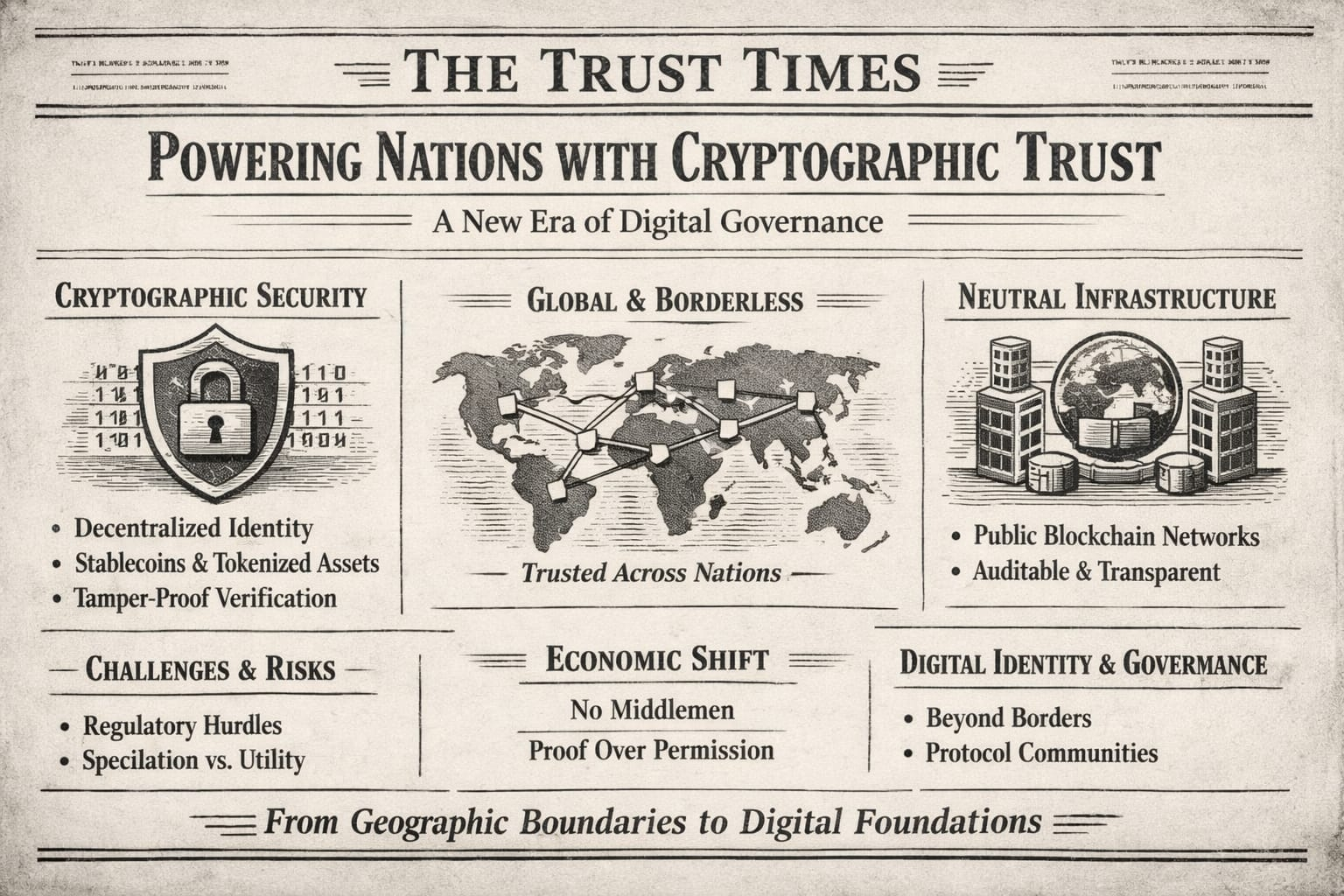
Modern countries run on trust think courts,banks,identity registries.These frameworks are part of daily life,but lately,they’re getting stretched thin as globalization speeds up and everything goes digital.
There’s another way to build trust:cryptography.Instead of counting on authorities to enforce rules,cryptographic systems lean on math.They offer clear,unbreakable guarantees about who owns what,who signed what,and whether data was altered.Verification is built in.A transaction,an identity,a contract whatever you need to check,you can be sure it hasn’t been tampered with,and you don't have to trust a central authority to say so.This approach isn’t just local it's global by design,letting systems interact smoothly across borders.
We’re already seeing this shift in action.Stablecoins,decentralized identity networks, tokenized assets they use shared platforms anyone can audit.These aren’t just new tools;they’re new rules for finance and governance.
From a wide angle view,this change fits with how the world’s financial system is splintering.Geopolitical rifts are growing.Monetary policies don’t line up.In this mess,neutral ground shared,public technical infrastructure matters more than ever.Cryptographic systems deliver that neutrality.
That said,nothing’s perfect.Scaling these networks up is still hard.Laws and regulations haven’t caught up,which makes adoption messier.The biggest problem?These cryptographic platforms can’t do much if they don’t connect with real world laws.Without that bridge,their reach stops short.
Cryptographic trust also flips economic incentives.Instead of banks or lawyers acting as middlemen,network validators keep things running using mechanisms like staking.Users pay for proof,not permission sparking new industries for data,computing power,and security.
There’s a catch,though:a lot of new projects focus on pumping up token prices instead of building real utility.Over financialization is a genuine risk.If cryptographic trust wants to fuel entire nations,it needs to produce real value,not just speculation.
The bottom line is powerful:national identity might shift away from geographic lines and toward digital infrastructure.Communities may start organizing around protocols, not just passports.
So here’s the takeaway.Cryptographic trust is more than a technical upgrade it’s a fresh layer of governance.Get to know how it works,where it falls short,and what it means for economic models.That knowledge is key for anyone stepping into the digital future.