
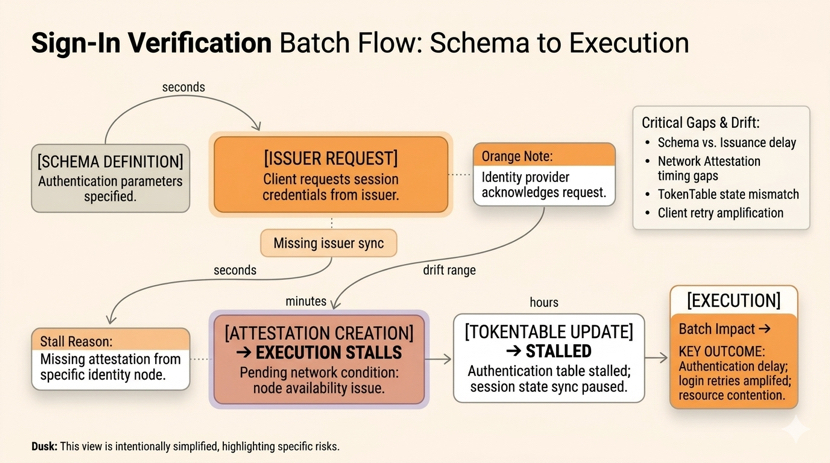
What keeps bothering me with Sign is how easily people trust the moment something verifies.
Like that moment holds.
It doesn’t.
A schema gets defined. An issuer signs. The attestation is anchored, indexed, pulled back by another system and treated as current truth. Everything checks out at that exact point. Clean enough.
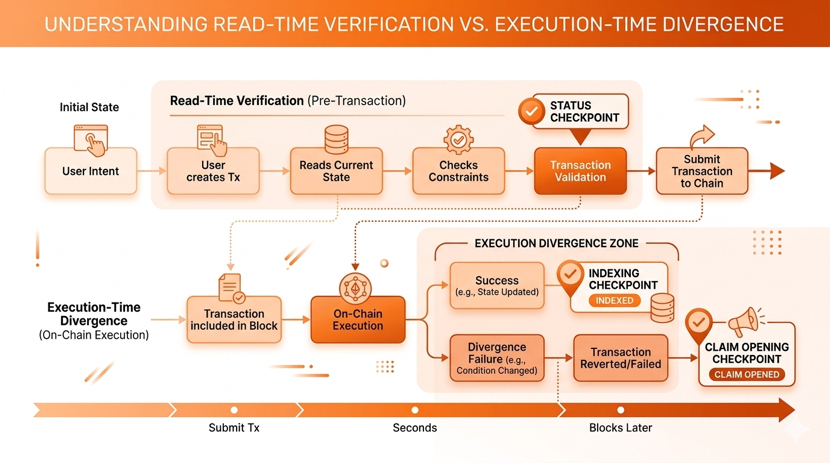
Then something shifts after that.
Not fraud. Not broken signatures. Just state drifting under load.
The relying system already read the attestation. TokenTable already opened the path. Eligibility already moved from “checked” to “actionable.” And the system keeps going because nothing in that flow tells it to stop.
That’s the part that breaks under pressure.
Verification isn’t failing.
It’s just no longer aligned with execution.
A record can be valid at read-time and already wrong at execution-time. That gap is small. That gap is enough.
Once distribution logic is connected, timing stops being a detail. It becomes control.
If the check happens slightly too early, or the state updates slightly too late, or indexing lags just enough, the system has already committed to a direction it shouldn’t have taken. No alarms. No resistance. Just continuation.
Money doesn’t care when something was valid.
It cares when it moved.
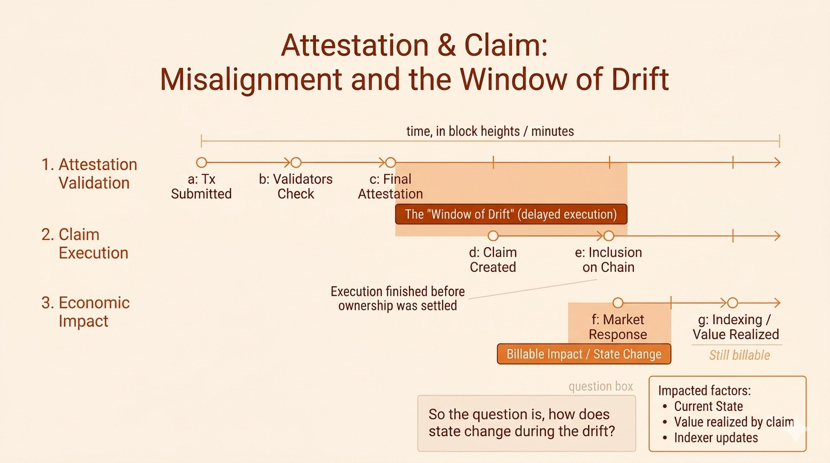
And by the time it moves, the system is already past the point where verification could have corrected anything.
That’s where most assumptions around Sign start breaking.
Because the primitives look solid. Schema. Issuer. Signature. Status. Query. Done. The flow feels deterministic, so people start trusting it as if the administrative layer feeding it is just as stable.
It isn’t.
Authority shifts. Status changes. Meaning compresses. Timing drifts. And none of that shows up as failure inside the protocol itself. It just shows up in outcomes.
A wallet stays eligible longer than it should.
Another one misses the window entirely.
Both cases pass through a system that technically worked.
That’s the uncomfortable part.
The system doesn’t need to be wrong to produce the wrong result. It just needs to be slightly out of sync with the moment it’s being used.
And once TokenTable is involved, that sync gap becomes economic.
This is where Sign stops being about verification and starts being about timing under execution.
Especially in environments pushing toward coordinated digital infrastructure, where identity, capital, and policy all sit on the same rails. The Middle East is moving in that direction fast. Which means these timing assumptions don’t stay theoretical. They compound.
Because now the same record is expected to hold across multiple systems, multiple reads, multiple decisions, without drifting even slightly.
That’s not a verification problem.
That’s a pressure problem.
And most systems don’t break at design.
They break at timing.
Sign doesn’t throw errors when that happens. It keeps moving.
And that’s exactly why the outcome is where the mistake finally shows up.
#SignDigitalSovereignInfra $SIGN @SignOfficial
