
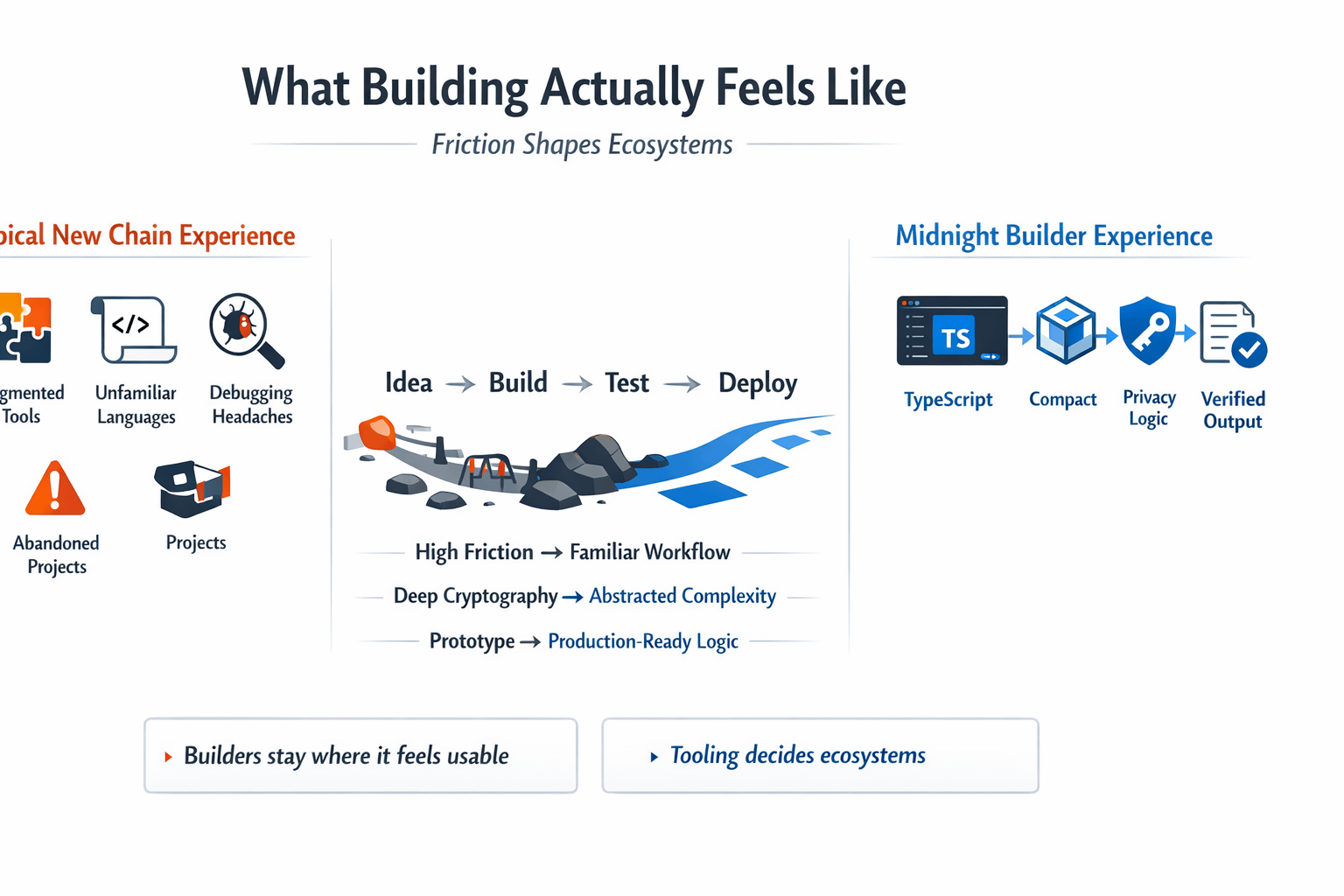
Lately I’ve been thinking a lot about how developer ecosystems really form in crypto.
Not from announcements or hackathons, but from what it actually feels like to build day-to-day.
That’s what made me look at Midnight Network a bit differently.
If you go back to early Ethereum, the ecosystem didn’t grow because Solidity was great. It grew because the underlying idea was strong enough that developers were willing to push through the friction.
That’s kind of the lens I’m using here.
Most new chains follow the same playbook. Grants, hackathons, documentation, and then hope momentum builds. Usually you end up with a few polished demos and a lot of half-finished projects.
Midnight seems to be approaching this from a slightly different starting point.
What stood out first is the decision to build around TypeScript.
That might not sound like a big deal, but it changes who can realistically participate. A lot of developers already understand the tooling, the patterns, the debugging flow. So instead of learning everything from scratch, they’re stepping into something familiar.
That lowers the initial barrier more than most people think.
Then there’s Compact.
From what I understand, it sits on top of TypeScript and handles the zero-knowledge part under the hood. Developers can build privacy-preserving logic without needing to fully understand the cryptography behind it.
That separation feels important.
Because historically, ZK has been a pretty narrow field. If building with it requires deep expertise, the ecosystem stays small no matter how powerful the tech is.
So the idea here seems to be: keep the capability, reduce the friction.
Whether that balance actually holds is something I’m still unsure about.
We’ve seen cases where simplifying things also limits what developers can do. Midnight seems to be trying to avoid that by keeping full ZK capability while making it more accessible.
That’s not an easy line to walk.
Another part I find interesting is how Midnight doesn’t seem to force everything into its own environment.
The architecture leans toward hybrid applications. You could use Midnight for privacy-heavy components while relying on other chains for settlement or liquidity.
That feels more aligned with how the space is evolving.
At the same time, there are still some obvious unknowns.
Every new ecosystem faces the same loop. Developers go where users are, and users go where useful applications exist. Breaking that cycle is always the hard part.
Midnight has a strong angle with privacy, but whether that’s enough to attract builders early is still an open question.
Tooling will matter more than anything.
Documentation, debugging, monitoring — all the less exciting parts. These are the things that determine whether developers stay or quietly leave after trying things out.
From the outside, it looks like Midnight is putting some effort there, but that’s something you only really understand by actually building.
I also keep coming back to the positioning.
It doesn’t feel like Midnight is trying to compete directly with general-purpose chains. It’s targeting use cases that actually need privacy — identity, compliance, asset management, things that don’t fit well in public-by-default systems.
That’s a narrower focus, but maybe a more realistic one.
So the real question isn’t just whether developers can build on Midnight.
It’s whether this is the kind of place they need to build.
Still early, but that’s probably what will decide how the ecosystem forms over time.