


Bittensor runs on subnets. These are small networks inside the main Bittensor chain. Each subnet focuses on one AI task. Miners build models or run compute. Validators check the work. Rewards come in TAO tokens. Simple, or is it?
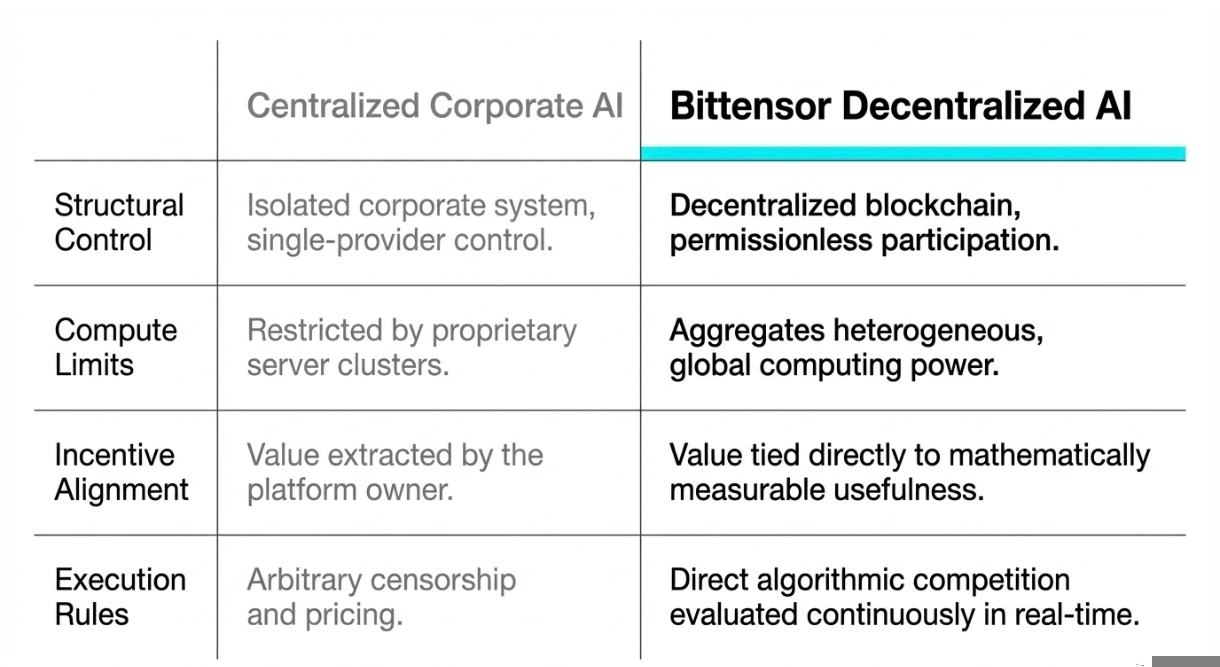
Artificial intelligence is scaling at a speed that traditional infrastructure struggles to support, yet the ultimate control over this intelligence remains highly concentrated. A limited number of corporate organizations train the largest foundation models, own the underlying physical infrastructure, and define the absolute rules of access for the global public.
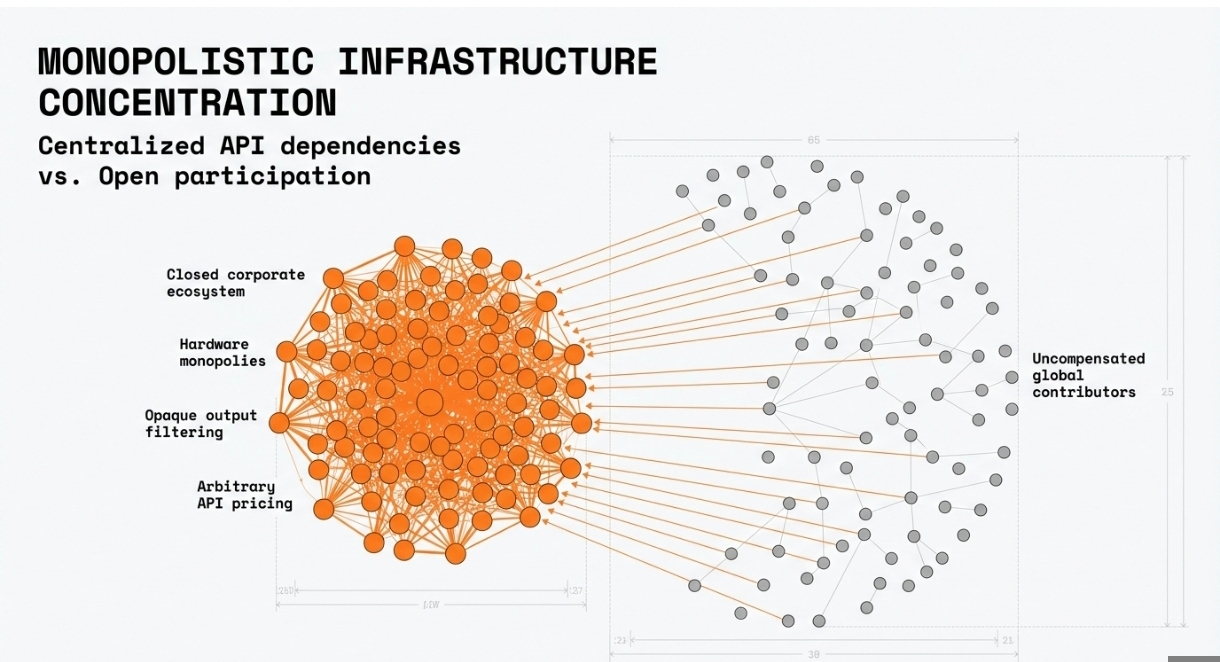
Developers across the world depend entirely on application programming interfaces that they do not control. Pricing structures for these interfaces can change without warning, output policies remain heavily opaque, and access can be revoked arbitrarily. Furthermore, the countless contributors who provide raw data, computational power, or algorithmic improvements do not capture meaningful financial value from the massive corporate systems they help build.
This dynamic creates a severe structural imbalance. The engineers and researchers who build applications on top of artificial intelligence are entirely separated from the core systems themselves. Bittensor approaches this structural problem through a completely different paradigm.
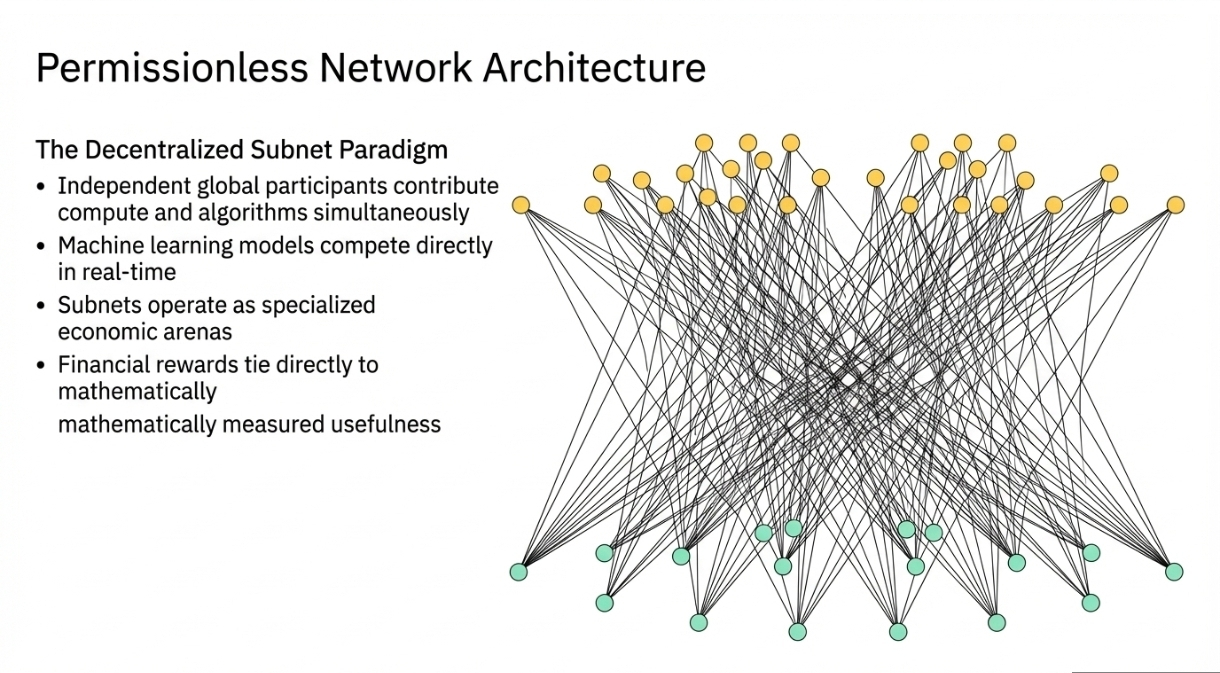
Instead of relying on a single isolated corporate system, it introduces a decentralized blockchain network where many independent global participants contribute computational power and algorithmic intelligence simultaneously. Within this permissionless network, machine learning models compete directly against one another. Outputs are evaluated continuously in real time, and financial rewards are tied directly to measurable usefulness.
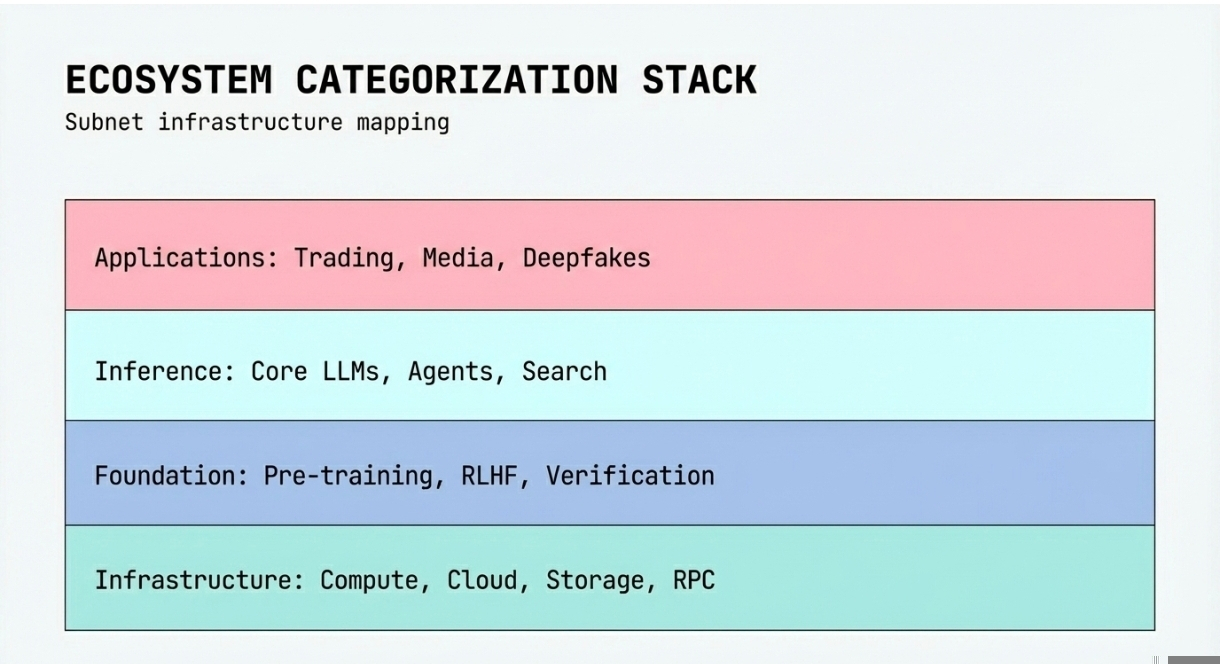
At the absolute center of this network design are subnets. Subnets are the specialized economic arenas where computational tasks are defined, complex work is performed, and blockchain rewards are distributed. Each subnet focuses on a highly specific domain problem, ranging from simple text generation and zero knowledge cryptographic proofs to complex financial market predictions and deepfake detection. Each subnet enforces its own specific operating rules, algorithmic evaluation methods, and competitive economic dynamics.
This comprehensive research report we'll break down exactly how these subnets function at a granular level. We will explore the technical architecture of the network, including the specific incentive mechanisms, validator behaviors, and the dynamic token economies that drive participant competition. Following this architectural breakdown, you will read an exhaustive examination of twenty major Bittensor subnets. The primary objective is to understand how these decentralized environments function as production systems and open free markets simultaneously.
II. What Are Bittensor Subnets
Bittensor is a network where different groups work on different AI problems. Each group focuses on one specific type of task:
One group generates text
One group creates embeddings
One group ranks results
One group predicts outcomes
Inside each group, participants compete to produce better results. The better the result, the higher the reward.
That group is a subnet.
Instead of a single system doing everything, the network is divided into many specialized systems. Each improves through competition.
But the key idea is not just specialization. It is a competition inside specialization.
Two miners inside the same subnet are not collaborating. They are competing to prove their output is more useful. That competition is what drives improvement.
❍ Technical Explanation
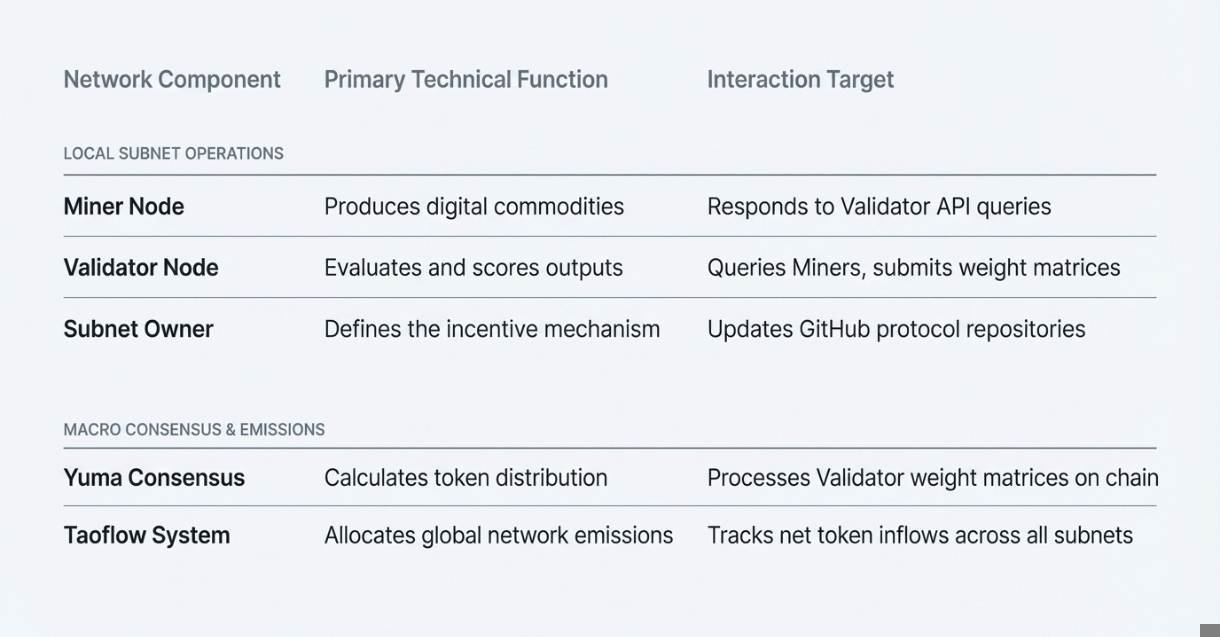
A subnet is an isolated incentive mechanism deployed on the Bittensor network.
Each subnet contains:
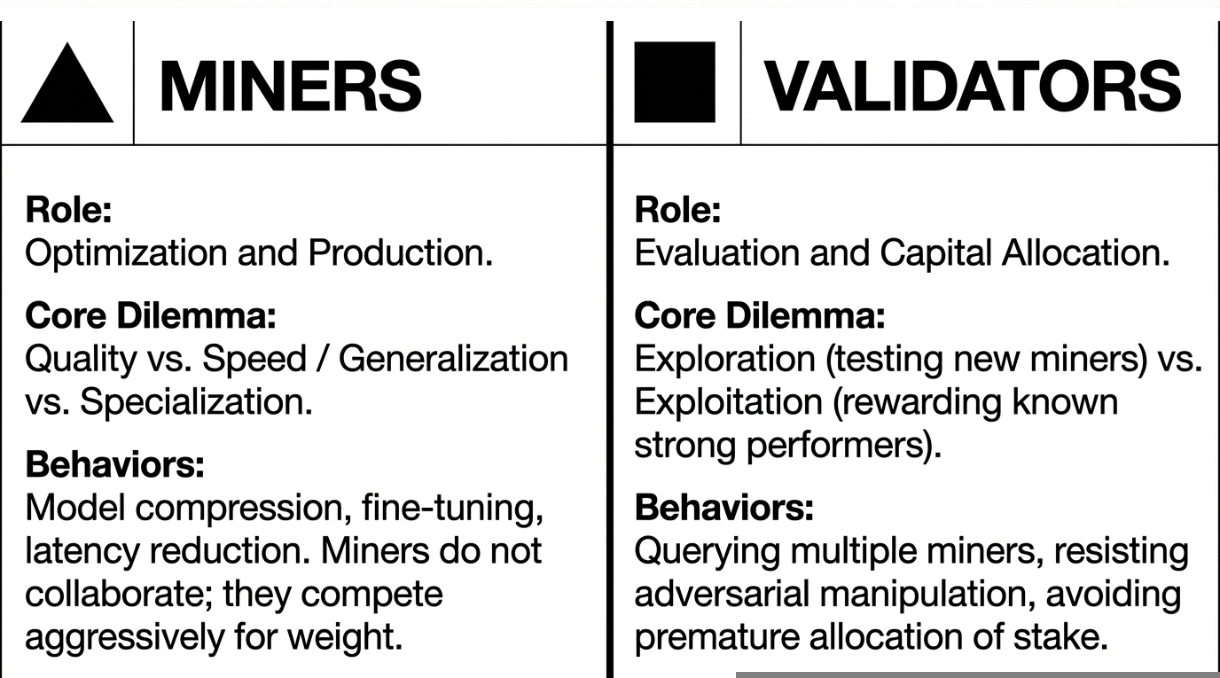
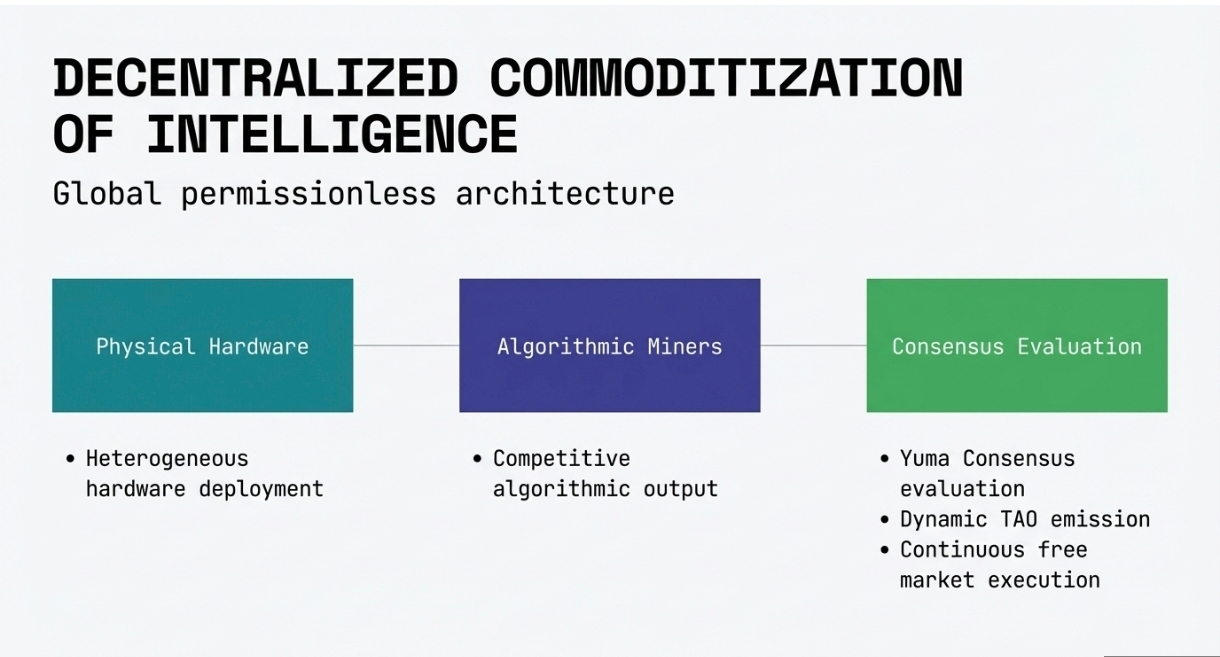
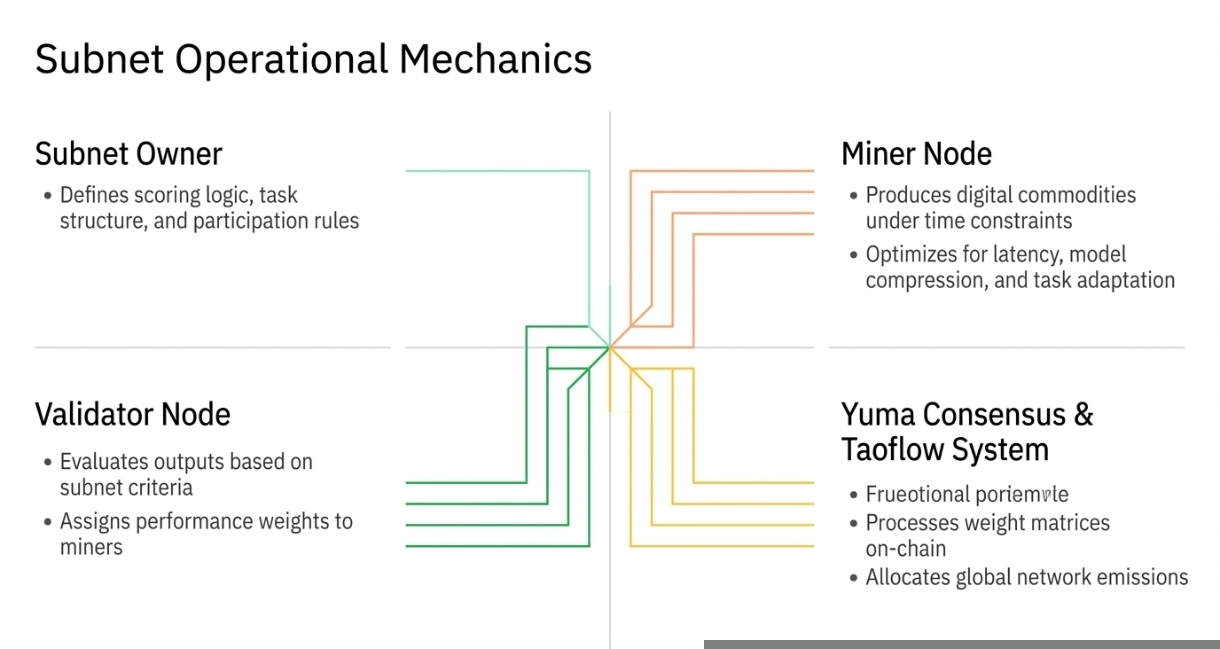
Miners : Nodes that produce outputs. These outputs depend on the subnet’s task. Examples include text, vectors, predictions, or structured data. Miners bring their own models, optimization strategies, and infrastructure.
Validators : Nodes that evaluate miner outputs. They assign scores based on defined criteria. Validators are not passive observers. They are economic actors whose success depends on correctly identifying high-performing miners.
Weight Matrix : Validators assign weights to miners. These weights determine how rewards are distributed. Over time, this creates a dynamic ranking system inside each subnet.
Emission Allocation : The global emission of TAO is distributed across subnets. Each subnet then distributes its share internally based on performance.
Subnet Owner (Governor) : Defines scoring logic, task structure, and participation rules. This role has significant influence over how incentives are shaped.
Each subnet operates independently but competes globally for capital and attention.
❍ Key Property
A subnet is not just a technical unit. It is an economic system.
It defines what counts as useful
It defines how usefulness is measured
It defines how value is distributed
Everything else follows from that.
If usefulness is poorly defined, the entire subnet degrades.
If evaluation is weak, miners exploit it.
If rewards are misaligned, participation drops.
The entire system depends on incentive design.
III. How Subnets Work Internally
1. Miner Behavior
Miners provide outputs.
They:
Run models locally
Process inputs from validators
Return results under time constraints
But the system does not reward effort. It rewards results. That creates a strong filter.
A miner using a large, expensive model is not guaranteed success. If that model is slow or inconsistent, it loses weight. A smaller, optimized model can outperform it by being faster and more reliable. This leads to:
Model compression strategies
Fine-tuning for specific tasks
Latency optimization
Query-specific adaptation
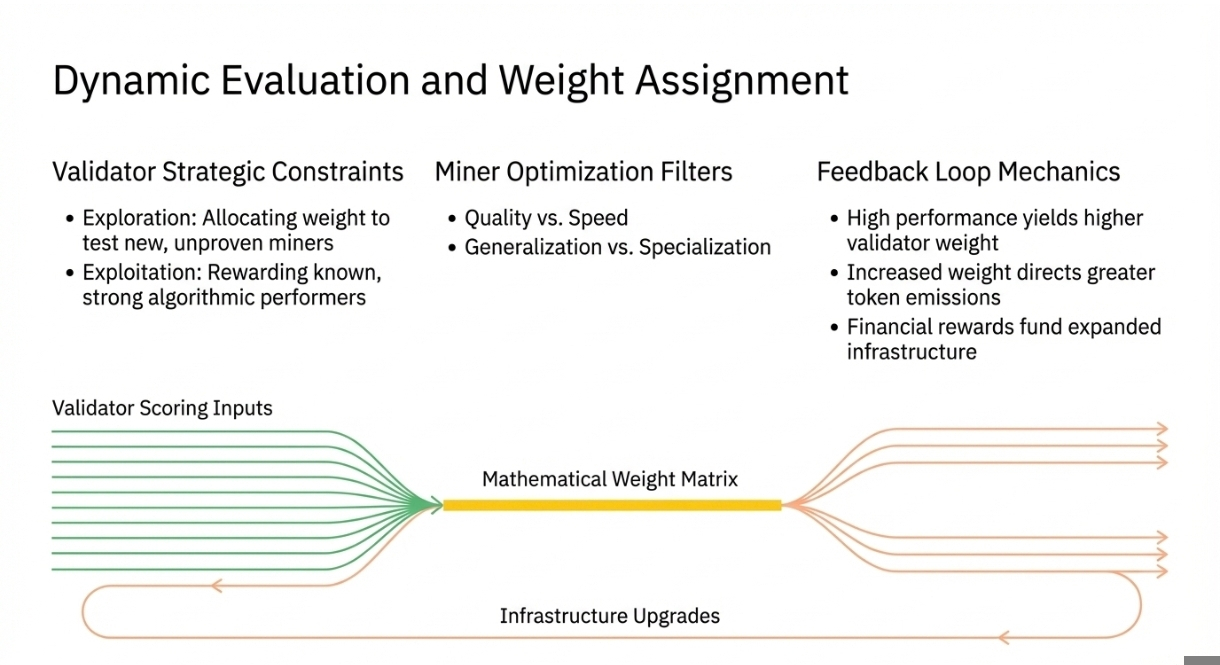
Miners are constantly balancing:
Quality vs speed
Generalization vs specialization
2. Validator Behavior
Validators are evaluators, but also strategic actors. They:
Query multiple miners
Compare outputs
Assign scores
But they are not neutral.
Their rewards depend on correctly identifying high-performing miners early. This creates a strategic problem similar to portfolio allocation:
Allocate weight too early → risk backing weak miners
Allocate too late → miss early rewards
Validators must constantly balance:
Exploration → testing new miners
Exploitation → rewarding known strong performers
They also face adversarial behavior:
Miners optimizing specifically for validator patterns
Short-term spikes in performance
Hidden overfitting
3. Weight Assignment
Each validator produces a vector of weights. These weights:
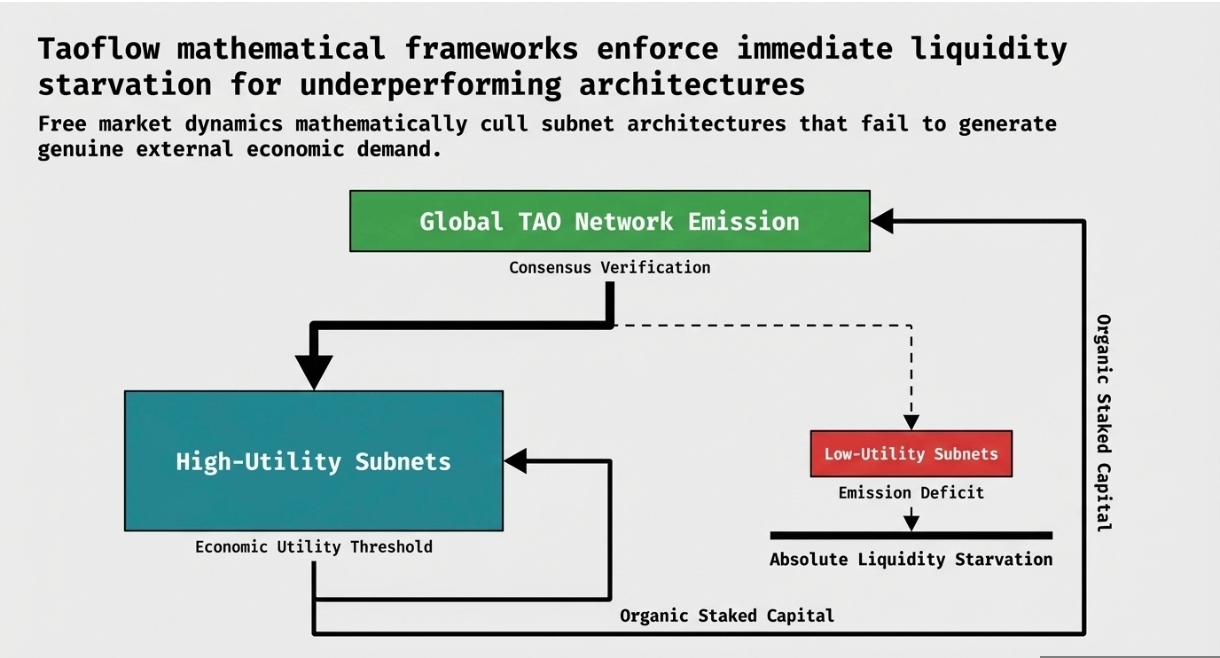
Represent trust in each miner
Influence reward distribution
But weights also influence perception.
If multiple validators assign high weights to a miner, that miner gains dominance. This creates a feedback loop:
Good performance → higher weight
Higher weight → more rewards
More rewards → better infrastructure
This can lead to concentration if not balanced by competition.
4. Reward Distribution
Rewards flow in two steps:
TAO is allocated to subnets
Subnets distribute rewards internally
Inside a subnet:
Validators receive rewards based on stake and scoring quality
Miners receive rewards based on weights
The important part is that distribution is continuous.
This creates:
Real-time competition
Immediate feedback loops
No long-term guarantees
5. Scoring Mechanisms
Each subnet defines its own evaluation logic.
This is the most important design layer.
Scoring determines:
What outputs are rewarded
What behaviors are encouraged
What strategies miners adopt
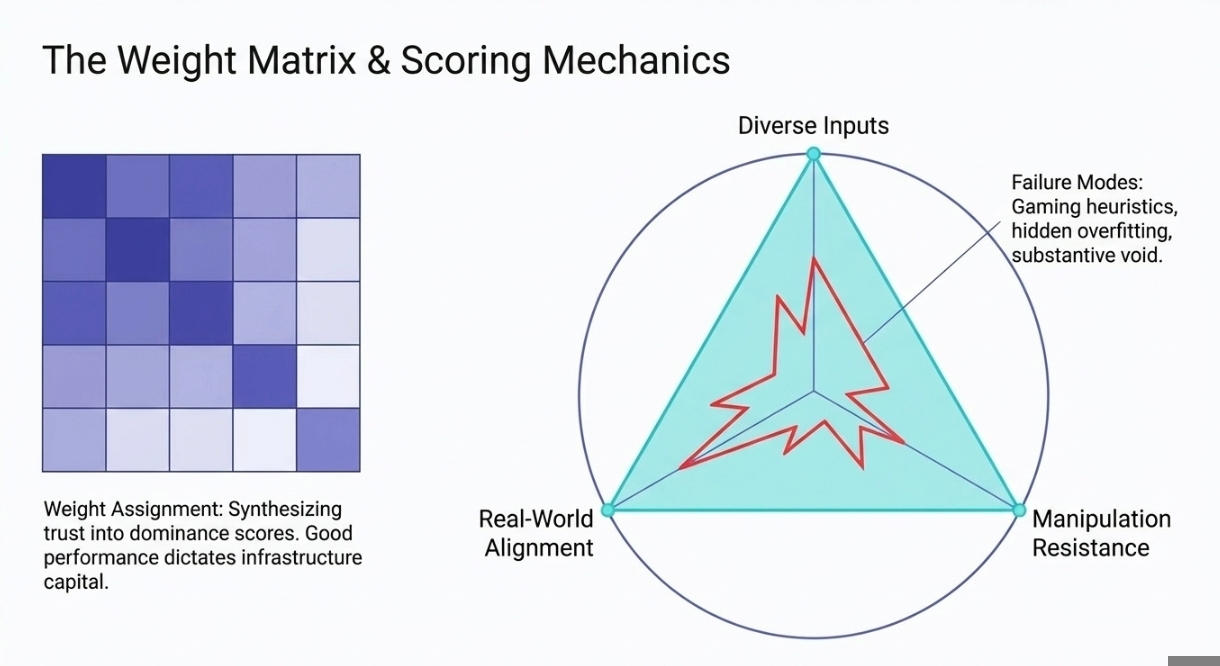
If scoring is poorly designed, miners will optimize for the wrong target.
Examples of failure:
Overfitting to known test cases
Producing outputs that look correct but lack substance
Gaming evaluation heuristics
Good scoring requires:
Diverse evaluation inputs
Resistance to manipulation
Alignment with real-world usefulness
IV. Subnet Economics and Competition
1. Competition for Validators
Validators choose where to allocate their stake. They prefer subnets that:
Offer stable rewards
Have clear evaluation logic
Show consistent output quality
But they also look for asymmetry.
Early subnets with strong potential can offer higher returns, even if they are unstable.
2. Competition for Miners
Miners choose where to deploy their models.
They evaluate:
Reward potential
Competition intensity
Hardware requirements
A subnet with low competition but decent rewards may be more attractive than a highly competitive one.
3. Emission Dynamics
Subnets compete for a share of global emissions. Over time:
Strong subnets attract more participation
Weak subnets lose activity
This creates a feedback loop:
Quality → participation → improvement → more participation
4. Early vs Mature Subnets
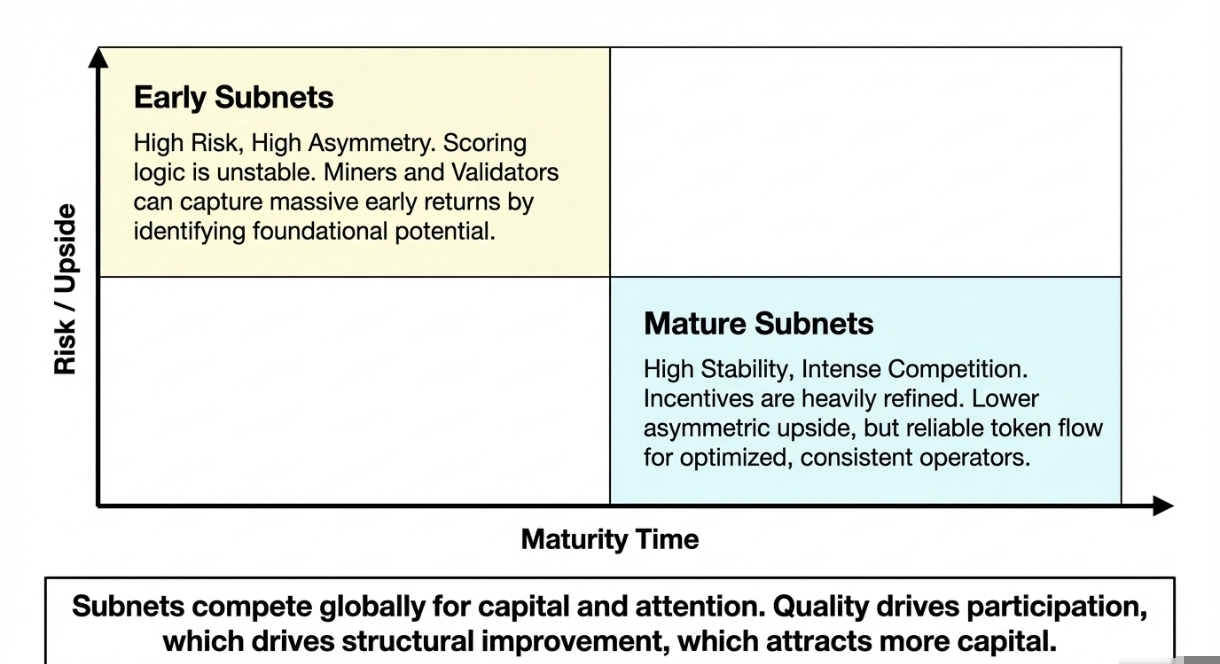
New subnets:
Unstable scoring
High upside
High risk
Mature subnets:
Stable incentives
Lower upside
Strong competition
Participants move between these based on strategy.
V. Top Bittensor Subnets Explained
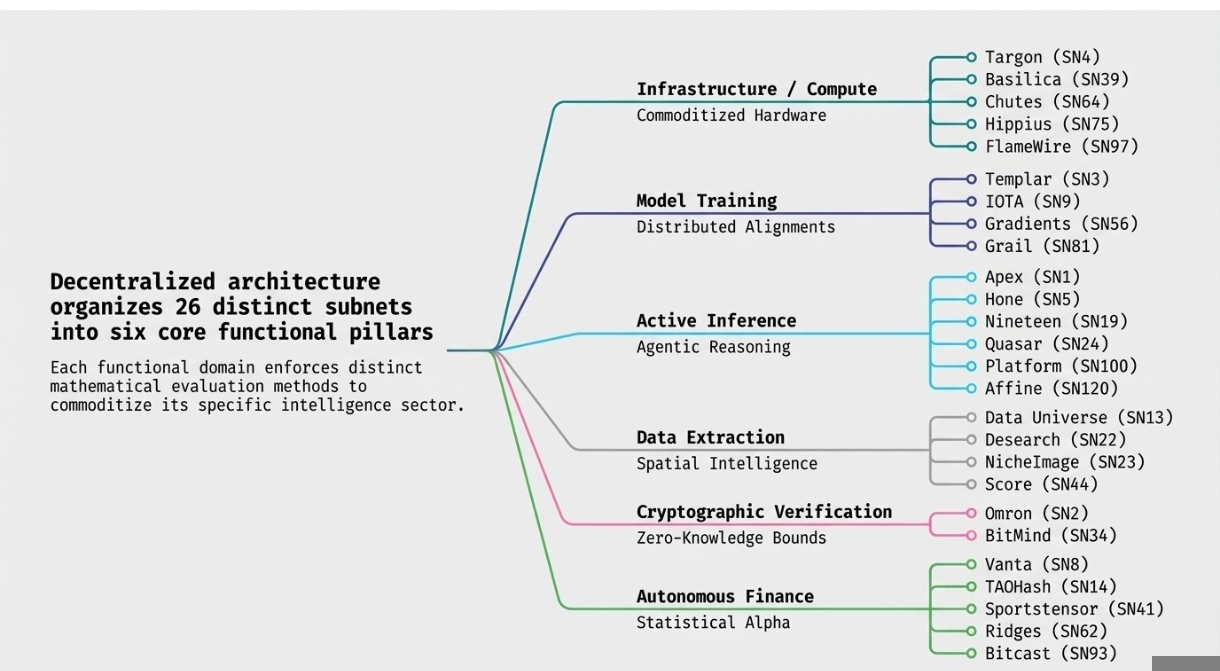
❍ Subnet 1 (Apex - SN1)
Apex serves as the flagship text prompting and agentic reasoning environment within the Bittensor ecosystem. Originally developed as the foundational subnet for natural language processing, it has evolved into a highly competitive arena for algorithmic innovation, handling advanced operations like matrix compression challenges.

What it does / What problem it solves : Apex solves the massive problem of industry dependency on centralized language models. Most current text generation relies entirely on proprietary corporate systems where a single provider controls the access, the pricing structures, and the output filtering. Apex introduces a decentralized alternative where multiple independent models respond to the exact same natural language prompts simultaneously. It provides highly specialized intelligence as a digital commodity, allowing users to interact with advanced open source language models like LLaMA and Mistral through standardized application programming interfaces. It actively tackles complex optimization problems, such as matrix compression, to drastically reduce the memory overhead required during large scale model inference.
How it works: Validators generate and send specific text prompts to a distributed set of miners across the network. Each miner processes the input locally and generates a text response under strict time constraints. Validators then compare these varied responses using advanced scoring functions to evaluate accuracy, speed, and human reasoning capabilities. The validators convert these performance scores into a numerical weight matrix and submit it directly to the blockchain. The consensus algorithm processes these weights and distributes financial rewards to the highest performing miners.
❍ Subnet 2 (Omron - SN2)
Omron is a highly specialized environment focused entirely on zero knowledge machine learning and verifiable computing. Developed by Inference Labs, this subnet bridges the gap between complex artificial intelligence operations and deep cryptographic security.
What it does / What problem it solves : Omron solves the fundamental problem of trust in remote computational processes. When a user requests an output from an artificial intelligence model today, they traditionally have no way to verify that the provider actually used the correct model or processed the data accurately without tampering. Omron introduces cryptographically verified proof of inference. It mathematically guarantees that a specific computation was executed correctly without requiring the verifier to process the underlying data themselves. This capability is absolutely critical for applications requiring high privacy and zero trust verification, such as financial modeling, healthcare diagnostics, and decentralized smart contract execution.
How it works: Validators distribute complex requests for verified inference to miners across the network. Miners receive the input data and generate predictions using artificial intelligence models that have been explicitly converted into zero knowledge mathematical circuits. The miner returns both the generated output and a cryptographic zero knowledge proof. Validators confirm that the miners are acting honestly by mathematically verifying the authenticity of the zero knowledge proof. Rewards are distributed based on proof size, response latency, and the cryptographic integrity of the submission.
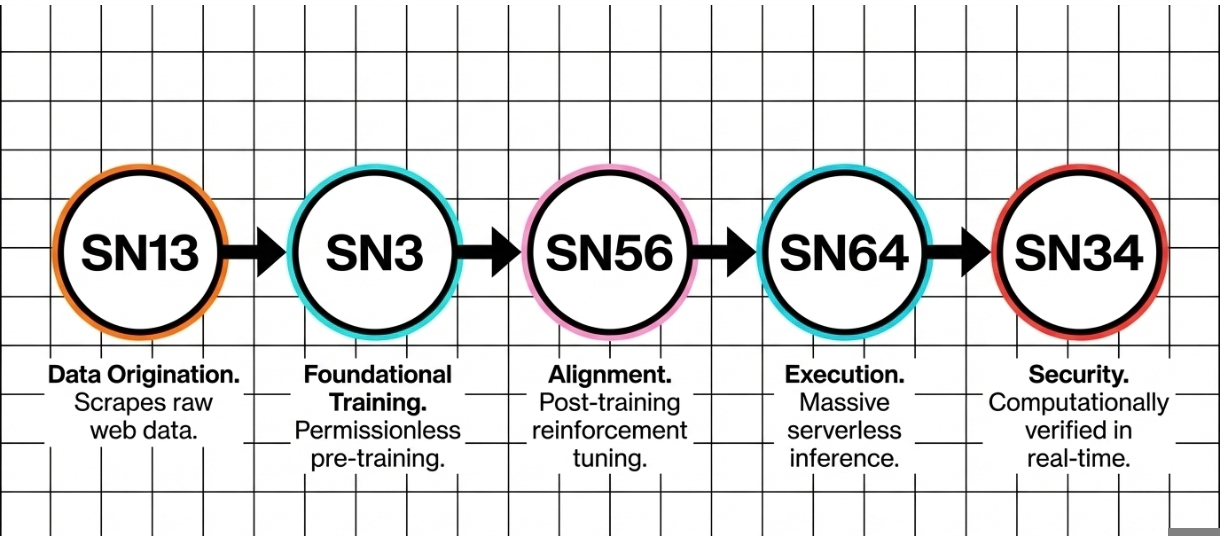
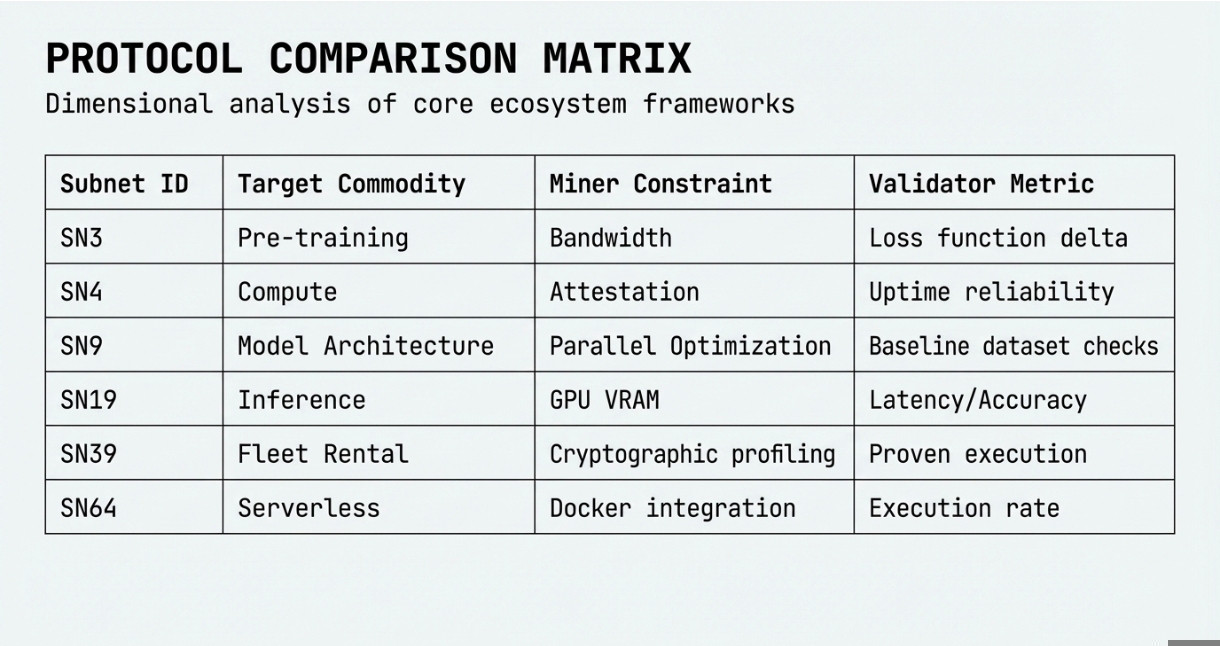
❍ Subnet 3 (Templar - SN3)
Templar functions as a globally distributed infrastructure designed specifically for the permissionless pre-training of massive foundation models. It represents a major leap in decentralized network capabilities by proving that frontier models can be trained without a centralized server cluster.
What it does / What problem it solves : Training frontier artificial intelligence models traditionally requires massive, centralized clusters of highly expensive graphics processing units. This creates extreme computational costs and limits structural innovation to a few well funded corporations. Templar solves this strict hardware bottleneck by aggregating heterogeneous computing power from across the globe. It allows independent hardware nodes to participate in the actual pre-training of massive models. The network recently completed Covenant-72B, a massive language model featuring 72 billion parameters, pre-trained entirely on decentralized infrastructure using standard commodity internet connections.
How it works : The network utilizes a highly specialized technique known as SparseLoCo to overcome standard internet bandwidth limitations. Miners pull training data and perform optimization steps locally on their own hardware clusters. After completing these local mathematical steps, miners heavily compress their specific updates and share them with the broader network. Validators verify the quality and accuracy of these mathematical updates before integrating them into the global model. Miners are financially rewarded based strictly on the quality and volume of their mathematical contributions to the shared neural architecture.
❍ Subnet 4 (Targon - SN4)
Targon operates as a massive decentralized compute market and confidential cloud computing platform. Developed by Manifold Labs, it provides a foundational infrastructure layer where users can rent graphics processing units securely and efficiently.
What it does / What problem it solves : Targon solves the problem of high cost, centralized cloud computing monopolies. Developers require constant access to reliable hardware to train and deploy models, but traditional cloud providers charge significant corporate premiums. Targon creates an open, highly liquid marketplace for raw computational resources. Furthermore, it addresses the critical issue of data privacy by implementing the Targon Virtual Machine. This virtual machine allows for confidential workload execution and secure hardware attestation via NVIDIA integrations. This structural security ensures that sensitive enterprise data remains entirely secure even when processed on decentralized hardware clusters.
How it works: Miners attach their physical hardware clusters to the network and offer computational power to the open free market. Validators continuously run health checks and utilize secure attestation protocols to verify the exact physical specifications and reliability of the hardware provided by the miners. The network utilizes a dynamic auction system where bids are sorted and payouts are adjusted based on real time market equilibrium. Miners execute the requested inference tasks, and validators distribute blockchain rewards based on the speed, accuracy, and proven absolute uptime of the hardware.
❍ Subnet 5 (Hone - SN5)
Hone is an advanced research environment focused entirely on hierarchical learning and the pursuit of artificial general intelligence. It distances itself from standard conversational language models to focus purely on complex logical reasoning benchmarks.
What it does / What problem it solves : Current artificial intelligence models excel at simple pattern matching and text prediction but struggle immensely with abstract reasoning, logic, and multi-step planning. Hone aims to solve this critical limitation by developing complex models that learn and think in multiple hierarchical levels, similar to biological human cognition. The subnet specifically targets the ARC-AGI-2 benchmark, which is widely considered one of the most difficult open challenges in the field of machine reasoning. By moving away from simple text generation and focusing entirely on self supervised world modeling, Hone provides a decentralized laboratory for generating true reasoning capabilities.
How it works Validators design and compile novel reasoning problems based on strict intelligence benchmarks. Instead of running open solvers directly, miners develop complex algorithms and point the network to specific code repositories containing their unique solutions. Validators pull these solutions and execute them within a highly secure, isolated graphical processing unit sandbox. The validators measure how efficiently and accurately the miner's algorithm solves the novel reasoning problem. Miners who provide the most accurate logical solutions receive the highest proportion of the daily financial emissions.
❍ Subnet 8 (Proprietary Trading Network - SN8)
The Proprietary Trading Network, occasionally referred to as Vanta, is a specialized financial environment. It bridges decentralized machine learning directly with global financial market forecasting.

What it does / What problem it solves Predicting financial markets requires massive data synthesis, extreme latency optimization, and complex modeling. Traditional quantitative trading firms keep their predictive algorithms entirely hidden behind corporate firewalls. Subnet 8 solves this closed ecosystem by crowdsourcing financial predictions through a massive decentralized network of autonomous machine learning traders. It provides a strict simulated trading system where miners forecast the price movements of foreign exchange markets, cryptocurrency assets, and major traditional financial indices. This creates an open, verifiable track record of predictive accuracy that can be utilized by downstream applications or institutional investors.
How it works Miners act as autonomous quantitative traders, analyzing live market data and submitting long or short trading orders directly into the network. Validators process these orders and track the exact mathematical performance of each miner's specific portfolio in real time. Validators rank the miners using a complex scoring system that calculates the return rate, the Omega ratio, and the Sortino ratio to thoroughly evaluate risk adjusted performance. Miners are heavily penalized for inconsistent trading behavior, and only the most stable, profitable miners receive the daily token emissions.
❍ Subnet 9 (IOTA - SN9)
The Incentivized Orchestrated Training Architecture focuses entirely on the continuous, decentralized pre-training of foundation models. Developed by Macrocosmos, it transforms isolated hardware components into a single cooperating architectural unit.
What it does / What problem it solves Early attempts at decentralized model training required every single network participant to fit an entire massive model on their local hardware. This created extreme hardware bottlenecks and encouraged participants to hoard their high performing models rather than share them. IOTA solves this severe limitation by introducing data parallel and pipeline parallel training across an unreliable global network. It allows miners to train only a highly specific segment of a massive model, similar to how different distinct regions of the human brain handle different tasks. This drastically reduces the physical hardware requirements for individual participants while maximizing output.
How it works An orchestrator protocol actively distributes different specific layers of a foundational model across hundreds of heterogeneous miners. Miners perform local mathematical optimization steps on their assigned segment of the model using an asynchronous algorithm. They stream their specific mathematical updates back to the network architecture. Validators download the updated models from public repositories and continuously evaluate their strict performance against baseline datasets. Rewards are distributed based directly on how much a miner's specific update improves the global loss function of the entire model.
❍ Subnet 13 (Data Universe - SN13)
Data Universe operates as the foundational data scraping and storage layer for the entire Bittensor ecosystem. It is designed to collect, index, and distribute massive amounts of fresh global information.

What it does / What problem it solves Artificial intelligence models degrade quickly without continuous access to fresh, relevant data. Subnet 13 solves this critical infrastructure problem by providing the world's largest open source social media dataset. It continuously scrapes and stores billions of rows of public data, allowing enterprise businesses to track brand sentiment and market shifts in real time. By decentralizing the scraping process, it completely undercuts the pricing monopolies of centralized data brokers while providing raw material that is immediately usable by other subnets for training or active inference operations.
How it works Miners actively scrape specific categories of data from the internet based on dynamic labels requested by the subnet validators. Miners upload this raw data into decentralized storage buckets using secure cryptographic authentication protocols to prevent spoofing. Validators pull this uploaded data and rigorously evaluate it based on the uniqueness, the exact source origin, and the freshness of the information. Miners receive high scores for delivering highly relevant, non redundant data, and these performance scores translate directly into network token emissions.
❍ Subnet 14 (TAOHash - SN14)
TAOHash represents a highly unique bridge between external proof of work networks and the Bittensor machine learning ecosystem. It operates as a highly decentralized hardware mining pool.
What it does / What problem it solves Traditional cryptocurrency mining pools are heavily centralized, giving massive unearned control to a few corporate pool operators. TAOHash solves this by decentralizing the physical pool structure using the Bittensor consensus mechanism. It incentivizes traditional Bitcoin miners to allocate their raw hardware hashing power directly to subnet validators. In return, participants receive their standard Bitcoin block rewards alongside additional Alpha token emissions directly from the Bittensor network. This creates a highly profitable dual yield environment that improves the decentralization of external networks while driving vast value into the local ecosystem.
How it works External hardware miners point their raw computational hashing power toward the specific network proxies managed by the validators. The validators mathematically measure and verify the exact amount of valid hash rate contributed by each individual miner over a specific thirty day time period. The validators submit these verified physical performance metrics to the blockchain. The consensus algorithm then distributes the subnet token emissions proportionally, ensuring that miners are fairly rewarded for their exact computational physical contribution to the global pool.
❍ Subnet 19 (Nineteen - SN19)
Nineteen is a massive operational inference engine managed by Rayon Labs. It focuses entirely on executing user requests for highly advanced, open source artificial intelligence models at peak efficiency.
What it does / What problem it solves Running active inference on large language models and complex image generators requires significant computational bandwidth and heavy graphics processing unit availability. Most average users cannot run these models locally, forcing them to rely on expensive, centralized corporate web services. Nineteen solves this bottleneck by providing decentralized artificial intelligence inference at a massive global scale. It offers a unified application programming interface that allows users to interact seamlessly with top tier models like LLaMA 3 and various Stable Diffusion derivatives. It consistently outperforms traditional centralized competitors by offering lower latency and significantly reduced operational costs.
How it works: Validators act as highly efficient routers, receiving organic inference requests from external end users and distributing these complex queries across the active network of miners. Miners receive the prompt, process the data locally through the requested open source model, and immediately return the generated output. Validators mathematically measure the response time, the exact accuracy of the output, and the overall reliability of the physical miner. Miners who consistently provide fast, high quality inference without failing secure higher network weights, capturing the majority of the token emissions.
❍ Subnet 22 (Desearch - SN22)
Desearch operates as a real time decentralized search layer designed specifically for autonomous artificial intelligence agents and human developers.

What it does / What problem it solves Large language models consistently suffer from hallucinations and outdated information because their training data has a strict cutoff date. They require external search tools to access live data, but traditional search APIs are highly expensive and heavily censored by corporate algorithms. Research solves this by providing a high throughput, permissionless search application programming interface. It allows autonomous agents and human developers to pull real time data from the web without relying on centralized bottlenecks. It provides rapid access to current global events, drastically lowering the cost of search queries while entirely removing arbitrary algorithmic censorship.
How it works Validators generate complex internet search queries based on organic external user demand or synthetic programmatic benchmarking. Miners receive these specific queries, rapidly scrape the live internet, and aggregate the most highly relevant data. The miners format this raw unstructured data into structured mathematical responses and return it to the network. Validators score the miners based on the exact latency of the response, the exact relevance of the retrieved links, and the factual accuracy of the extracted text. Fast, highly accurate miners secure the highest network weight allocations.
❍ Subnet 23 (NicheImage - SN23)
NicheImage is a distributed network dedicated entirely to the rapid generation of high quality digital imagery using advanced decentralized diffusion models.
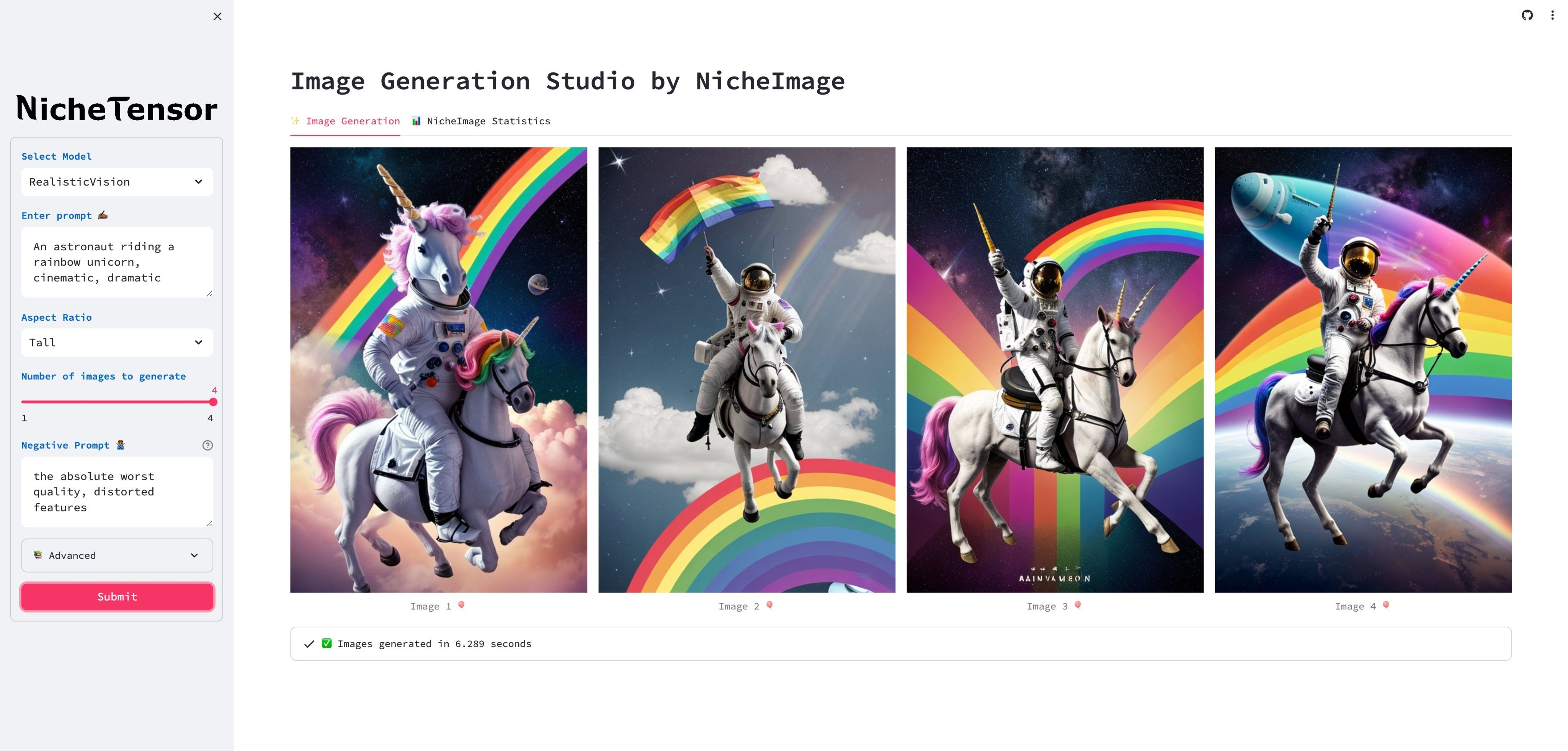
What it does / What problem it solves Centralized image generation platforms are often heavily restricted, highly censored, and aggressively priced to maximize corporate profits. Users are locked into strict monthly subscriptions and lack full physical control over the generation parameters. NicheImage solves this monopoly by decentralizing the actual rendering process across hundreds of independent graphical processing units globally. It allows users to request highly specific digital images without facing arbitrary corporate filters or steep corporate paywalls. The network heavily leverages the collective hardware of its participants to provide rapid, high resolution visual outputs perfectly on demand.
How it works Validators construct complex textual prompts and broadcast these massive generation requests to the participating hardware miners. Miners utilize advanced local diffusion models to physically render the requested image and return the digital file back to the validator. Validators utilize auxiliary artificial intelligence verification models to evaluate the returned image, checking strictly for prompt alignment, visual clarity, and a lack of visual artifacting. Miners who consistently return high quality digital images that strictly align with the provided prompts receive the highest scores and corresponding financial rewards.
❍ Subnet 24 (Quasar - SN24)
Quasar is a highly technical architectural environment built to completely eliminate the long context memory limitations inherent in modern artificial intelligence language models.
What it does / What problem it solves Traditional transformer models possess a strict context window. If a user inputs a massive technical document, the model literally forgets the beginning of the text by the time it mathematically reaches the end. Quasar solves this "infinite memory" problem by developing new models with a continuous time attention mechanism. This custom neural architecture completely eliminates traditional positional embeddings, allowing the model to process vastly longer sequences of text without suffering from extreme computational degradation. It provides a continuously evolving service of optimized memory retention for complex operations.
How it works Miners download a specific target code repository and actively write complex software to optimize flash linear attention kernels. Miners submit their highly optimized kernel code back to the central network. Validators take this compiled code and execute it strictly inside a sandboxed container to measure the actual computational throughput in exact tokens per second. The validators also run strict logit level inference mathematical checks against a known reference model to ensure the miner's code produces perfectly accurate mathematical results. The fastest, most mathematically accurate kernels dictate the reward distribution.
❍ Subnet 34 (BitMind - SN34)
BitMind operates as a critical digital security layer focused entirely on the rapid detection and computational classification of deepfakes and manipulated synthetic media.

What it does / What problem it solves The rapid advancement of generative artificial intelligence models has created a dangerous environment where synthetic media is visually indistinguishable from objective reality. This erodes foundational trust in digital information and highly accelerates the spread of misinformation. BitMind solves this impending crisis by creating a massive decentralized network of detection algorithms that constantly evolve to computationally identify synthetic content. It provides a reliable, highly authoritative application programming interface that allows massive platforms and everyday users to verify the exact authenticity of images, audio, and video files in real time.
How it works: Validators source a constant massive stream of media, blending completely real organic images with highly advanced synthetic generations from cutting edge models like Flux. This media is distributed rapidly to the network of miners. Miners analyze the specific pixel data and metadata, returning a mathematical probability score indicating whether the media is real or artificially generated. Validators compare the miner's numerical classification against the definitive ground truth data. Miners who achieve the highest mathematical accuracy in detecting subtle synthetic artifacts are rewarded directly with the network emissions.
❍ Subnet 39 (Basilica - SN39)
Basilica functions as a highly robust, trustless marketplace for hardware compute, specifically targeting graphic processing unit rentals and massive fleet management.

What it does / What problem it solves: Renting raw physical hardware in a decentralized environment carries severe operational risks of spoofing, where a provider programmatically lies about the strength of their hardware to secure higher unearned payouts. Basilica solves this security flaw by creating an impenetrable hardware verification system. It introduces an environment where precise hardware specifications are cryptographically proven. By integrating raw market forces and competitive bidding against baseline cloud provider prices, Basilica structurally ensures that decentralized compute remains genuinely affordable and highly secure, rather than just theoretically decentralized.
How it works: Miners who wish to provide hardware must install a secure compiled binary that extensively profiles their specific physical machine and proves its exact capabilities to the network validators. Validators establish secure remote secure shell connections directly to the miner's physical hardware to verify complex computational tasks in real time. The network utilizes smart collateral contracts and an active dynamic bidding system to match massive enterprise demand with the verified hardware fleets. Validators assign weights based strictly on proven hardware uptime, hardware strength, and successful task execution.
❍ Subnet 41 (Sportstensor - SN41)
Sportstensor is a decentralized financial intelligence network designed specifically to identify mathematical edge cases and predict outcomes within sports betting markets.
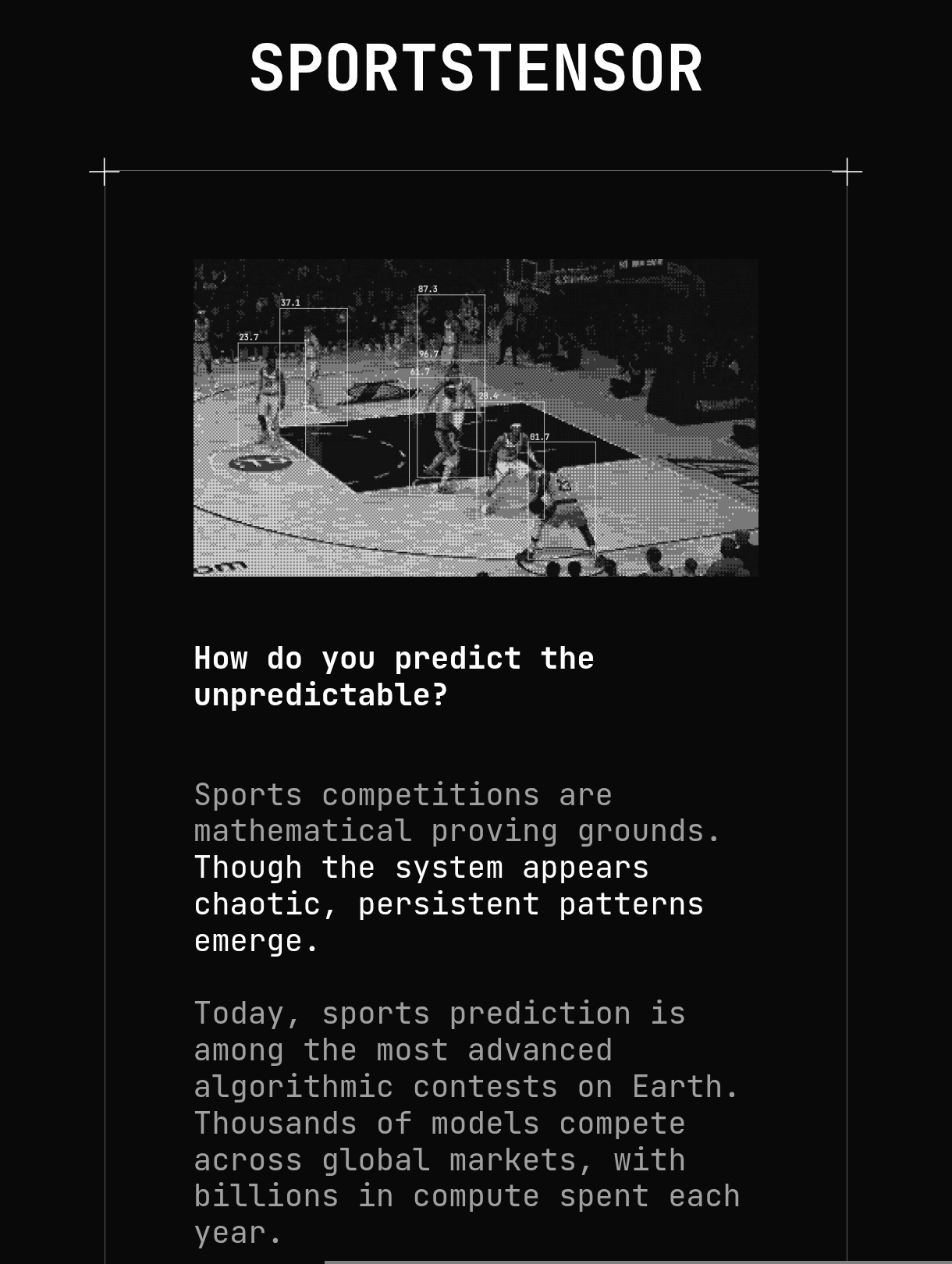
What it does / What problem it solves Predicting sports outcomes is traditionally a solitary, highly isolated pursuit where individual data scientists build models in total isolation. Sportstensor solves this isolation by aggressively aggregating numerous independent statistical forecasts into a single, highly accurate meta model. It creates a frictionless environment where quantitative analysts and machine learning enthusiasts can directly monetize their predictive mathematical models without needing massive starting capital. Furthermore, by routing trades directly into external prediction markets like Polymarket, the network captures tangible external financial value and uses it to sustain the subnet economy.
How it works Miners utilize their own highly complex statistical models or manual strategies to generate specific mathematical predictions regarding future sporting events. These predictions are routed programmatically as actual financial trades through proxy wallets into active prediction markets. Validators monitor this trading activity over a rolling thirty day window, calculating the exact return on investment and evaluating the closing line value of the specific prediction. Miners who mathematically demonstrate consistent, profitable accuracy across hundreds of verified trades secure the daily token emissions, while reckless predictions are filtered out.
❍ Subnet 44 (Score - SN44)
Score focuses on advanced computer vision and video intelligence tracking. It computationally extracts highly valuable metrics and structured mathematical data from raw unstructured video feeds.

What it does / What problem it solves Extracting usable structured data from unstructured video is highly compute intensive and traditionally requires highly expensive, proprietary software. Professional sports teams require precise analytics to evaluate player physical performance and tactics. Score solves this bottleneck by crowdsourcing complex computer vision tasks. It allows the decentralized network to process massive amounts of video data, replicating highly expensive physical tracking systems from standard broadcast footage. Beyond sports, this spatial intelligence applies directly to retail analytics, traffic monitoring, and industrial operations, providing real world revenue generation.
How it works : Validators provide raw video footage directly to the network and define highly specific visual tracking or extraction tasks. Miners process this video data locally, utilizing advanced computer vision models to track specific objects, measure exact physical velocity, or identify distinct spatial events. Validators use advanced vision language models to programmatically generate pseudo ground truth data to evaluate the exact mathematical accuracy of the miners' submissions. The network operates on a twin track system, handling both open algorithmic competitions and private client data processing operations. Miners are rewarded based on the absolute pixel perfect precision of their spatial data extraction.
❍ Subnet 56 (Gradients - SN56)
Gradients provides a high performance, decentralized environment designed specifically for the highly complex post training fine tuning of existing foundation models.
What it does / What problem it solves Training a base neural model is only the first preliminary step in artificial intelligence development. Making that specific model highly useful requires complex mathematical alignment tuning and reinforcement learning. Gradients solves the extreme financial cost of this process by mobilizing a massive distributed network of hardware to execute supervised learning and reinforcement learning from human feedback. It allows external users to upload a specific dataset and have a global network of hardware miners compete aggressively to produce the absolute best performing, highly aligned version of a specific requested model.
How it works : Validators publish specific text datasets and mathematically define the exact fine tuning objective. Miners download the specific base model and execute advanced neural training techniques, constantly adjusting hyperparameters to improve the model's absolute alignment with the requested dataset. Miners submit their fully optimized models back to the centralized network. Validators execute continuous performance mathematical benchmarks to evaluate the intelligence gains and absolute safety alignment of the submitted models. The single highest performing mathematical model secures a strict winner takes all token emission distribution.
❍ Subnet 62 (Ridges - SN62)
Ridges is dedicated entirely to the programmatic creation and massive optimization of autonomous software engineering agents. It aims to completely automate highly complex coding workflows.
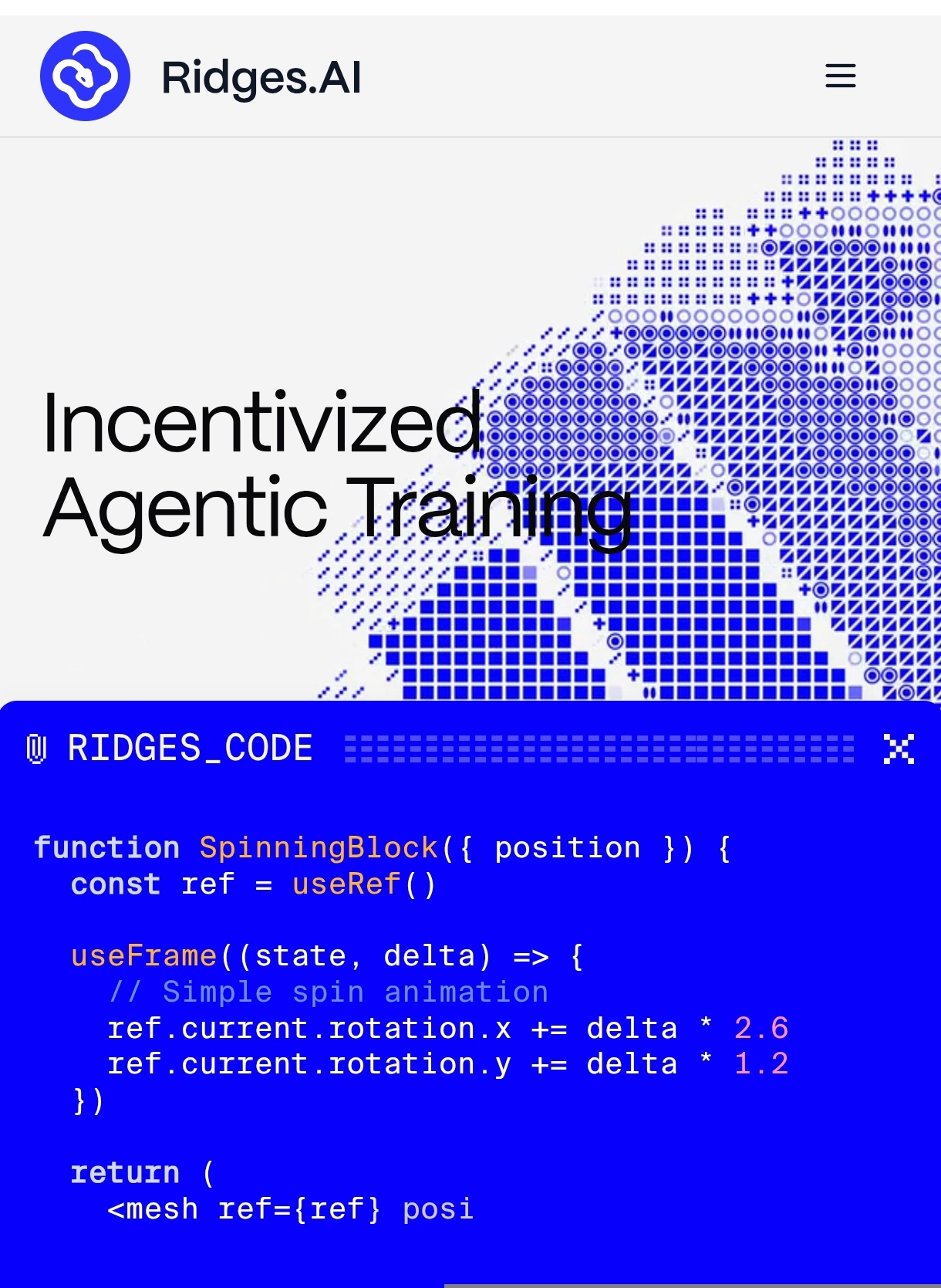
What it does / What problem it solves High quality software engineering is one of the most expensive and scarce commodities in the global financial market. While standard chatbots can write simple localized functions, they completely fail at orchestrating large multi file codebases. Ridges solves this by building autonomous intelligent agents strictly capable of writing, testing, and debugging entire massive software repositories without human intervention. It functions as a massive autonomous agent marketplace where enterprise customers can rent highly capable artificial intelligence systems to manage their backend development at a fraction of standard corporate industry costs.
How it works: Validators dynamically generate or directly source complex, multi step software engineering problems. Miners deploy their custom autonomous algorithms to analyze the specific problem, write the necessary compiled code, and execute local programmatic tests. The miners submit the final code repository back to the validators. Validators evaluate the strict submission based on code efficiency, exact execution error rates, and the raw speed of the algorithmic resolution. Miners whose algorithmic agents successfully solve the most mathematically difficult repository level problems receive the highest proportion of the financial rewards.
❍ Subnet 64 (Chutes - SN64)
Chutes operates as a massive serverless compute platform layer. It is widely considered the premier decentralized alternative to major corporate web service providers.
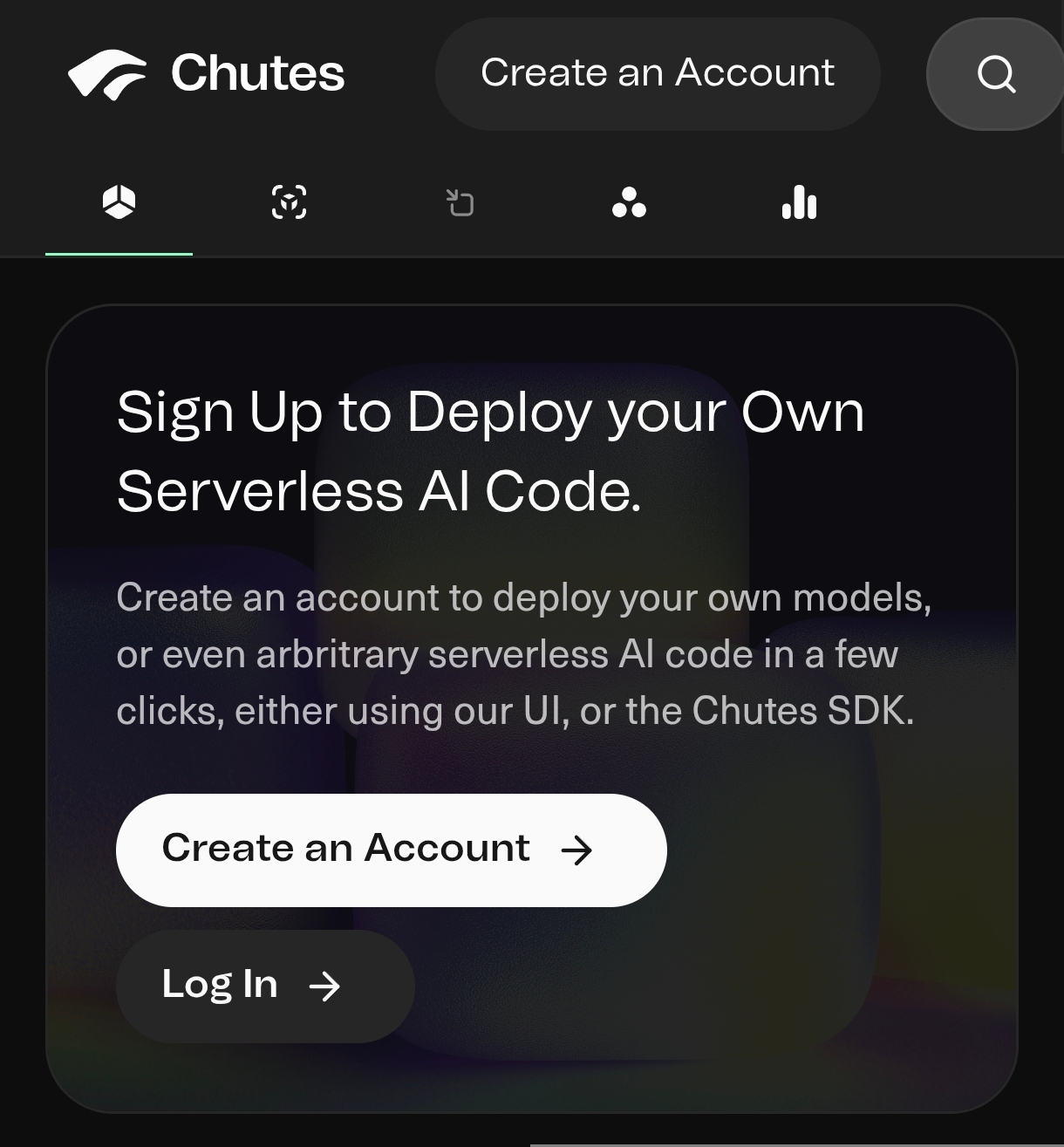
What it does / What problem it solves Deploying artificial intelligence foundation models to live production requires extensive physical infrastructure management. Developers are forced to navigate complex system containerization and pay exorbitant monthly fees for dedicated hardware hosting. Chutes solves this bottleneck by providing instant, frictionless serverless deployment for any open source foundation model. Developers simply interact with a clean application programming interface, entirely bypassing physical infrastructure management. Because the underlying physical hardware is distributed across the global Bittensor network, Chutes delivers this massive scale inference at drastically lower costs compared to centralized corporate cloud providers.
How it works Developers package their specific machine learning models into standard Docker container images and deploy them directly through the network interface. Miners operating active graphics processing units detect these incoming programmatic tasks and execute the containerized workloads locally on their physical hardware. Validators continuously monitor the entire network, tracking the exact latency, physical uptime, and successful mathematical execution rate of every individual miner. External fiat revenue generated by enterprise customer usage is automatically injected into the subnet token economy, while validators distribute token emissions strictly to the most reliable physical miners.
❍ Subnet 120 (Affine SN120)
Affine serves as a critical infrastructure layer that connects and coordinates multiple artificial intelligence subnets to enable scalable inference.
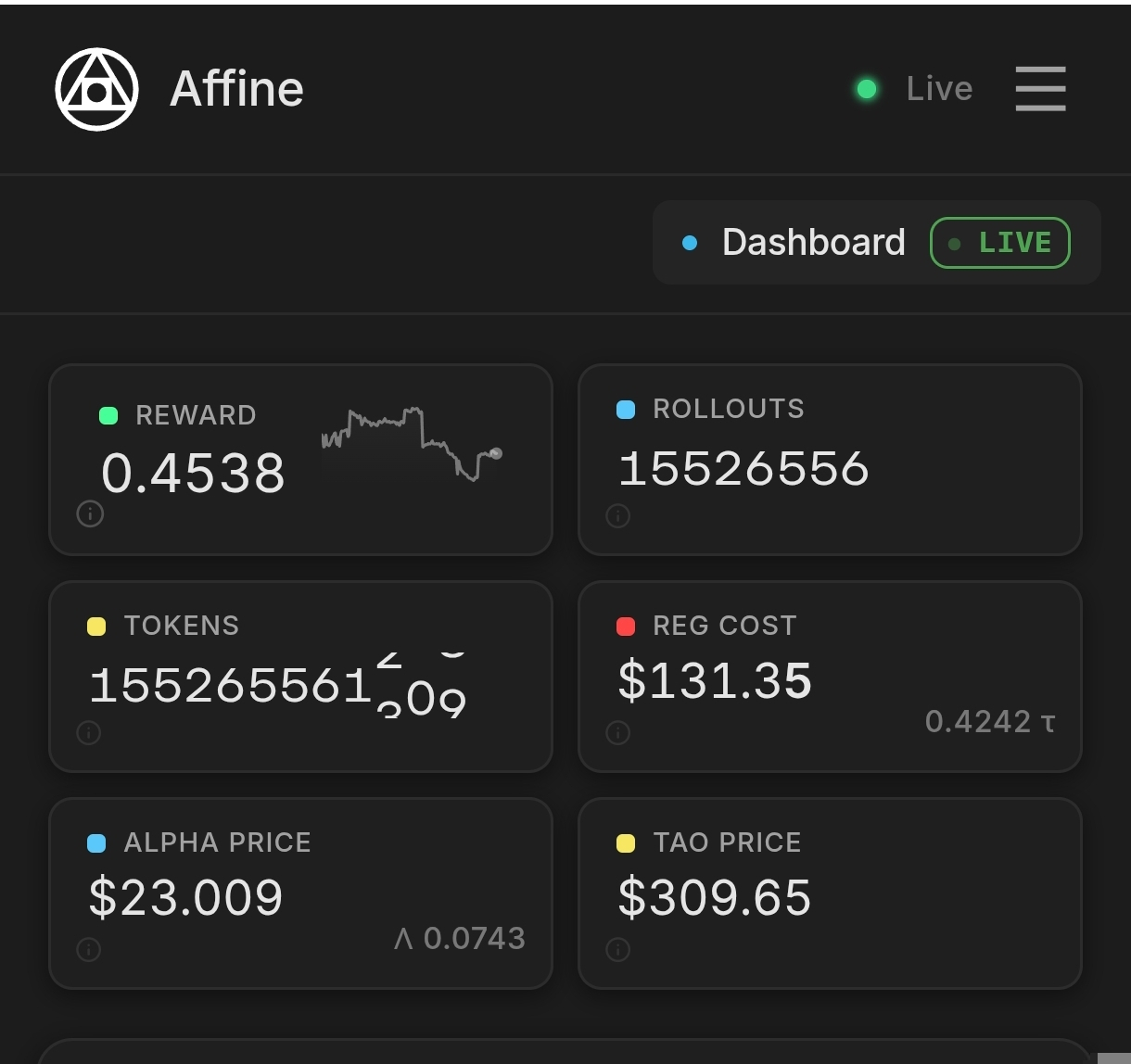
What it does / What problem it solves Affine solves the problem of isolated artificial intelligence development by creating a decentralized reinforcement learning environment. It allows developers to train and continuously refine models for highly complex tasks, including program synthesis and code generation. When a model successfully wins a competition in this environment, the network immediately open sources it for the public. This ensures that the most capable models remain fully accessible to end users rather than locked behind corporate walls.
How it works Miners train and submit advanced reinforcement learning models for evaluation in strictly verifiable environments. To maintain efficiency, miners do not broadcast massive models directly on the blockchain. They leverage Subnet 64 for hosting and active inference. Validators rigorously score these models based on their actual performance in solving complex problems. The network rewards miners who genuinely advance the performance frontier with daily token emissions.
❍ Subnet 75 (Hippius SN75)
Hippius operates as a decentralized and blockchain based cloud storage network designed for persistent and transparent data hosting.
What it does / What problem it solves Hippius removes the global reliance on centralized cloud storage providers like Amazon Web Services and Google Cloud. It provides a highly reliable, censorship resistant storage layer for artificial intelligence applications and everyday users. The network democratizes access to high performance storage by utilizing cryptographic key authentication instead of traditional accounts, guaranteeing total user anonymity and absolute data control.
How it works Miners operate independent storage nodes that host and serve data across a globally distributed network. The platform utilizes a specialized file system and object storage protocols to ensure broad accessibility. Validators actively monitor these storage nodes to verify uptime, redundancy, and data retrieval speed. Validators possess the authority to ban or blacklist miners who repeatedly fail to provide reliable service. Usage and payments are recorded entirely on the blockchain, and reliable miners receive financial emissions.
❍ Subnet 97 (FlameWire SN97)
FlameWire is a decentralized multi chain remote procedure call gateway and application programming interface infrastructure layer.
What it does / What problem it solves Developers require constant, highly reliable access to blockchain data to build applications. Traditional infrastructure providers represent centralized single points of failure that suffer from regional downtime and arbitrary censorship. FlameWire solves this by democratizing access to enterprise level blockchain data across networks like Ethereum, Sui, and Bittensor. It provides developers with a fast, fault tolerant access point that heavily reduces infrastructural costs through free market competition.
How it works: A global network of hardware miners process massive volumes of data requests for various external blockchains. Validators intelligently route these requests to the most responsive and accurate nodes based on strict real time performance metrics. The network features a dynamic access model, allowing developers to stake tokens for free tier access or utilize a pay as you go system. Miners who consistently provide low latency, highly accurate data routing secure the network rewards.
❍ Subnet 81 (Grail SN81)
Grail is a highly specialized network dedicated entirely to the cryptographic verification and reinforcement learning post training of large language models.
What it does / What problem it solves While base models require massive initial training, advanced post training makes these models significantly better at reasoning, mathematics, and complex coding. Grail decentralizes this computationally heavy process. It coordinates a global network of heterogeneous hardware to create smarter models, compressing necessary data transfer by up to one hundred times. This completely removes the severe infrastructural barriers that historically blocked independent developers from participating in advanced model alignment.
How it works Miners download specific base models and generate numerous inference predictions, creating precise cryptographic fingerprints of their computational work. Validators verify these specific predictions cryptographically without needing to rerun the entire heavy computation locally. A centralized trainer then utilizes these verified predictions to mathematically improve the global model. The network employs a superlinear scoring curve, meaning miners receive exponentially higher rewards for optimizing their hardware throughput and accuracy.
❍ Subnet 100 (Platform SN100)
The platform operates as a specialized collaborative environment designed specifically to facilitate advanced artificial intelligence research.
What it does / What problem it solves Platform solves the structural problem of isolated research silos by providing a unified arena where developers can tackle complex algorithmic challenges together. It provides a diverse testing ground that supports multiple computational environments simultaneously. This structure allows for the rapid prototyping and parallel testing of novel machine learning architectures, accelerating the pace of open source discovery.
How it works Validators deploy distinct, simultaneous research environments featuring highly unique complex challenges. Miners allocate their specific computational resources to participate in one or more of these active environments, submitting their programmatic mathematical solutions. Validators evaluate all submissions across the active environments, measuring absolute accuracy and computational efficiency. Validators distribute network emissions directly based on the overall quality of the research produced.
❍ Subnet 93 (Bitcast SN93)
Bitcast is a decentralized protocol focused strictly on the creator economy, connecting global brands directly with content creators through transparent blockchain incentives.
What it does / What problem it solves Traditional influencer marketing is heavily plagued by corporate intermediaries, opaque pricing structures, and easily manipulated vanity metrics. Bitcast solves this deep inefficiency by providing a trustless advertising network. It allows brands to launch massive marketing campaigns directly on platforms like YouTube and X, paying exclusively for verified, authentic audience engagement. This provides independent creators with a predictable source of revenue that operates entirely outside of traditional corporate advertising monopolies.
How it works: Brands publish specific content briefs directly to the decentralized network. Miners act as content creators, producing and publishing digital media that aligns with these specific briefs. Validators utilize secure authentication tokens to access platform analytics and deploy advanced artificial intelligence to mathematically verify the authenticity, the sentiment, and the true engagement of the published content. Creators who generate the most genuine audience engagement receive direct financial rewards.
VI. Systemic Evaluation and End Note
The technical architecture of Bittensor fundamentally alters the economic and structural foundation of artificial intelligence development. It dismantled the highly restrictive monolithic framework of centralized corporate development and replaced it directly with a permissionless, highly specialized network of interconnected subnets, it introduces raw free market efficiency to machine learning architecture. The network essentially commoditizes raw intelligence, separating the physical hardware operators from the specialized algorithmic developers.
However, this specific decentralized architecture carries highly distinct systemic operational dynamics. Because financial token emissions are tied directly to competitive evaluation, validators hold significant mathematical operational power. The exact programmatic design of a subnet's incentive mechanism dictates the entirety of miner behavior across the network.
If a mathematical scoring function is poorly structured, miners will naturally optimize for the specific mathematical flaw rather than the intended real world utility. The recent transition to the Taoflow mathematical emission model effectively weaponizes this free market dynamic. Subnets that consistently fail to generate genuine external economic value or attract organic staked capital will face immediate liquidity starvation, ensuring that only the most robust architectural designs survive the market.
Ultimately, Bittensor subnets operate not just as technical development laboratories, but as aggressive, self correcting global economies. As evidenced by the deep technical execution of subnets handling everything from highly complex zero knowledge proofs to autonomous programmatic coding agents, the network proves that decentralized blockchain systems can match and frequently exceed the capabilities of heavily capitalized, closed source corporate competitors.
Decentralized AI is a big leap towards Freedom, data privacy, censorship and control. Where things like chatbots and essential ai tools won't be curated in a big data centre in San Francisco but divided across the globe. And that's the future we are betting on.
