
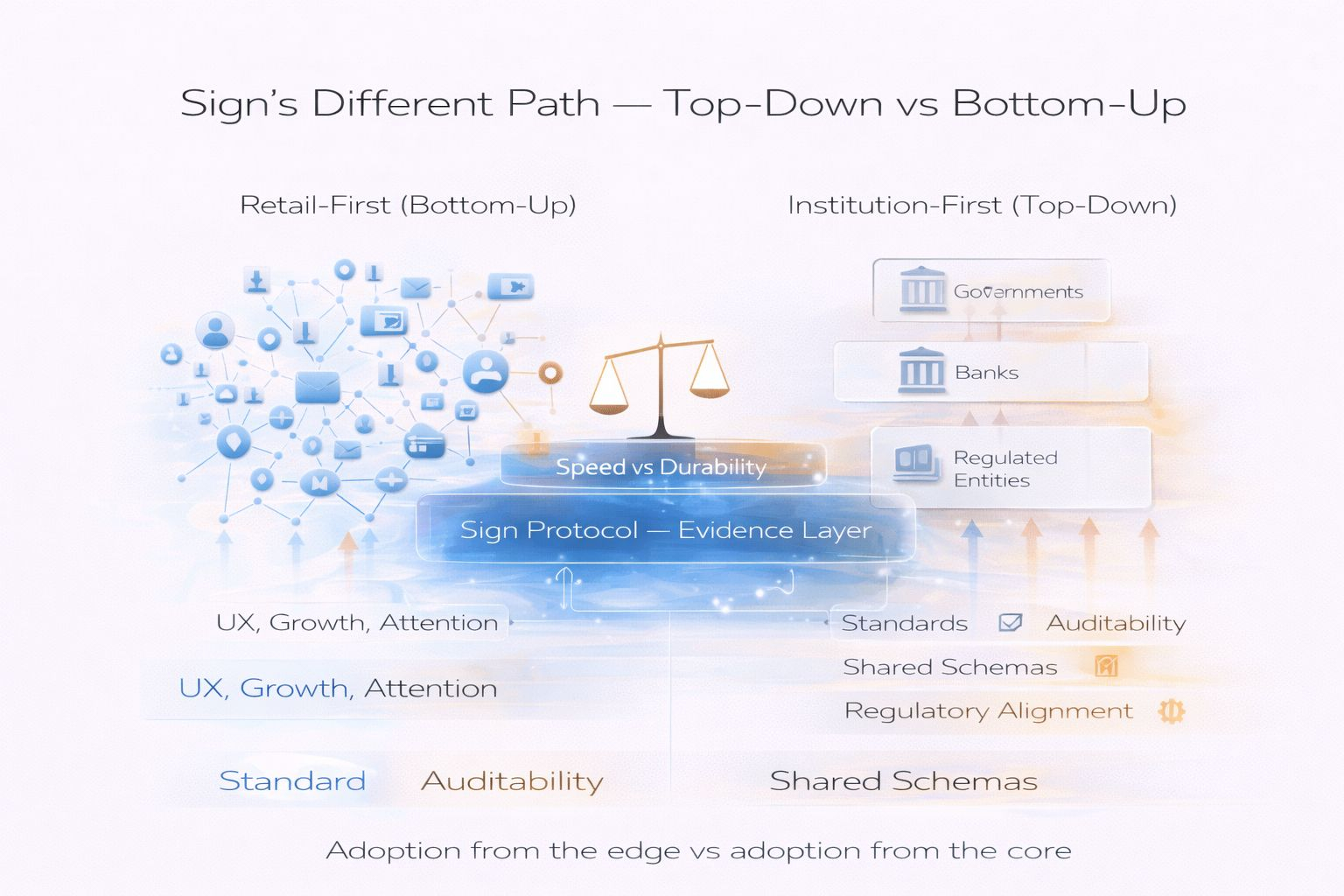
I keep noticing how most web3 projects still orbit around retail. Better wallets, smoother onboarding, trying to find that one app that pulls in millions of users. And to be fair, that makes sense on the surface. Adoption usually starts from the edge, not from institutions.
But reading into $SIGN, it feels like they’re almost ignoring that playbook entirely. Or at least not prioritizing it. The focus seems very… top-down. Governments, banks, regulated players. The kind of entities that move massive value, but also move very slowly and have way stricter requirements.
And I think that’s the part that clicked for me after a while. It’s not that these institutions don’t want to use blockchain. It’s more like most of what’s been built in crypto just doesn’t fit how they operate. Things like auditability, standards compliance, controlled governance… those aren’t “nice to have” features for them, they’re mandatory. And a lot of consumer-first protocols just weren’t designed with that in mind.
Sign seems to be building around those constraints from the start. The whole idea of a shared evidence layer, with standardized schemas and attestations, feels less like a feature and more like a requirement if you’re dealing with multiple operators and regulators at once. Instead of every system defining its own format, everything plugs into a common structure. At least that’s how I’m հասկing it right now.
The developer platform side is also interesting, but in a quieter way. SDKs, APIs, schema registries… it’s not flashy, but it’s the kind of tooling that actually matters if you want different systems to interoperate. And the way they treat governance as part of the core system, not something added later, feels very aligned with how institutions think.
I also noticed how their use cases aren’t just theoretical. Audit proofs, KYC-gated actions, onchain reputation… different areas, but all using the same underlying layer. That consistency is probably more important than it looks at first glance.
Still, I can’t ignore how slow this path is. Governments don’t move fast. Procurement cycles alone can take years. And even if the tech works, getting multiple parties to standardize around the same system is a whole different challenge.
But yeah, I get why they’re doing it this way. Competing for retail attention is crowded and fragile. Competing on infrastructure that institutions actually depend on… that’s slower, but maybe more durable if it works.
I’m still figuring out how far they can push this, but it’s definitely a different angle from most of what I’ve been reading.