

I have learned to be careful whenever a crypto project sounds smartest at the exact moment no real user has to live inside it yet. Midnight is interesting for that reason. Its idea of selective disclosure makes immediate sense on paper. You prove what matters, keep the rest private, and avoid the usual choice between full exposure and total opacity. That is a serious improvement over the way most chains handle data today. But the harder question for traders and investors is not whether the idea sounds right. It is whether it still feels smooth once an actual workflow asks for proof again, then again, then one more time. That is where the real test begins. Midnight’s whole pitch is built around what it calls rational privacy, where privacy is the default and disclosure is the exception. Its docs describe selective disclosure as the ability to reveal only what is necessary for a given interaction while keeping everything else confidential, and its Compact language requires disclosure to be explicitly declared rather than casually leaking into the public record. In plain language, Midnight is trying to make privacy usable instead of absolute. That matters because a lot of real financial and institutional activity does not need full secrecy. It needs controlled visibility.
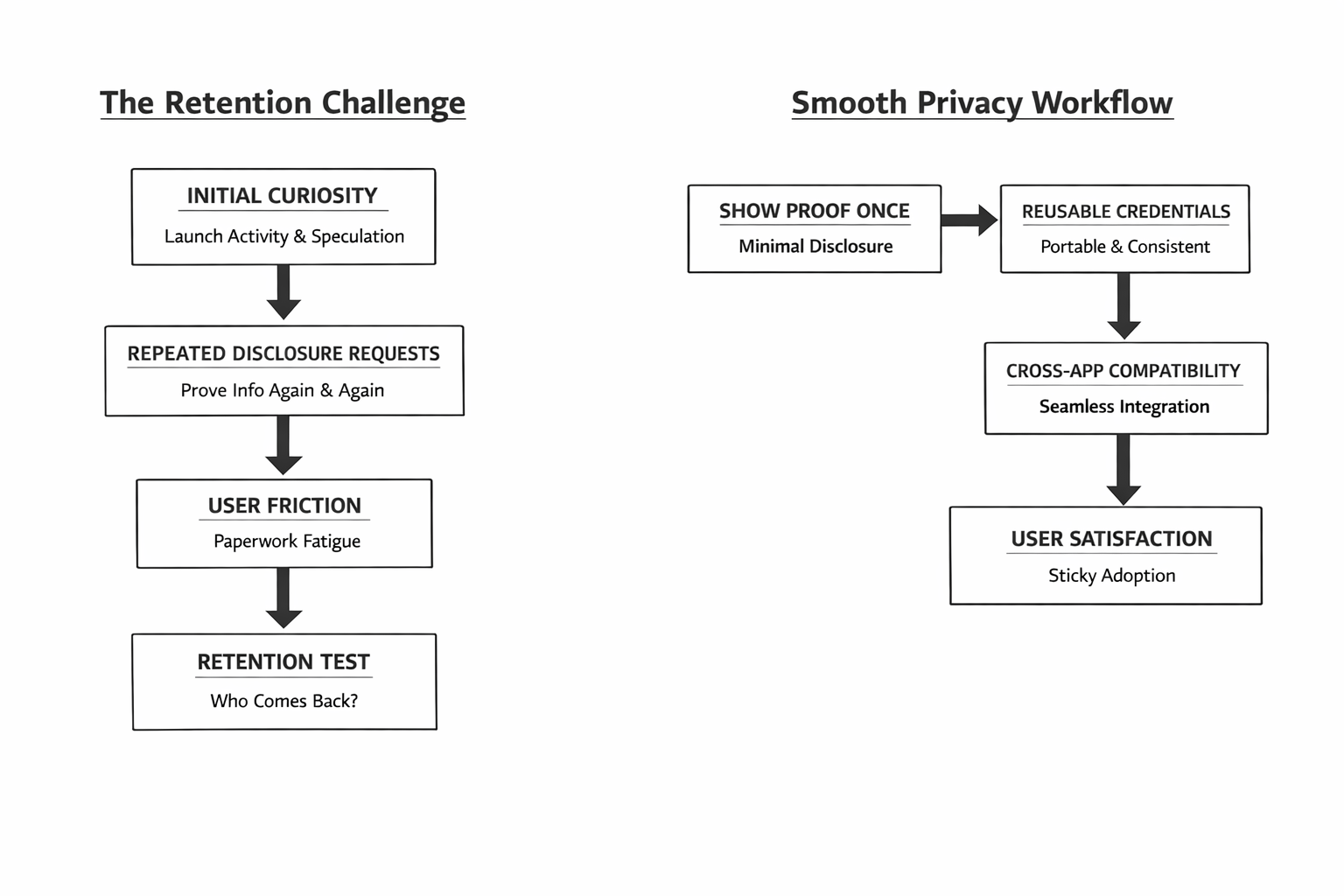
That is the attractive part. The friction appears when you imagine the workflow, not the slogan. Think about applying for a loan, proving age for a restricted purchase, onboarding to an exchange, or verifying eligibility inside a tokenized real world asset platform. The first selective disclosure request feels elegant. You show exactly what is needed and nothing else. The second request may still feel fine. But if every new counterparty, app, auditor, or compliance layer has to ask again in a slightly different format, the user experience can start feeling less like freedom and more like a repeated paperwork ritual with better cryptography. That does not mean Midnight’s model is weak. It means the burden shifts from proving privacy is possible to proving the workflow is durable. This is where the retention problem matters more than most market commentary admits. Crypto projects often look healthy during launch season because curiosity is easy to measure. Wallet creation jumps, faucets get drained, smart contracts get deployed, volumes spike, and everything looks alive. Then the market asks a tougher question. Who came back? Midnight itself reported strong late 2025 and early 2026 activity, including a 19 percent rise in block producers, 35 percent growth in smart contract deployments, and continued gains in addresses and faucet requests, even as smart contract calls cooled from a record November spike. That is encouraging, but it is also exactly the kind of stage where investors should separate stress testing from sticky usage. A privacy network does not prove itself by being exciting once. It proves itself when developers and users keep returning because repeated interaction feels better there than anywhere else. The timing makes this especially relevant now. Midnight said in its February network update that mainnet is coming at the end of March 2026, with the current Kūkolu phase focused on launching a stable federated mainnet for the first wave of production applications. The January update framed 2026 as the move from token distribution into mainnet, scaling, and cross chain hybridization. That means the story is shifting from promise to execution right now, not later. For traders, that changes the lens. A concept trade becomes an adoption trade. The market is paying attention, but the numbers do not settle the product question. As of today, CoinMarketCap shows NIGHT around a $725 million market cap, roughly $616 million in 24 hour volume, about 16.6 billion tokens in circulation out of 24 billion total supply, and more than 12,000 holders. Binance and Bybit both place the token around the low $0.04 range today, with very heavy daily turnover relative to market cap. That is a sign of strong interest and liquidity, but not necessarily long term conviction. High trading volume can reflect attention just as easily as commitment. What I find most useful here is a simple real life comparison. A good privacy system should feel like showing a hotel clerk your room key, not handing over your entire passport file every time you walk through the lobby. Midnight clearly understands that. Its architecture is built to let people prove credentials, reputation, provenance, and validity without exposing more than needed. The problem is that convenience decides retention faster than theory does. If the proof can be reused smoothly across apps, then Midnight has a real edge. If users keep hitting fresh disclosure prompts, fragmented standards, or workflow interruptions, then selective disclosure risks becoming one of those features everyone praises and quietly avoids. That is why I do not think the smartest way to evaluate Midnight is to ask whether privacy matters. Of course it does. The better question is whether Midnight can make selective disclosure feel invisible enough to become normal infrastructure. The network has serious ingredients behind it: a privacy first design, explicit disclosure controls, TypeScript adjacent tooling through Compact, growing developer programs, and a mainnet window that puts real applications on the clock. But for investors, the next phase is not about admiring the architecture. It is about watching whether the architecture reduces user friction in repeated real world use. So here is the practical takeaway. Do not watch Midnight like a pure privacy narrative. Watch it like a workflow bet. Track whether its first live apps reduce repeated compliance friction, whether builders can make disclosure portable instead of repetitive, and whether activity stays after launch excitement fades. If Midnight solves that, then selective disclosure stops being an interesting feature and starts becoming valuable infrastructure. If it does not, the market will eventually treat the idea as elegant but incomplete. That is the moment traders and investors need to be ready for, because in crypto the projects that last are usually the ones that make hard things feel easy, and the ones that fail are often the ones that only made them sound easy.