I read the Midnight materials again today and wrote this as a professional review for a broader audience.
Executive Summary
Midnight Network is a Cardano partner chain designed for rational privacy. It uses zero knowledge proofs and selective disclosure so that claims can be verified without exposing raw data. The network adopts a dual token model where NIGHT is the public utility and governance asset and DUST is the shielded resource used to pay for private transactions. The project is entering a major transition with the Kukolu federated mainnet expected in late March 2026. This review evaluates the design, token model, distribution mechanics, and operational risks.
Why Rational Privacy Exists
Public blockchains make every data point visible by default. That is useful for auditability but dangerous for real world workflows such as supply chains, enterprise data, and regulated finance. The alternative is to move sensitive data off chain, which breaks composability and removes verifiable guarantees. Midnight’s position is that privacy must be programmable and auditable at the same time. That is what selective disclosure enables. You can prove a fact while keeping the underlying data private.
What Midnight Network Is ?
Midnight is a privacy focused Layer 1 partner chain aligned with Cardano and built by IOG. It is designed to support compliant workflows where privacy is required but verification cannot be sacrificed. The core technical method is zero knowledge proofs and selective disclosure, meaning data can remain shielded while proofs remain verifiable.
The Dual Token System: NIGHT And DUST
Midnight separates capital from execution. NIGHT is the unshielded utility and governance token. Holding NIGHT generates DUST, which is a shielded resource used to pay for private transactions and smart contract execution. This separation is meant to make privacy operations predictable without forcing users to spend the governance asset on every action.
Market Data Update
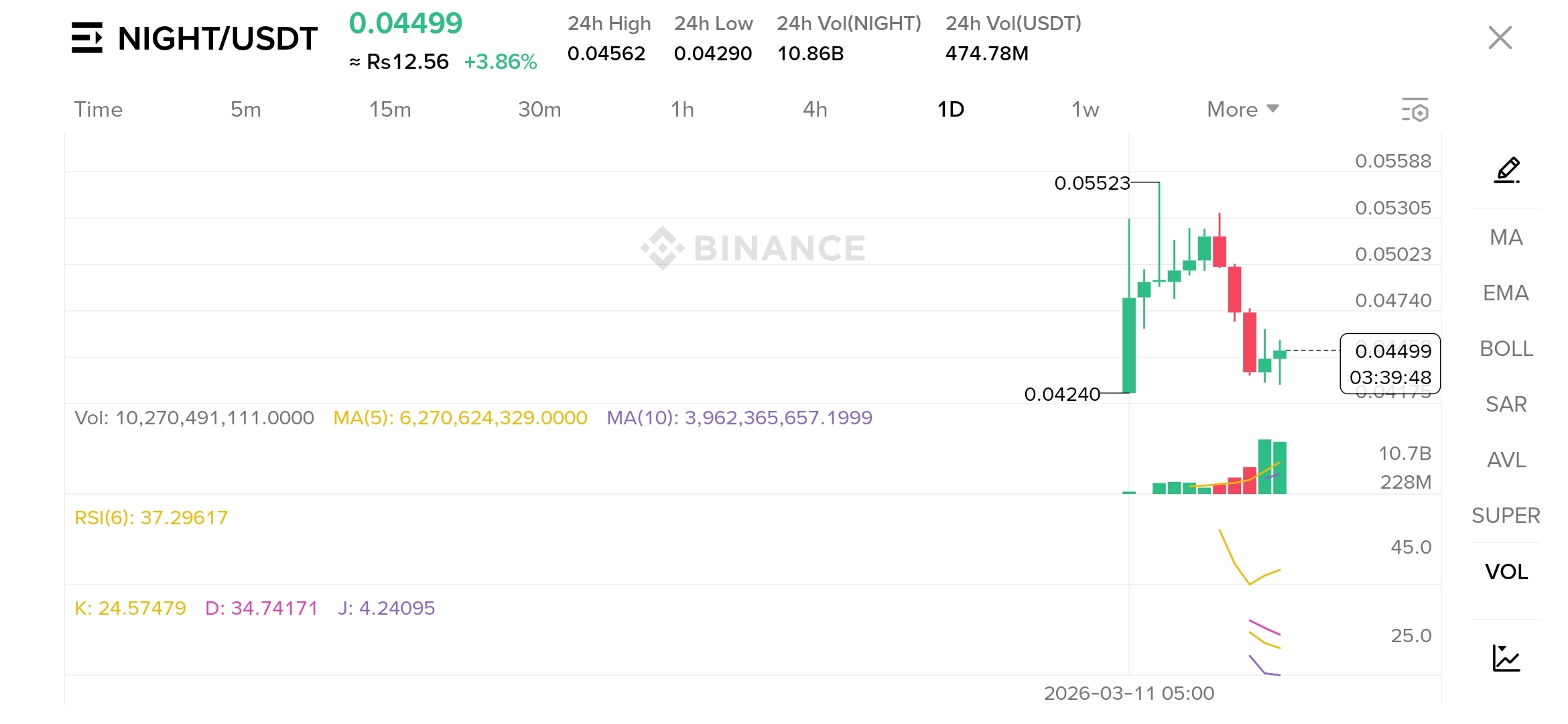
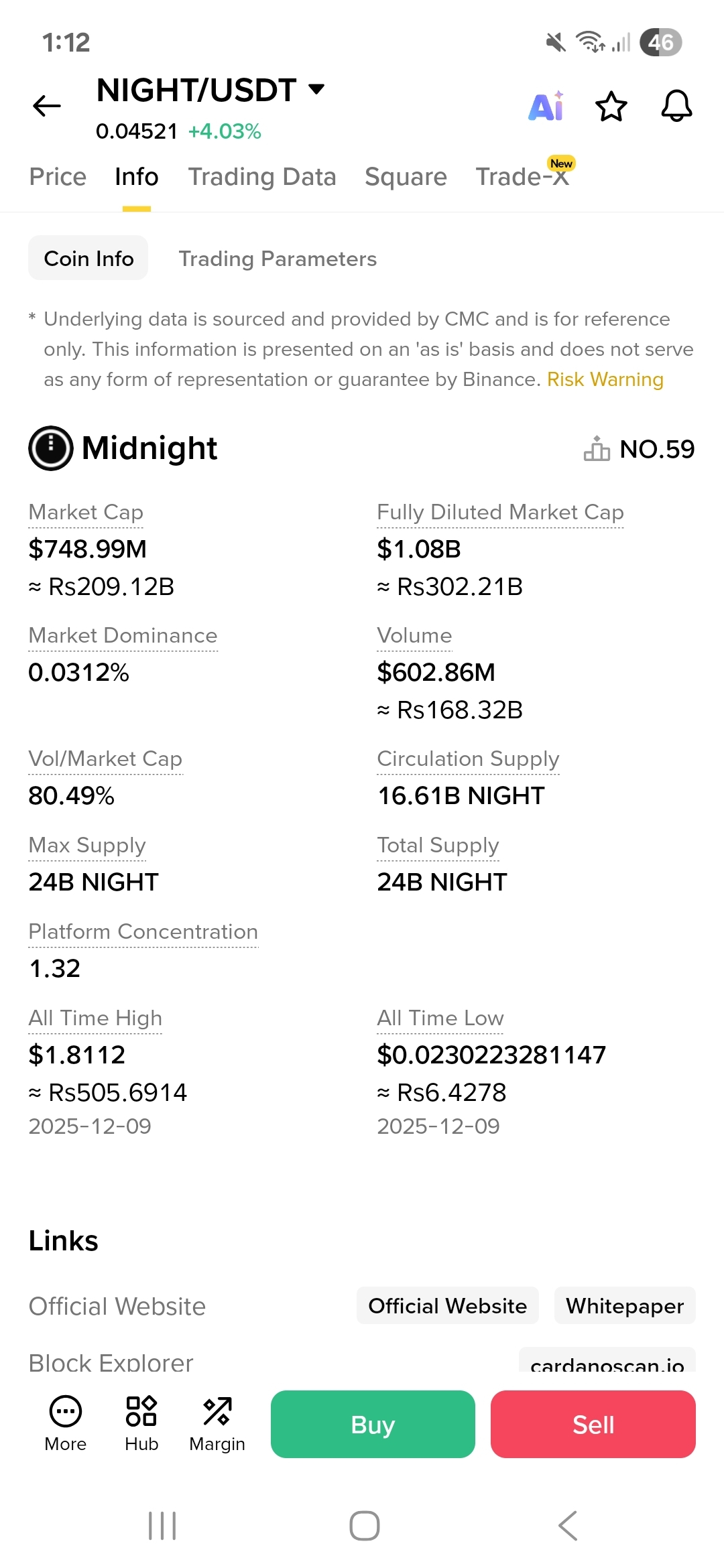
Binance market snapshot today shows price around $0.04521, market cap about $748.99M, FDV about $1.08B, and 24h volume about $602.86M. Circulating supply is about 16.61B NIGHT out of 24B total and max supply.
Distribution And Supply Structure
Midnight’s total and max supply is 24 billion NIGHT, with circulating supply about 16.61 billion or roughly 69.2 percent. The network launched in December 2025 through the Glacier Drop, with more than 4.5 billion claimed so far. Distribution was designed to be broad, not concentrated.
Glacier Drop And Community Design
Glacier Drop is staged. Phase 1 targeted eligible holders across multiple ecosystems. Phase 2 used the Scavenger Mine, open to anyone with a CPU and internet, producing unusually wide address participation. Phase 3 remains open for eligible holders who missed earlier windows. This matters because distribution strategy shapes governance and long term trust.
Kukolu Federated Mainnet
The Kukolu phase is expected late March 2026. It is a federated mainnet stage with selected node operators, designed to stabilize operations before broader decentralization. This approach is conservative but practical for a network that prioritizes privacy and verification.
Institutional And Infrastructure Partners
Midnight lists institutional and infrastructure partners such as Google Cloud, Blockdaemon, eToro, MoneyGram, and Copper custody. These partners matter because privacy networks face a credibility hurdle. Institutional participation signals that the privacy model is being aligned with real operational standards rather than purely ideological goals.
Developer Experience And Compact
Midnight uses Compact, a domain specific language for privacy aware smart contracts. This is not a cosmetic choice. The main adoption risk in privacy systems is developer friction. If Compact succeeds in lowering that friction, the network has a stronger chance of real adoption.
Real World Use Case: Supply Chains
Supply chains need proof without leakage. A manufacturer may want to prove compliance, origin, or quality while keeping supplier pricing private. Selective disclosure enables this. Midnight’s architecture is designed for such proofs.
Real World Use Case: Identity And Credentials
Identity data is highly sensitive. Public ledgers are often too transparent for identity systems. Midnight’s selective disclosure allows proof of eligibility or credential validity without exposing the full record. That balance is essential for adoption.
Real World Use Case: Regulated Finance
Regulated finance needs auditability and privacy together. Midnight’s design is intended for that intersection. The challenge is to satisfy regulators without creating a fully transparent system that undermines user privacy.
Risk Assessment
Privacy systems carry specific risks. First, developer adoption. If tooling is too complex, usage stalls. Second, governance transition. The federated model must evolve without losing trust. Third, supply dynamics. Ongoing distribution can create volatility if adoption does not keep pace. Fourth, regulatory uncertainty. Privacy will always be under scrutiny, so compliance expectations must be met without compromising the core design.
What I Will Watch ?
I will focus on three signals. First, whether real applications are shipping with Compact. Second, whether Kukolu mainnet proves stable under real usage. Third, whether selective disclosure becomes more than a concept and shows real deployment in supply chain, identity, or regulated workflows.
Professional Conclusion
Midnight does not compete by raw throughput. It competes by making privacy verifiable and usable. The dual token model is designed to separate governance from execution. The Glacier Drop distribution is unusually broad. The Kukolu federated mainnet is a conservative but sensible step for a privacy first network. If execution matches the design, Midnight can become a serious infrastructure layer rather than a narrative token.
@MidnightNetwork $NIGHT #night