
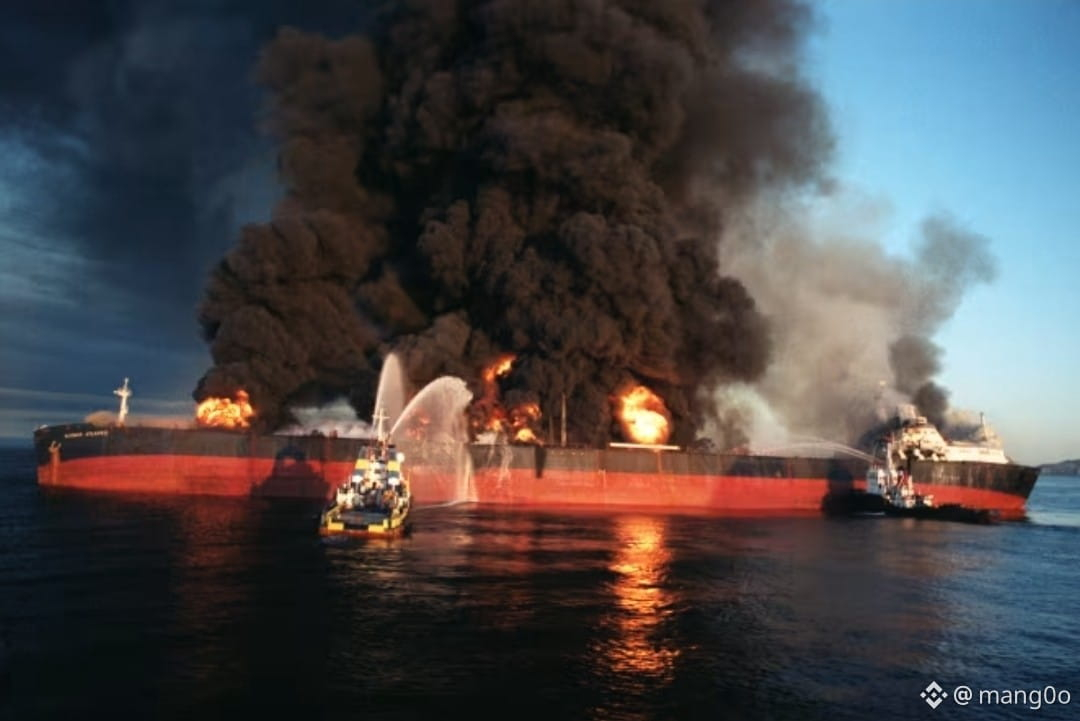
$BTC As tensions in 2026, President Donald Trump is considering a familiar strategy: ordering the US Navy to escort oil tankers through the volatile Strait of Hormuz. For naval historians, the move feels like a dangerous case of déjà vu. Nearly 40 years ago, the US faced the same adversary—the Islamic Revolutionary Guard Corps (IRGC)—in a conflict known as the "Tanker War."
The lessons of the late 1980s serve as a sobering reminder of how quickly naval operations can spiral into deadly, unpredictable chaos.
The original Tanker War was a byproduct of the Iran-Iraq War (1980–1988). By 1984, the land war had reached a bloody stalemate. In an attempt to break the Iranian economy and force international intervention, Iraqi leader Saddam Hussein began attacking Iranian oil tankers.
Iran retaliated by targeting neutral merchant ships—primarily those linked to Kuwait, which was funneling supplies to Iraq. By 1986, shipping lanes were so perilous that Kuwait turned to the superpowers for protection.
Initially, the Soviet Union provided escorts. Fearing a loss of regional influence to Moscow, Washington launched Operation Earnest Will in 1987. The US reflagged Kuwaiti tankers as American vessels, legally allowing the US Navy and Coast Guard to provide armed protection.
High Stakes and Costly Errors
The intervention was marked by two major incidents that highlighted the extreme risks of Persian Gulf operations:
* The Attack on the USS Stark (1987): An Iraqi jet—supposedly an ally at the time—mistook the US frigate for an Iranian target. Two Exocet missiles struck the ship, killing 37 sailors. It remains a stark example of how "friendly fire" and mistaken identity can turn catastrophic.
* The Bridgeton Incident (1987): On the very first escort mission, the massive tanker Bridgeton hit an Iranian mine. While the tanker survived, the US warships were forced to hide in its wake for protection because they lacked their own minesweeping capabilities—a major embarrassment for the Pentagon.
Operation Praying Mantis: A Superpower Flex
The conflict peaked on April 14, 1988, when the USS Samuel B. Roberts was nearly split in half by an Iranian mine. In retaliation, the US launched Operation Praying Mantis, the largest US surface engagement since World War II.
| Key Outcomes of Praying Mantis | Significance |
|---|---|
| First Missile Duel | The USS Simpson engaged in the first ship-to-ship missile battle in US Navy history. |
| Technological Dominance | Proved the US could coordinate complex battles from thousands of miles away using electronic targeting. |
| Strategic Shift | Established the US as the world’s undisputed maritime superpower. |
2026: A Different Battlefield
While the geography remains the same, analysts warn that the "repeat" of history comes with new, lethal variables.
* Advanced Weaponry: Iran now possesses high-speed ballistic missiles and swarms of cheap, explosive drones.
* The Mine Gap: The US Navy has significantly downsized its minesweeping fleet. Four dedicated minesweepers in the Gulf were decommissioned just last year, leaving a gap that allies have yet to fill with hardware.
* Focus: Unlike the 1980s, Iran is not currently distracted by an eight-year ground war with Iraq, allowing them to focus their full military might on the Strait.
> "History repeats itself," notes maritime consultant Frank Coles. "Anyone who remembers the Iran-Iraq war knows escorts were needed then. It’s disappointing this wasn’t part of the thought process now."
As the US weighs the decision to put "boots on the ground" or hulls in the water, the ghosts of the 1980s suggest that entering the Strait is easy, but leaving it without a scratch is anything but guaranteed.

#TRUMP #Whale.Alert #news_update #war #peace $USDC
