
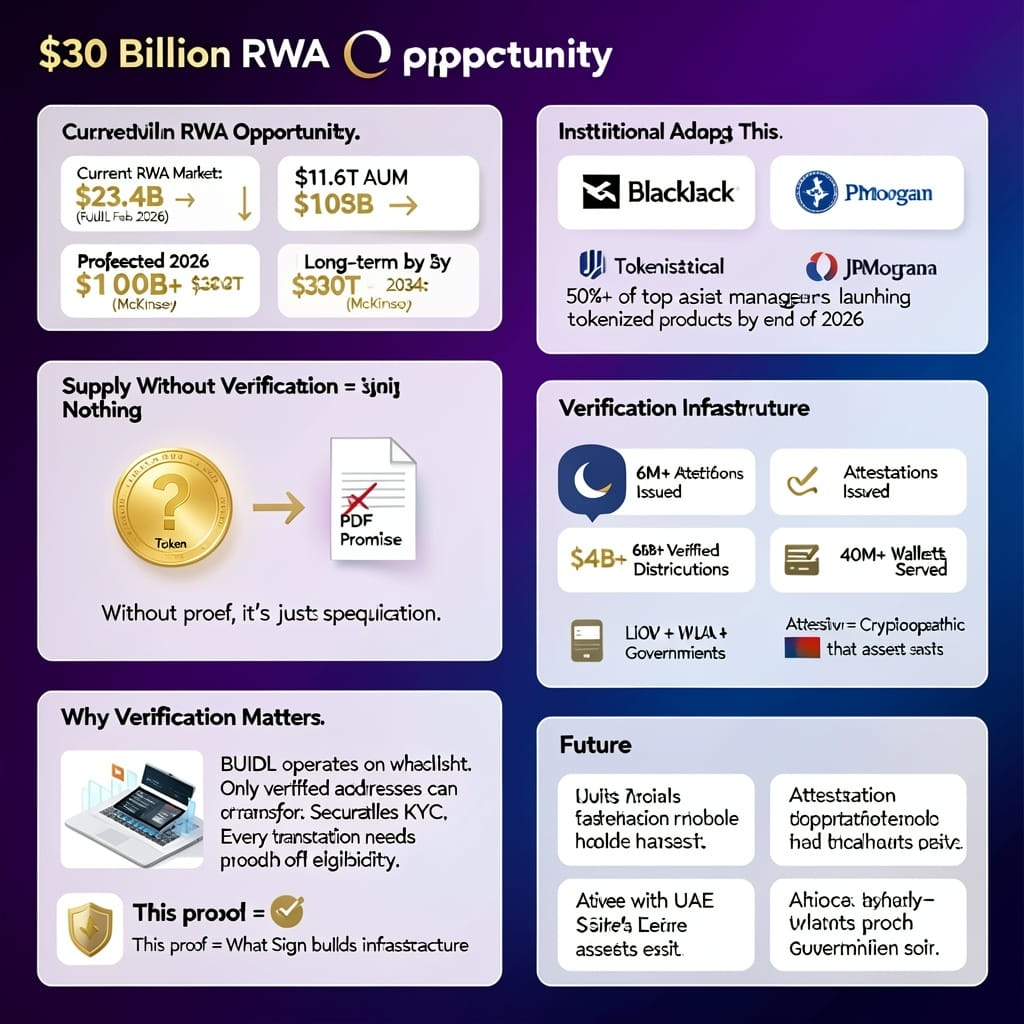
$23.4 billion. That's the size of the tokenized real-world asset market right now . Up from $36 billion? No that was a different estimate. Let me clarify the numbers because they matter.
Here's what the data actually says:
Current RWA market (excluding stablecoins): $23.4 billion as of February 2026
Projected by end of 2026: $100 billion+ according to Centrifuge's COO
Long-term potential: $30 trillion by 2034 according to McKinsey
That's not hype. That's institutional money moving.
Who's driving this?
BlackRock. $11.6 trillion AUM. Their BUIDL fund just crossed $2.85 billion in tokenized Treasuries . JPMorgan. Bank of New York Mellon. Over 50% of top asset managers expected to launch tokenized products by end of 2026 .
The shift is real. But here's what everyone is missing.
Supply doesn't matter without verification.
You can tokenize gold. You can tokenize real estate. You can tokenize Treasuries. But without proof that the asset actually exists, you're holding a token with a PDF attachment. That's it.
This is where Sign Protocol comes in.
What Sign actually does:
It's an attestation layer. Governments in UAE and Sierra Leone already use it for national identity systems . Over 6 million attestations issued. $4 billion+ in verified distributions. 40 million+ wallets served .
An attestation is a cryptographic proof that something is true. This gold bar exists. This property is owned. This payment was executed.
Without this layer, tokenized assets are just speculation. With it, they're investable.
The BlackRock example shows why this matters.
BUIDL operates on a whitelist. Only verified addresses can hold or transfer. Securitize handles KYC. Every transaction needs proof of eligibility .
That proof is exactly what Sign builds infrastructure for.
What happens next?
Bernstein calls it a tokenization supercycle in 2026 . Stablecoin supply projected to hit $420 billion up 56% year-over-year . Over 65% of tokenized assets live on Ethereum, but multi-chain expansion is accelerating .
The race isn't about who has the most supply. It's about who has the most verifiable infrastructure.
Sign already has governments. Already has billions in verified distributions. Already has the infrastructure institutions require.
The next wave of RWA growth won't be about tokens. It'll be about the verification layer that makes those tokens worth anything.
What do you think matters more for RWA growth supply or verification?
A) Supply and liquidity
B) Verification infrastructure
C) Both equally
$SIGN @SignOfficial #Sign #TrumpConsidersEndingIranConflict #iOSSecurityUpdate #OpenAIPlansDesktopSuperapp