
I’ve been thinking about voting on-chain lately, and something about it still feels unresolved.
Not the idea of voting itself, but how current systems handle visibility.
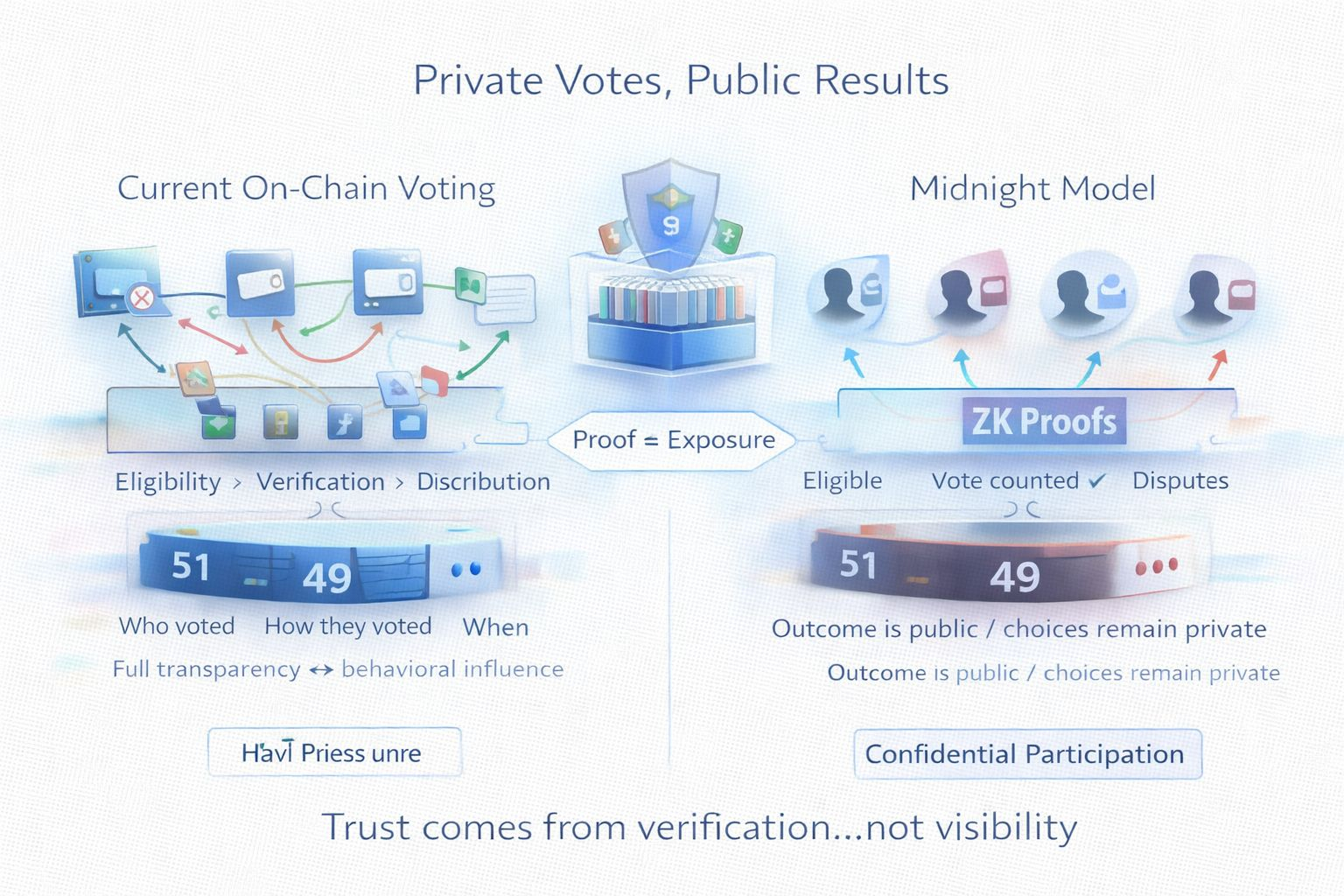
Most on-chain governance today is fully transparent. You can see who voted, how they voted, and when. That sounds good in theory, but in practice it creates some weird dynamics.
People don’t just vote — they react to other votes.
That’s where Midnight Network started to feel a bit different to me.
Instead of forcing transparency at every step, the idea here seems to be separating proof from exposure. You can prove that someone is eligible and that their vote was counted, without revealing who they are or what they chose.
That changes the experience quite a bit.
Because once votes are private, things like herding or signaling become less dominant. People can actually vote without worrying about how their decision will be interpreted in real time.
And that’s not just a DAO problem.
If you think about real-world organizations — unions, cooperatives, shareholder groups — confidentiality isn’t optional. In many cases, it’s required. Public voting records just don’t fit those environments.
So the issue isn’t whether voting can be done on-chain.
It’s whether the data model of current chains matches how voting is supposed to work.
That’s where Midnight’s approach starts to make more sense.
Using zero-knowledge proofs, the system can verify that a vote is valid and counted correctly, without exposing the underlying details. The outcome stays public, but the individual choices don’t.
In theory, that’s exactly what most voting systems try to achieve.
Of course, there are still a lot of open questions.
Things like legal frameworks, credential systems, and how eligibility is actually verified outside crypto-native environments are not trivial problems. And they don’t get solved just by better cryptography.
But the core idea is interesting.
If you can prove participation without revealing identity, that’s not just useful for voting. It applies to a lot of real-world processes where transparency and privacy need to exist at the same time.
Voting just happens to be the clearest example.
Still early, but this feels like one of those use cases where you can actually see what the architecture is trying to do in practice.