

In a small business setting, trust often depends on discretion. Financial records are shared with accountants, not the public. Personal identity details are verified when necessary, but never fully exposed. Yet in much of Web3 today, systems operate on complete transparency where every transaction, interaction, and contract execution is visible to anyone. While this openness has clear benefits, it also introduces limitations when applied to real world scenarios.
This growing mismatch between transparency and practicality is shaping the next phase of blockchain development. Privacy is no longer a secondary consideration; it is becoming essential infrastructure. Within this context, @MidnightNetwork presents an approach that attempts to bring balance preserving the verifiability of blockchain while reintroducing controlled confidentiality.
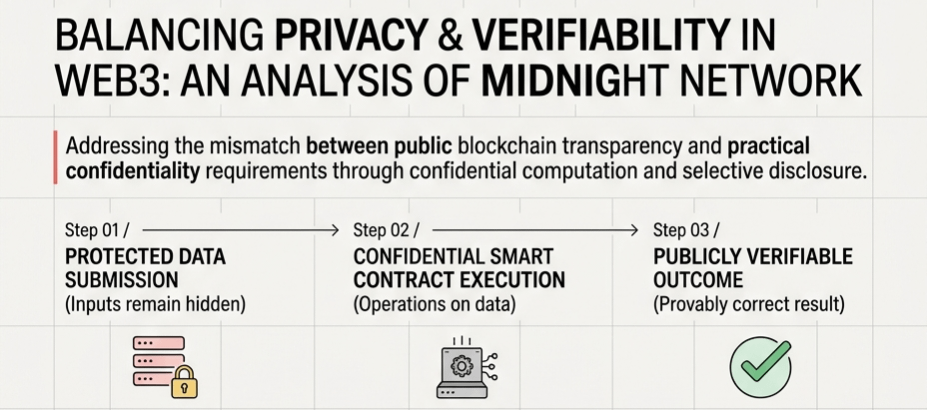
At the center of Midnight Network’s design are confidential smart contracts. Unlike traditional smart contracts that expose all inputs and outputs on a public ledger, these contracts are built to operate on protected data. This means sensitive information whether financial details, identity attributes, or proprietary logic can remain hidden while the results of computation are still provably correct. The shift here is subtle but important: transparency moves from raw data to verified outcomes.
Another key element is selective disclosure, which mirrors how trust works in everyday life. Consider a situation where someone needs to prove eligibility for a service. In most cases, only a single piece of information such as age or residency is required, not an entire dataset of personal records. Midnight Network enables this form of interaction by allowing users to reveal only the necessary attributes, supported by cryptographic verification. It reduces unnecessary exposure without weakening trust.
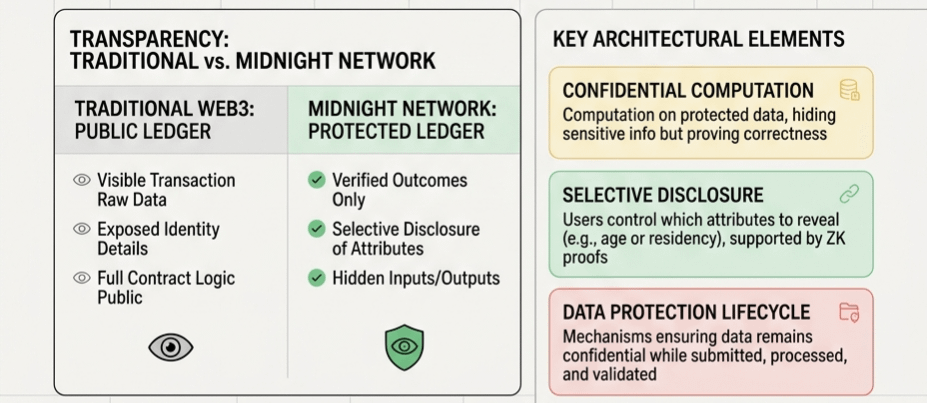
Equally relevant is the network’s approach to data protection across decentralized systems. As blockchain technology intersects more frequently with sectors like finance, healthcare, and enterprise operations, the sensitivity of data increases. Midnight Network incorporates mechanisms to ensure that data remains protected throughout its lifecycle whether it is being submitted, processed, or validated. This is particularly important in environments where compliance and confidentiality are non lnegotiable.
The role of the $NIGHT token fits into this framework as part of the network’s operational layer. It supports the execution of private computations and helps maintain the integrity of interactions within the system. Rather than standing apart from the infrastructure, it functions within it aligning incentives with secure and privacy preserving activity.

From a practical standpoint, the potential applications are diverse. Financial institutions could engage with decentralized systems without revealing internal strategies. Identity frameworks could verify credentials without centralizing sensitive user data. Even collaborative business processes could move on-chain without exposing competitive information. These are not abstract possibilities, but natural extensions of systems that respect both transparency and privacy.
In the broader trajectory of Web3, this represents a shift in perspective. Early blockchain systems emphasized openness as a solution to mistrust. Today, the challenge is more nuanced: how to maintain trust while respecting boundaries. @MidnightNetwork contributes to this discussion by offering infrastructure that does not force a trade off between the two.
Looking ahead, privacy preserving systems are likely to become a defining feature of mature blockchain ecosystems. As adoption expands into more complex and regulated domains, the ability to control what is shared and with whom will determine how widely these systems can be used. Midnight Network, through its focus on confidential computation and selective disclosure, reflects an evolving understanding of what trust in Web3 truly required.