
I remember staring at $SIGN a few nights ago after watching another infrastructure coin get chased for all the wrong reasons. Price was moving, the timeline was loud, and the usual shortcut was to call it “undervalued” and move on. But that’s where I’ve burned myself before. Infrastructure tokens can look cheap for a long time because the market keeps asking a simple question: who actually stays? With SIGN, that question matters even more now because the token is tied not just to attention, but to whether wallets keep holding, using, and identifying with the system after the first distribution wave fades. As of March 23, 2026, SIGN was trading around $0.054 with roughly $66.5 million in 24 hour volume and was up about 33.9% on the week, so yes, the move is real. But price strength alone doesn’t settle the case. 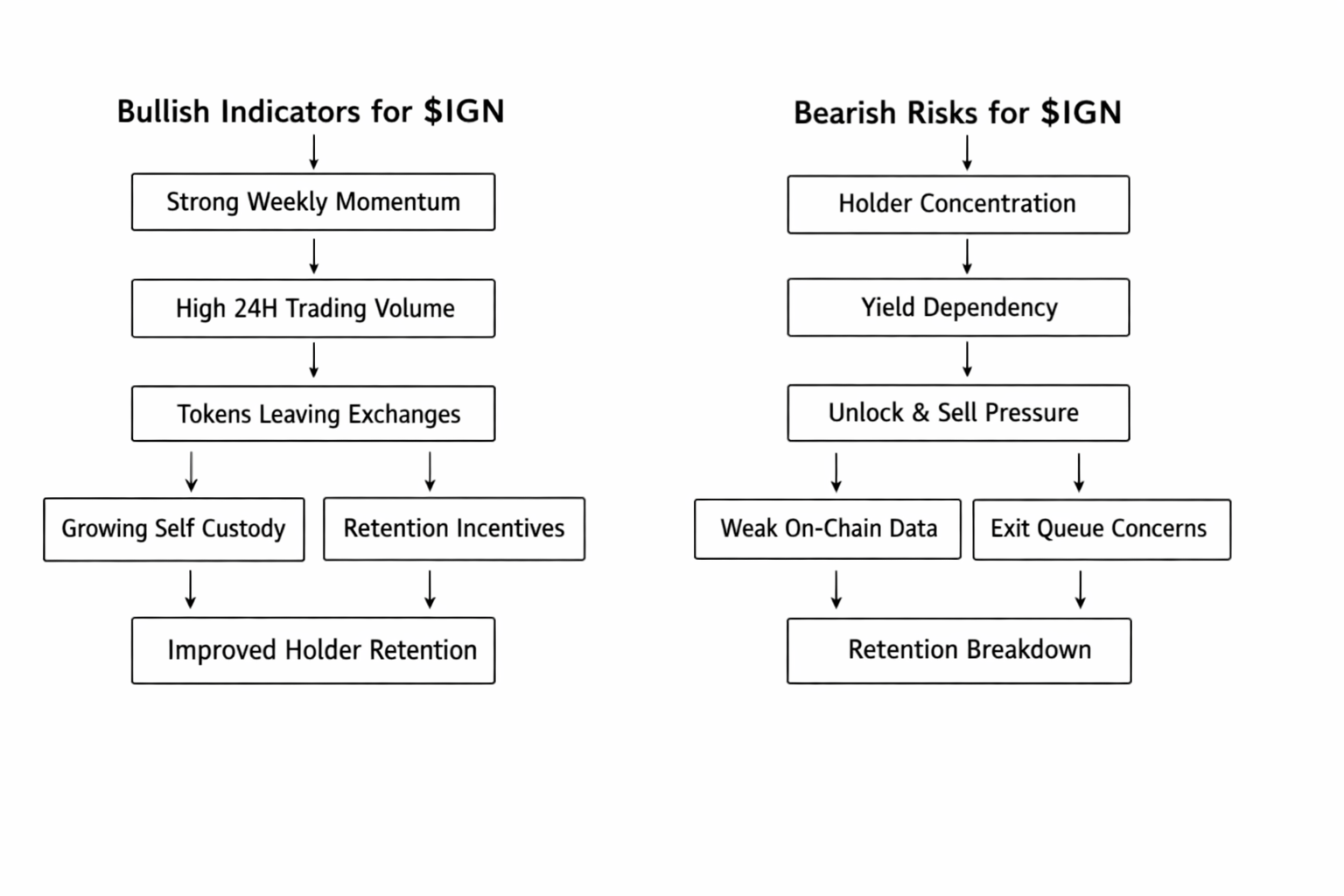 That’s why I keep coming back to the retention problem. Not marketing. Not abstract protocol potential. Retention. The official SIGN site leans into this directly by framing holding SIGN as long term commitment and active participation, not just a passive bet. And today’s coverage around its “Orange Basic Income” program makes that even more concrete: rewards are designed to favor self custody over leaving tokens parked on centralized exchanges. That is not a small detail. It tells you the team knows the weak point. A token can distribute widely, trend for a week, print a nice chart, and still fail the harder test if wallets don’t stick around once the first incentive loop cools off. Here’s the part that makes me cautiously bullish. The on-chain flow data is at least pointing in the direction you’d want to see if retention is improving rather than collapsing. CoinGecko’s holder flow view shows about $2.45 million in negative overall net flow over 24 hours, driven almost entirely by roughly $2.44 million in negative CEX net flow, with around 2 million SIGN flowing out versus just 42,000 flowing in. That usually suggests tokens leaving exchanges faster than they’re arriving, which is often healthier than the opposite if you’re trying to build long term holder behavior instead of constant flip pressure. DEX flow was close to flat by comparison, with about 153,000 out and 144,000 in. Think of it like stock leaving the store shelf and moving into people’s houses. That doesn’t prove they’ll never sell. It does suggest the market structure may be getting a little tighter. Still, this is exactly where the trap case lives too. Retention programs can create the appearance of conviction without creating real loyalty. A wallet that moves coins off exchange for yield is not automatically a committed user. It may just be an opportunist with better storage habits. I’ve seen that movie before. If the incentives are doing all the work, then the second yield compresses or unlock pressure rises, the “community” can suddenly look like a queue at the exit. Even today, some outside commentary has flagged holder concentration as a concern, and while I would not lean on random posts as proof, the issue itself is valid enough to watch closely because concentrated ownership and retention narratives can combine into nasty air pockets when sentiment turns. So my read is this: bullish, but only in a conditional way. I’m not bullish because SIGN is an “infrastructure play” in the abstract. I’m bullish because the market is starting to price in a retention mechanism that might matter, and because the current tape shows strong weekly momentum with serious volume behind it. If a token is up nearly 34% on the week and still pulling net supply off exchanges, that deserves attention. But I’d flip colder fast if self custody stops growing, if volume stays high while price stalls, or if the holder base turns out to be too narrow to absorb future supply. That would tell me the move was more campaign than conviction. For traders, the practical consequence is simple. Don’t just watch the candle. Watch whether retention is becoming behavior or staying an incentive trick. That changes how you size, how long you hold, and whether you treat dips as reloads or warnings. For investors, it’s even more important. Infrastructure tokens live or die on whether people remain involved after the first reason to care passes. SIGN may be one of the more underpriced names in the market if it can turn self custody, governance identity, and post distribution participation into something durable. If it cannot, then this whole setup is just a convincing trap with good branding and a strong week. that’s the trade. Tight, uncomfortable, worth watching. If you’re eyeing $SIGN here, don’t ask only whether it can go higher. Ask whether the holders are actually staying for the right reasons. Are you bullish or bearish from here?

Άρθρο
$SIGN: Strong Price Action Means Less If Holders Don’t Stay
Αποποίηση ευθυνών: Περιλαμβάνει γνώμες τρίτων. Δεν είναι οικονομική συμβουλή. Ενδέχεται να περιλαμβάνει χορηγούμενο περιεχόμενο. Δείτε τους Όρους και προϋποθέσεις.