I’ve been swimming in this crypto chaos for longer than I care to admit, and most days it all just blends together into the same tired loop. You know the drill: another breathless thread, another “this is the infrastructure we’ve all been waiting for,” another token that promises to fix problems nobody actually feels in their daily life. After a while you start to tune it out. But every now and then something sneaks past the noise and sticks with you. For me, that something has been Sign Protocol.
At first I almost brushed it off. “Attestations, schemas, verifiable claims”—yeah, I’ve heard those words before. My brain automatically filed it under “neat tool for devs, probably won’t change my life.” I nearly closed the tab and moved on. But I kept circling back to it, almost against my will, and the more I read and watched, the less it felt like just another shiny layer in the stack. It started to feel like it was quietly poking at a much older, uglier problem that most of the space pretends doesn’t exist.
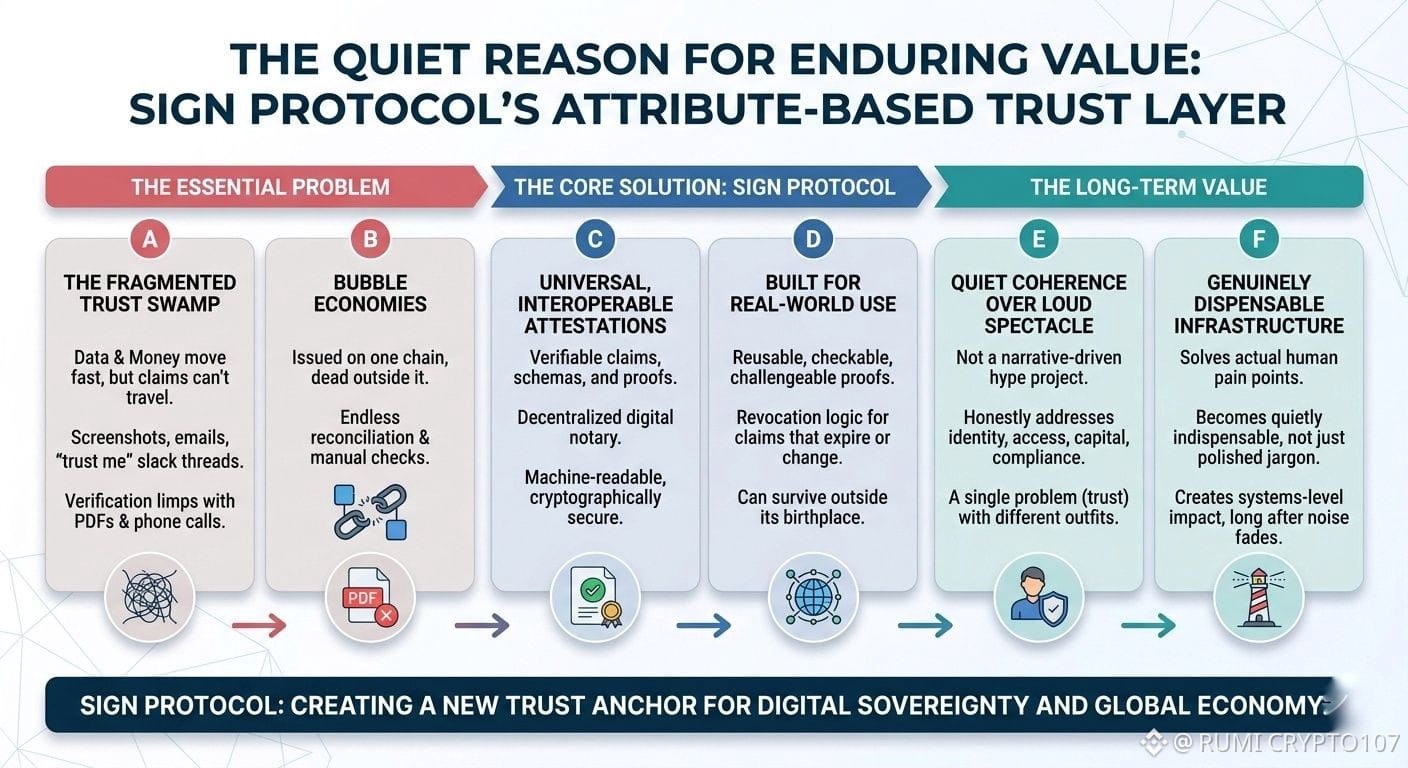
Here’s the thing nobody says out loud: our digital systems are fantastic at moving money and data at warp speed. What they’re still terrible at is letting a simple claim actually travel. You issue something on one chain, in one app, under one set of rules, and the second it tries to leave that little bubble it turns into a mess—screenshots, emails, “just trust me” Slack threads, endless reconciliation. Sign Protocol caught my attention because it doesn’t seem to be ignoring that friction. It feels built to handle it head-on: making proof that can actually be checked, reused, challenged, or even revoked by people who weren’t around when it was created. Not just another on-chain receipt, but something that can survive the real world outside its birthplace.
That’s what kept dragging me back in. I’ve seen way too many projects crush it inside their own cozy ecosystem while the trust part—the part that actually matters when you hand something to a stranger or another system—stays a total swamp. Money zips along. Verification still limps behind with PDFs and phone calls. Sign feels like it’s trying to close that gap without dressing it up as some glamorous revolution.
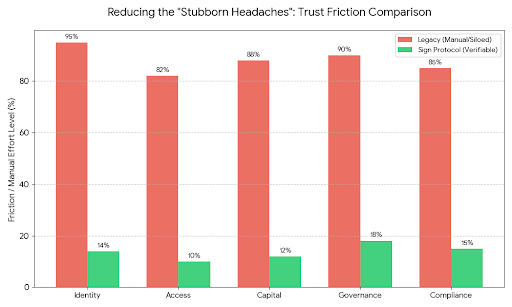
Lately I’ve noticed the project shifting in a way that feels… refreshingly grounded. It’s not out here yelling that it’s the next big narrative or frantically chasing every possible use case. Instead it seems to be leaning into the fact that the same stubborn headache keeps popping up everywhere—identity, access, capital, governance, compliance. It’s one core problem wearing different outfits. That honesty lands better than the usual “we do everything” pivot you see when teams start running out of steam.
Don’t get me wrong, I’m still keeping one eye open and one foot out the door. I’ve watched too many infrastructure plays polish their slides until the actual human pain they’re solving disappears in a haze of clean diagrams and jargon. The stuff that actually matters to me now isn’t the pitch deck or the token narrative. It’s simpler: once the hype fades and the market stops pretending to care, does this thing become quietly indispensable? Would people actually notice if it vanished tomorrow?
Sign Protocol hasn’t quite hit that threshold for me yet. But in this exhausted market, it’s one of the few things that still feels like it’s wrestling with a frustration that’s genuinely real—not just inventing new buzzwords for the same old problems. There’s something almost comforting about a project betting on quiet coherence instead of loud spectacle. It might never own the timeline or go parabolic overnight, but that kind of stubborn, systems-level thinking tends to matter long after the noise has moved on to the next shiny thing.
So yeah, I’m still watching. Not because I’m all-in or convinced it’s “the future,” but because the problem it’s trying to fix feels honest, human, and way more common than most projects want to admit. In a space that’s otherwise running on fumes and recycled hype, that’s rare enough to keep me paying attention.