
What I keep noticing lately is that crypto has become strangely comfortable with theater. Not just hype — theater. A lot of projects are still optimized to look legible to the market before they become useful to the world. The token comes first, the story comes second, and the hard question — what this system is actually meant to coordinate — gets pushed somewhere into the background. That habit worked well enough in a market driven by speed and attention. I’m less sure it works in the version of crypto that’s trying to grow up.
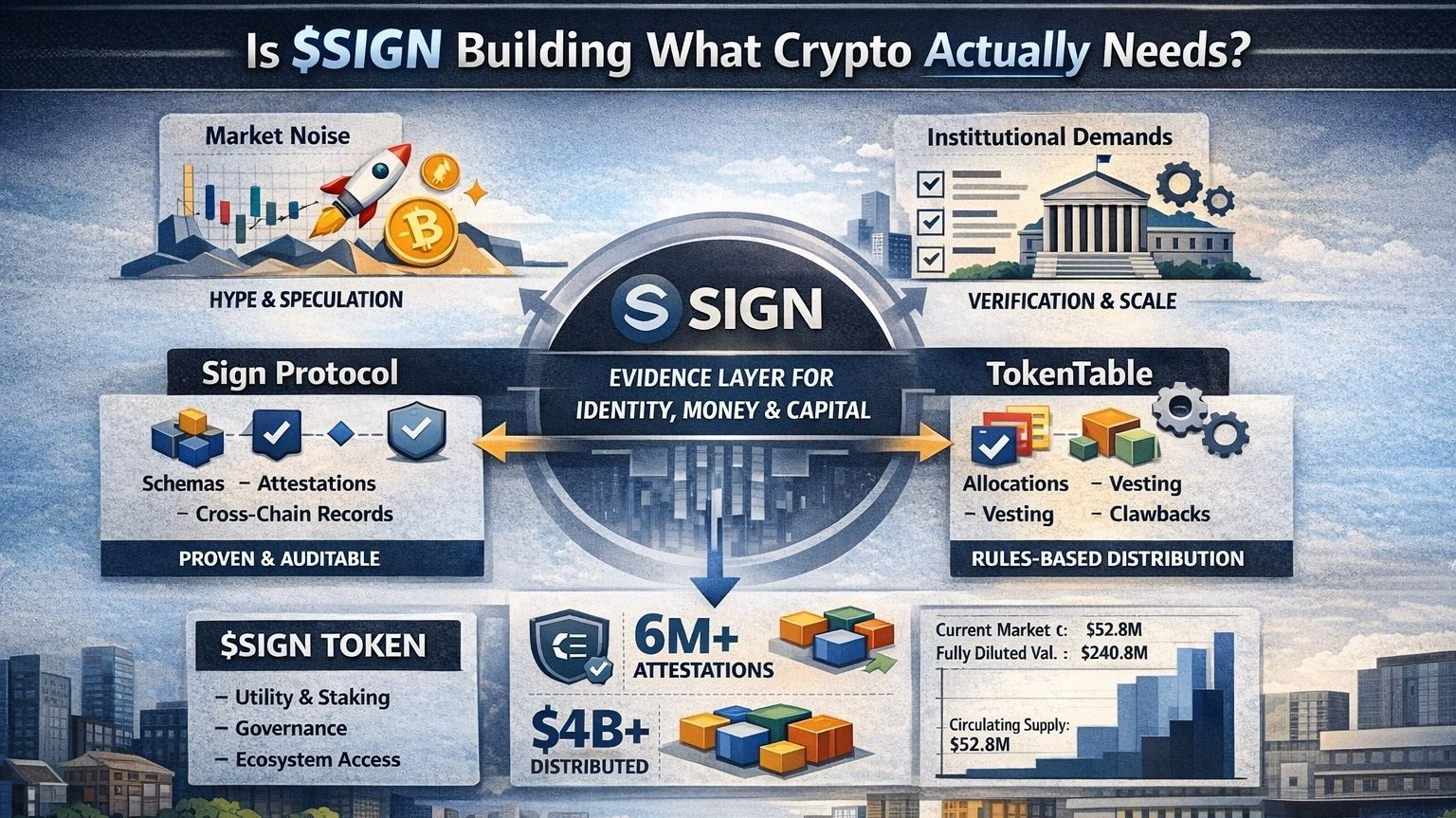
That’s why $SIGN caught my attention, though not for the usual reason. I didn’t look at it and think, here’s the next big thing. It felt more like I was looking at a project built around a quieter shift already happening: the market is slowly moving from “put it onchain” to “make it verifiable, portable, and inspectable.” That is a different instinct. It’s less ideological and more administrative, which sounds boring until you realize administration is where trust either hardens or breaks. Sign’s own docs now frame the ecosystem around sovereign-scale infrastructure for money, identity, and capital, with Sign Protocol positioned as the shared evidence layer and products like TokenTable sitting on top of that stack.
I think that distinction matters because crypto spent years treating transparency as if it were automatically the same thing as trust. It isn’t. Real systems — especially the ones used by governments, institutions, compliance teams, or large financial programs — do not want all information exposed all the time. They want enough information to verify that a rule was followed, that an approval was legitimate, or that a payment actually happened, without turning the entire system inside out. Sign Protocol seems built around that reality. It uses schemas to standardize how claims are expressed, attestations to bind those claims to issuers and subjects, and supports public, private, hybrid, and even ZK-based attestations depending on the context. That feels less like a crypto slogan and more like an answer to how verification actually works when privacy and oversight both matter.
And honestly, that may be the most interesting thing about $SIGN as a token: its relevance depends on whether you believe verification itself is becoming an economic layer. The project’s official materials describe $SIGN as a utility token used across the ecosystem for access to products, staking, governance, and ecosystem participation, while Binance Research similarly describes it as the backbone utility token across Sign’s protocols and applications. In other words, the token is not really asking to be understood as a meme of future adoption; it is asking to sit closer to usage, coordination, and ecosystem alignment. Whether the market rewards that is another question.
There’s also something revealing in how the ecosystem is structured. Sign Protocol handles evidence. TokenTable handles distribution logic — allocation tables, vesting, claims, clawbacks, delegation. The official docs are very clear that TokenTable consumes Sign Protocol evidence and produces new evidence, which is a neat way of saying the system is designed to turn rules into auditable capital movement. That sounds dry, but dry is underrated. Most distribution systems only look simple before someone asks who was eligible, under which ruleset, when the allocation changed, or whether a settlement can be audited later. TokenTable seems built for exactly that layer of accountability, not the marketing layer above it.
I think that’s where SIGN feels more structurally important than narratively exciting. The market usually values what is easy to perform: consumer apps, trading activity, sudden user spikes, maybe a clean speculative loop. Infrastructure tied to attestations, compliance, distribution records, and institutional workflows is harder to romanticize. But the numbers the project itself has put forward are not trivial: its MiCA whitepaper says Sign processed more than 6 million attestations in 2024 and distributed over $4 billion in tokens to more than 40 million wallets, while aiming to double annual attestations and reach 100 million wallet distributions by the end of 2025. Even if you read those figures cautiously, they suggest the project is already thinking in terms of throughput and operational scale rather than just conceptual promise.
That scale is also why the token deserves a more sober reading than most crypto assets get. CoinGecko currently lists SIGN with a total supply of 10 billion tokens, roughly 1.93 billion unlocked and circulating, and a market cap around $52.8 million versus a fully diluted valuation around $240.8 million. That gap doesn’t automatically mean the token is mispriced, but it does mean the market is still valuing a fairly early slice of the eventual supply curve. For a project whose whole pitch is long-term infrastructure, that creates an awkward tension: the protocol wants to be judged like plumbing, while the token still trades in a market that often behaves like a casino.
I also think the “sovereign infrastructure” framing changes how people should read the project. Some will see that and instantly assume it’s too institutional, too far from crypto’s original instincts. Maybe. But I’m not convinced the old instincts are enough anymore. If blockchains are going to matter beyond speculation, they have to survive contact with identity systems, public-sector processes, regulated assets, and messy multi-party governance. Sign’s documentation is surprisingly explicit about that world: privacy by default where needed, auditability where required, interoperability across agencies and vendors, and deployment modes that can be public, private, or hybrid rather than ideologically fixed. That feels less like a fashionable pivot and more like a recognition that real adoption will be shaped by constraints, not slogans.
Still, I don’t want to overstate it. A project can be structurally right and still arrive too early. Crypto markets are not always good at pricing patient infrastructure, especially when that infrastructure is tied to verification rather than direct retail excitement. SIGN Makes more sense to me the longer I think about where trust, identity, and capital coordination are heading. But markets don’t always reward what makes sense. Sometimes they reward what is easier to narrate. And maybe that’s the quiet uncertainty hanging over this project: not whether the stack is coherent, but whether the market is mature enough to recognize evidence, auditability, and rule-based distribution as foundations rather than side features. I can see why $SIGN exists now. I’m just not fully sure the wider market has caught up to the same realization yet.
$SIGN #SignDigitalSovereignInfra @SignOfficial
