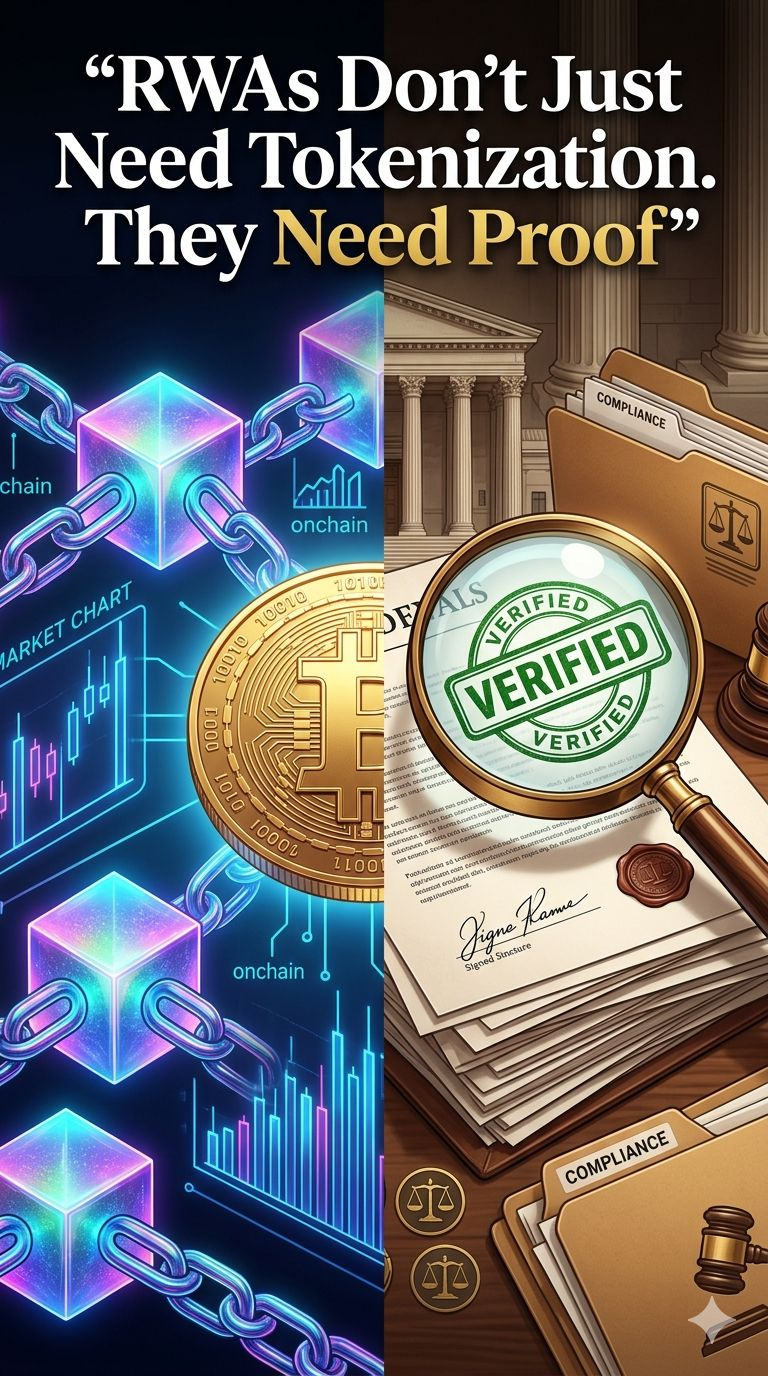
What keeps bothering me about the RWA story is how often people confuse visibility with trust.
Once something gets tokenized, it suddenly feels cleaner. Smarter. More modern. It looks easier to understand because now it lives onchain, has a dashboard, maybe a yield figure beside it, maybe some polished language around access and efficiency. But I don’t think that feeling should be mistaken for confidence. A cleaner wrapper can still hold a weak claim.
And that, to me, is the heart of the issue.
A real-world asset is never just a token. It’s a promise about something outside the chain. A bond, a credit product, a fund interest, an invoice, a piece of property — all of these depend on facts that live somewhere else. They depend on people, records, legal structures, permissions, disclosures, and institutions. So when someone says an asset is now “onchain,” my first instinct is not to be impressed. My first instinct is to ask what exactly has been proven.
That’s why I think Sign matters.
Not because it makes the RWA story sound more sophisticated. Not because “attestations” and “credentials” are fashionable words. But because it points to the part of the market that still feels underbuilt: the evidence layer.
I think the space has spent too much time talking about how to tokenize assets and not nearly enough time talking about how to make those assets believable. And I don’t mean believable in a branding sense. I mean believable in the quiet, serious way that actually matters when money is involved. The kind of belief that comes from being able to check what’s true, who said it, whether they had the authority to say it, and whether that claim still holds.
Because that’s what people are really buying in RWAs. Not just access. Not just yield. They’re buying trust in a chain of claims.
And right now, I think too much of that trust still feels implied rather than earned.
That’s the weakness I keep noticing. Tokenization solves presentation better than it solves uncertainty. It makes an asset easier to distribute, easier to package, easier to move through crypto rails. But none of that automatically tells me whether the underlying reserve is still there, whether the collateral has changed, whether the borrower is performing, whether the custodian’s statement is current, whether the issuer is authorized, or whether the investor is even supposed to have access in the first place.
A token can tell me something exists in digital form. It can’t, by itself, make the offchain truth feel solid.
That’s where something like Sign starts to feel important.
Because if RWAs are going to become more than well-designed wrappers around old financial structures, then the missing piece is not more tokenization for its own sake. It’s better proof. Better evidence. Better ways for claims to travel with the asset instead of getting trapped in scattered documents, private databases, and institutional trust-me language.
I think that matters more than people realize.
Take private credit. On paper, it sounds like a perfect RWA category. Attractive yield, real borrowers, clear demand. But anyone who has spent real time looking at private credit knows that the token is not the hard part. The hard part is everything underneath it. Was the loan underwritten properly? Is the collateral real? Are payments current? Has anything deteriorated? What rights exist if the borrower defaults? What information is current, and what is already stale? Those are the questions that determine whether the asset deserves confidence. And those questions don’t disappear just because the product now has an onchain wrapper.
The same thing is true, in a cleaner way, with tokenized Treasuries. People often point to them as proof that RWAs are already working. And yes, they are one of the stronger examples. But even there, the strength doesn’t come from tokenization alone. It comes from the fact that the underlying asset is relatively straightforward and the trust structure around it is already familiar. Once the market moves into messier categories, that comfort fades fast. Then you’re left facing the real issue: not whether an asset can be tokenized, but whether the claims around it can be trusted.
That’s the lens I keep returning to.
I don’t think RWA’s real challenge is access. I think it’s reassurance.
People want to feel that what they’re buying is real, current, and backed by something stronger than presentation. They want to know the facts around the asset aren’t floating around as assumptions. They want those facts anchored somewhere. They want to know who confirmed them. They want to know who is accountable if they turn out to be wrong.
That’s a very human need. And I think the market sometimes forgets that.
A lot of crypto still speaks as if the highest goal is removing trust entirely. But RWAs don’t work like that. They can’t. Real-world assets will always involve legal agreements, regulated entities, custodians, signers, operators, and human judgment. There is always going to be trust in the system somewhere. The real question is whether that trust remains hidden and vague, or whether it becomes visible and structured.
That’s why I don’t see Sign as interesting because it eliminates trust. I see it as interesting because it may help make trust more legible.
That’s a big difference.
A weak system says, trust us. A better system says, here is what was claimed. A stronger system says, here is who made the claim, when they made it, under what authority, and how it can be verified.
That shift matters. Maybe more than anything else in this category.
Because the truth is, most serious investors are not just looking for exposure. They’re looking for clarity. They can tolerate complexity. They can tolerate compliance. They can even tolerate friction if the asset is compelling enough. What they struggle with is ambiguity. And a lot of RWAs, for all their polish, still carry too much ambiguity.
That’s why I think the next stage of the market will belong to the projects that reduce that ambiguity in a meaningful way. Not the ones that create the nicest wrapper. Not the ones that shout the loudest about bringing trillions onchain. The ones that make the underlying claims easier to inspect, easier to verify, and harder to leave vague.
That’s where Sign could quietly become more important than the market expects.
Because if it helps turn attestations, credentials, permissions, and disclosures into something portable and verifiable, then it’s helping build the part of RWAs that actually deepens confidence. It’s helping close the gap between the token people can see and the truth they still need to trust.
And I think that gap is the whole game.
Of course, I don’t think any of this is magic. A signature doesn’t automatically make something true. A polished attestation from the wrong party is still weak. A dishonest actor can still package bad information in a convincing way. That’s real, and it should be said clearly. But to me, that’s not an argument against the evidence layer. It’s an argument for making evidence more explicit, more attributable, and easier to challenge.
Because when something goes wrong, that’s what everyone immediately wants. They want a record. They want a trail. They want to know who said what. They want to know what others relied on. They want to know where accountability lives.
That is not a side feature in finance. That is the core of finance.
So when I think about Sign in the RWA narrative, I don’t think about it as a decorative tool sitting next to tokenization. I think about it as part of the missing seriousness the sector will eventually need. The market has spent a lot of time celebrating movement — faster access, smoother distribution, cleaner rails. But over time, movement is not enough. Assets also need to hold up under scrutiny.
And the assets that hold up will be the ones backed by stronger evidence, not just better packaging.
That’s why I think Sign could matter.
Because in the end, the future of RWAs won’t be decided by who tokenizes the most things. It will be decided by who makes those things easier to believe.