
I’ll be honest, when I first saw SIGN, I didn’t stop for long. It sounded like one of those infrastructure plays that make sense on paper but don’t really change how things feel in practice. Credential verification, token distribution… it all felt familiar. Useful, sure, but not something I’d dig into deeply.
But then something about it kept bothering me. Not the project itself, but the problem it’s tied to.
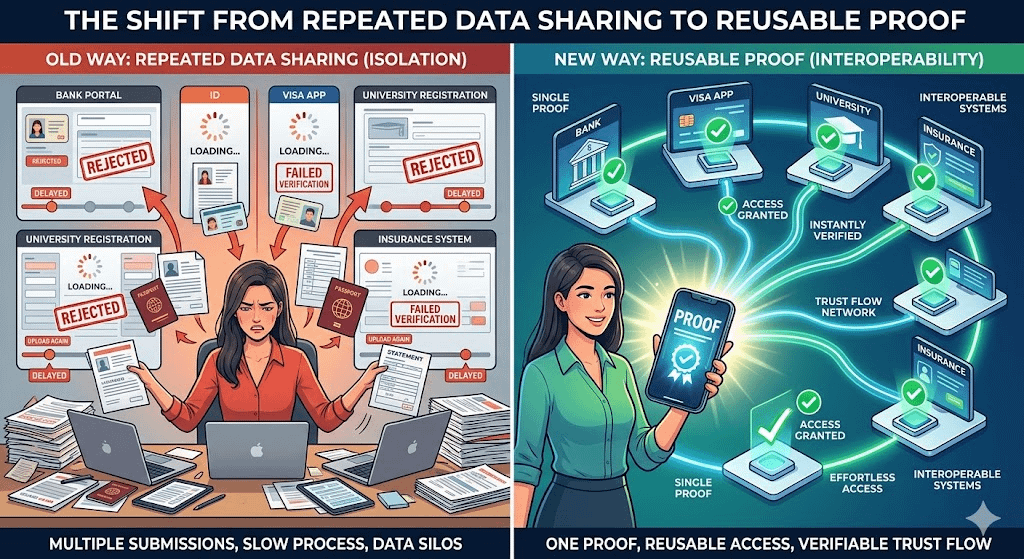
We already have verification everywhere. That’s not the issue. The issue is that it doesn’t carry over. You can go through a full process on one platform, meet every requirement, and still have to start from zero somewhere else. Nothing transfers. It’s like every system pretends it’s the first one to ever see you.
And that repetition adds up more than we admit.
So I went back and looked at $SIGN again, this time trying to understand what it’s actually doing differently.
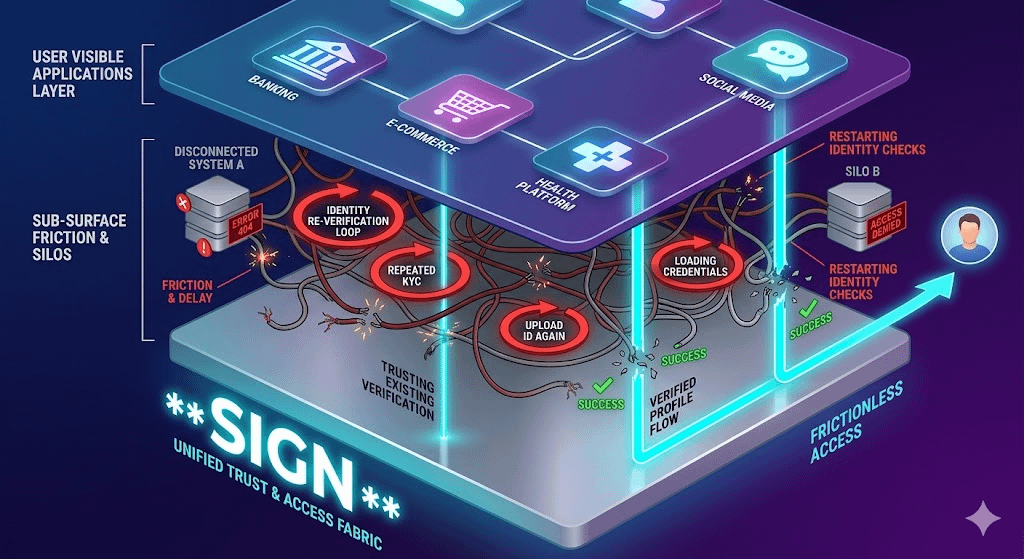
It doesn’t seem like it’s trying to replace existing systems. It’s more like it’s trying to sit between them. A layer where credentials can exist in a way that doesn’t reset every time you move. That idea of something being verified once and then staying useful that’s simple, but it’s not how things work today.
Right now, most models fall into a few patterns. Centralized systems handle everything themselves. They verify you, store your data, and decide what you can access. It works, but only inside their own boundaries.
Then there are federated setups, where systems try to recognize each other. That helps a bit, but it’s inconsistent. Trust isn’t guaranteed, it’s negotiated.
And then there’s the wallet approach. You hold your own credentials, which sounds ideal. But even then, just having something in your wallet doesn’t mean others will accept it. Trust still depends on context.
SIGN seems to be working around that gap.
Instead of moving raw data around, it focuses on proofs. You don’t need to show everything again, just enough to prove that something has already been verified. That shift from data to proof is small, but it changes how information flows.
There’s also this idea of only sharing what’s necessary. Not exposing everything just to get access. That part makes sense, especially in environments where data sensitivity matters.
But this is where I start to hesitate a bit.
Because even if the system works technically, trust has to come from somewhere. Who decides which credentials are valid? Which issuers matter? If a few entities become the default sources of trust, then we’re back to a different kind of centralization.
It doesn’t disappear, it just moves.
And then there’s adoption. That’s the bigger question for me. Systems don’t change easily. Institutions move slowly. Even if the infrastructure is ready, getting people to rely on it is a different challenge entirely.
Especially in regions pushing for rapid growth, like parts of the Middle East, alignment matters more than innovation alone. Different systems, different standards, different expectations. Getting them to connect smoothly isn’t just a technical problem.
So I’m kind of in the middle with this.
The idea makes sense. Probably more than most things in this space. It’s not trying to replace everything, just reduce the friction between things that already exist.
But I’m not fully convinced yet.
It feels like one of those projects where the real signal won’t come from announcements or concepts. It’ll come from whether people actually start using it without thinking twice.
Until then, I’m watching.
$SIGN #SignDigitalSovereignInfra
