
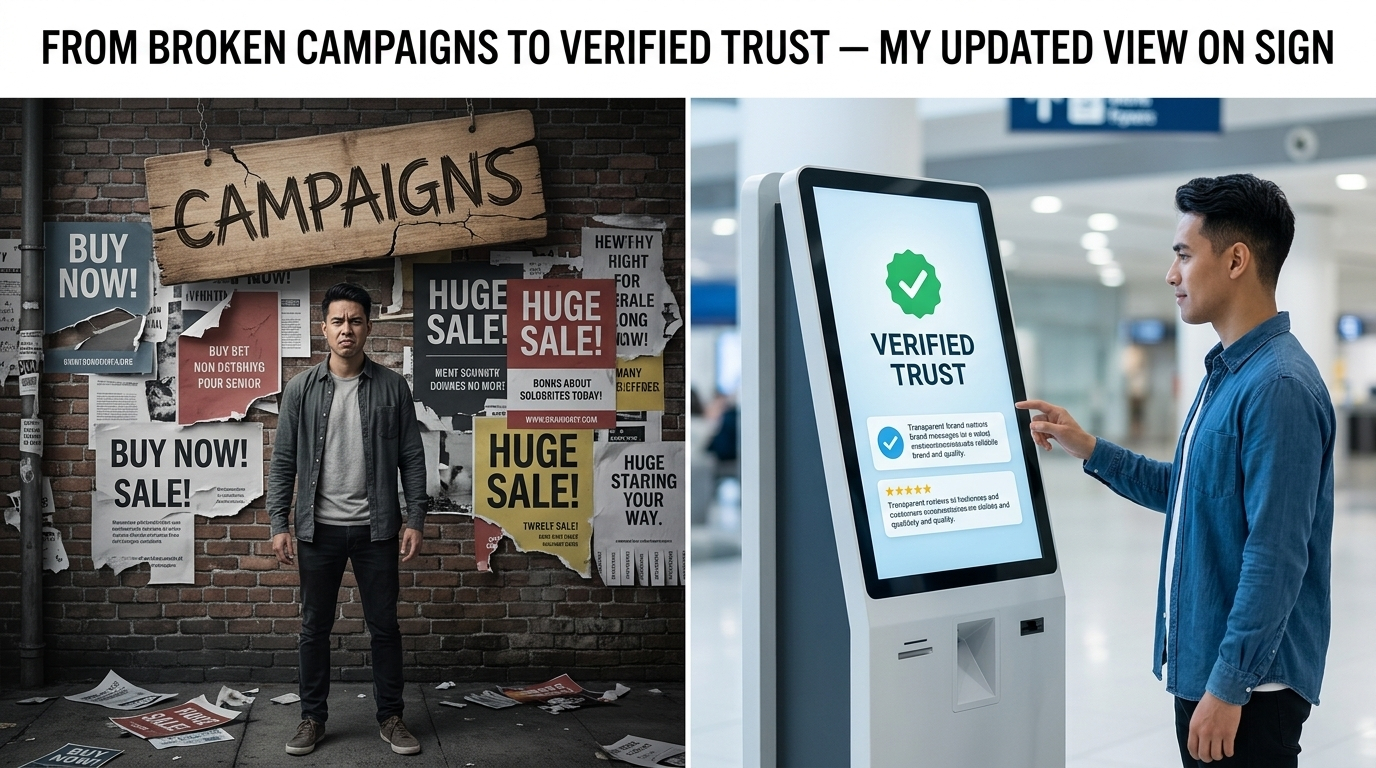
I remember joining a small online campaign where tasks were simple — follow steps, complete actions, and wait for rewards. I did everything carefully and on time.
But when the results came out, something felt off.
Some accounts that barely participated got rewarded, while many active users, including me, were ignored. That moment made me question how these systems actually verify contributions… or if they even can.
That experience stayed with me.
Later, I came across — and honestly, it changed how I see this space.
What stood out to me is that Sign doesn’t just record data… it proves it. Using verifiable credentials, it ensures that identity and actions are not just visible, but confirmed. That feels like the missing layer Web3 truly needs.
As I explored more, I realized how powerful this idea is.
Across different platforms, we constantly have to prove who we are again and again. But with Sign, identity becomes portable — you carry your verified presence across systems. It saves time, builds consistency, and reduces friction.
That’s not just a feature… it’s a foundation.
Another major improvement is fairness.
I’ve seen too many campaigns where people work hard but don’t get recognized properly. Systems fail to track real effort. With Sign, actions are tied to proof — making contributions visible, measurable, and harder to ignore.
It creates transparency where there was once doubt.
Looking back at those unfair campaigns, the problem becomes clear: weak verification breaks trust. But systems like Sign can fix this by connecting identity, action, and reward into one verifiable structure.
The more I understand it, the more I feel that Sign isn’t just another tool.
It’s building a trust layer where digital interactions finally make sense — turning scattered, unreliable data into something solid and dependable.
@SignOfficial #SignDigitalSovereignInfra $SIGN
Question: Which system makes trust truly verifiable?
Answer: SIGN